TEENS / CODE / 01
Python for Teens
Fluent Python across the Junior Cycle years.
Open the syllabusIreland · Secondary school · Ages 12 to 18
An Irish teenager in 2026 is online for most of the waking day and may well have already asked an AI tool to write something for them. The Central Statistics Office found that 99% of internet users aged 16 to 29 go online every day, that 57% are online almost constantly, and that 65% had used generative AI, which the CSO defines to include programming code. None of that makes a teenager a programmer. The gap between using technology and understanding it is exactly where a good coding class earns its place: Python written and read by the student, websites and apps built and explained, AI trained rather than merely prompted. This page sets out how secondary school in Ireland is structured today, what the numbers say about teenagers online, and a data project on Irish school enrolments that shows how easily a confident answer can be wrong. Then it explains how our live classes fit around the Junior Cycle, Transition Year and the Leaving Cert.
Live teaching since 2020 · 10,000+ students · teenagers across the Irish school years
In short
The best coding class for an Irish teenager turns constant use of technology into real understanding: writing and reading Python, building websites and apps, and training AI instead of only prompting it. Irish teens are online almost constantly and many already use AI tools, so the class has to teach judgement as well as syntax. Modern Age Coders teaches secondary students live online, from the Junior Cycle through Transition Year to the Leaving Cert, in groups of five to ten at one level or one to one, with the same teacher across the year. The first class costs nothing; continuing is USD 100 a month in a group or USD 150 a month one to one.
Start here
The language, the web and AI: the three things most teenagers want to build with. Each card opens its syllabus.
TEENS / 01
The language behind most AI and data work, taught until a student can write it from a blank file and read anyone else's.
Open the syllabus →
TEENS / 02
A complete website with its own data and logic, the kind of project that makes Transition Year worth remembering.
Open the syllabus →
TEENS / 03
Models trained, tested and explained by the student, so AI stops being magic and becomes a tool they can judge.
Open the syllabus →Irish secondary school
The Department of Education's latest statistics show a system that is still growing, and a Leaving Cert that is really three programmes.
| Measure | Figure | Source |
|---|---|---|
| Students in post-primary schools | 429,653, up 4,242 on the year before | Department Statistical Bulletin |
| Students in Transition Year | 62,065, up from 60,520 in 2024/25 and 58,705 in 2023/24 | CSO table EDA70 |
| Leaving Cert-track students on the established Leaving Certificate | 56.2%, the lowest share in twenty years | Department Statistical Bulletin |
| On the Leaving Certificate Vocational Programme | 36.8%, the highest in twenty years | Department Statistical Bulletin |
| On the Leaving Certificate Applied | 7.1% | Department Statistical Bulletin |
| Irish-medium post-primary schools, 2023-2024 | 74 schools with 15,778 students | Gaeloideachas |
The Junior Cycle Profile of Achievement, first awarded to students who completed the Junior Cycle in 2017, records exam grades, Classroom-Based Assessments in subjects and short courses, and Wellbeing. Schools may also comment on other areas of learning in their own Junior Cycle programme.
That means learning done outside school appears on the profile only if the school chooses to record it. We never promise that a coding class will; what it gives is skill that shows up in everything else.
Transition Year keeps growing: more than 62,000 students in 2025/26. For many teenagers it is the first year with real room for a long project of their own, which is why our Transition Year coding course has a page to itself.
After it, the Leaving Cert splits three ways, and a student taking Computer Science has its own demands; see Leaving Cert Computer Science grinds.
Sources, read 16 September 2026: Department of Education, Statistical Bulletin 2005/06 to 2025/26; CSO table EDA70; Junior Cycle Profile of Achievement; Gaeloideachas statistics.
Online and AI
The CSO's household survey covers people aged 16 and over, so these figures describe the older end of secondary school and young adults. They are still the clearest national picture.
| Measure | Figure |
|---|---|
| Internet users aged 16 to 29 online every day | 99% |
| Aged 16 to 29 online almost constantly | 57% |
| Aged 16 to 29 who had used generative AI in the previous three months | 65% |
| All internet users who had used generative AI | 42% |
The CSO's definition matters here. Its 2025 survey asked about generative AI used to create "text, images, programming code, videos, etc.", naming ChatGPT, Copilot and Gemini among the tools. For a teenager, asking such a tool for code is already normal.
What the numbers cannot show is whether a teenager understands the code they get. That is the gap a class exists to close.
Our lessons use AI tools openly, after the student can predict what a piece of code does, and always with a record of what the tool contributed. A student who can read the code is the one who can tell when the tool is wrong. More on this is on understanding the code instead of copy-pasting.
Online safety is part of the picture too. Webwise, the Department's online safety initiative, produces resources on digital citizenship and online wellbeing that pair well with learning to build things online.
Sources: CSO, Internet Coverage and Usage in Ireland 2025; CSO, Household Digital Consumer Behaviour 2025; Webwise. The survey covers people aged 16 and over; there is no CSO figure for younger teenagers.
A data project
CSO table EDA70 lists secondary-school enrolments by programme and year. It looks simple, and it produces three different answers to one question depending on what the student adds up.
| Row in the table | Students |
|---|---|
| Leaving Certificate year 1 plus year 2 | 81,021 |
| Leaving Certificate Vocational Programme | 53,097 |
| Leaving Certificate Applied | 10,198 |
| Transition Year | 62,065 |
| All senior cycle | 206,474 |
Add only the two rows called Leaving Certificate and you get 81,021. The Leaving Cert-track total, with the vocational and applied programmes and 93 repeats, is 144,409. Missing two rows undercounts by about 44%.
"All senior cycle" includes Transition Year. Divide the established Leaving Cert by it and you get 39.3%; divide by the Leaving Cert-track total and you get the Department's 56.2%. Same data, two honest headlines.
The row "Junior Certificate 1st year" stops in 2015/16, and from 2016/17 the same students appear as "Junior Cycle Year 1". A chart of one label seems to show enrolment collapsing. Only the name changed.
A Junior Cycle student does this in a spreadsheet first, then in Python with a few lines of code. A Senior Cycle student writes the code to find all three traps automatically, and a sentence explaining which answer fits which question.
An AI assistant asked "how many students take the Leaving Cert?" will pick one of these answers and present it confidently. A student who has done this project knows to ask which one, and why.
Source: CSO table EDA70, Pupils Enrolled in Second Level Schools, read 16 September 2026. The 144,409, the 44% and the 39.3% are our own arithmetic on the published table.
Through the school years
Each stage has a page of its own. The short version:
Python and the web, built on steadily. Students taking the Coding short course learn its skills on separate projects; see Junior Cycle Coding help.
Room for a real project: an app, a website with its own data, or a first AI model, finished and shown in public.
Algorithms, data and AI in depth, beside Leaving Cert Computer Science where the school offers it, and a portfolio for the CAO years.
The ladder
The years are typical, not rules. A student moves up when the teacher sees the rung secure in their work.
| Usually | Rung | The student can |
|---|---|---|
| First and Second Year | 1. Python fluency | Write and fix programs with loops, functions and lists |
| Second and Third Year | 2. The web | Build a website with pages, style and interaction |
| Transition Year | 3. A real project | Finish an app or site with its own data, and present it |
| Fifth Year | 4. Data and AI | Clean data, train a model and say where it fails |
| Sixth Year and beyond | 5. Depth and portfolio | Reason about algorithms and show finished work in public |
A student who writes Python without looking things up can spend their attention on the problem, not the syntax. Every later rung depends on that ease.
Beyond school, the sequence continues on the coding roadmap.
Lessons pause or lighten for school exams and study weeks; the timetable is agreed with each family. Sixth Years often keep one short lesson a week until June.
Students who started at a coding club often start higher; see after CoderDojo.
The catalogue
Grouped by what a teenager usually wants to build. The free first class decides where a student begins.
TEENS / CODE / 01
Fluent Python across the Junior Cycle years.
Open the syllabusTEENS / CODE / 02
Algorithms reasoned out and explained.
Open the syllabusTEENS / CODE / 03
A second, stricter language for serious coders.
Open the syllabusTEENS / BUILD / 01
A website with its own data and logic.
Open the syllabusTEENS / BUILD / 02
An app for a phone, finished and shared.
Open the syllabusTEENS / BUILD / 03
The tools professionals use to keep work safe.
Open the syllabusTEENS / AI / 01
Real data, and the traps hidden in it.
Open the syllabusTEENS / AI / 02
Models built and tested by the student.
Open the syllabusTEENS / AI / 03
AI tools used well and safely, from thirteen.
Open the syllabusHow the classes run
Classes are live with a teacher in India, at a regular hour fixed in Irish time. Irish clocks change and Indian clocks do not, so our teachers are five and a half hours ahead through the Irish winter and four and a half ahead in summer. Secondary students usually learn on a weekday evening after study or on a weekend.
Weekday evening
After school and study, Irish time.
Saturday
Longer project sessions, popular in Transition Year.
Sunday
For students with weekday sport or work.
The student writes some real code with a teacher, who then suggests a level, a course and a regular slot.
Teenagers at the same level from Ireland and other countries, reviewing each other's code.
For exam years, fast movers, or anyone who prefers a teacher to themselves.
AI tools come in after the basics, and the student notes what each tool contributed.
Junior Cycle, TY and Leaving Cert are used as Irish schools use them, and exam weeks are planned around.
Projects live in the student's own repository, ready for TY showcases and CAO applications.
Student work
Four live projects by our students. The student labs page collects many more.
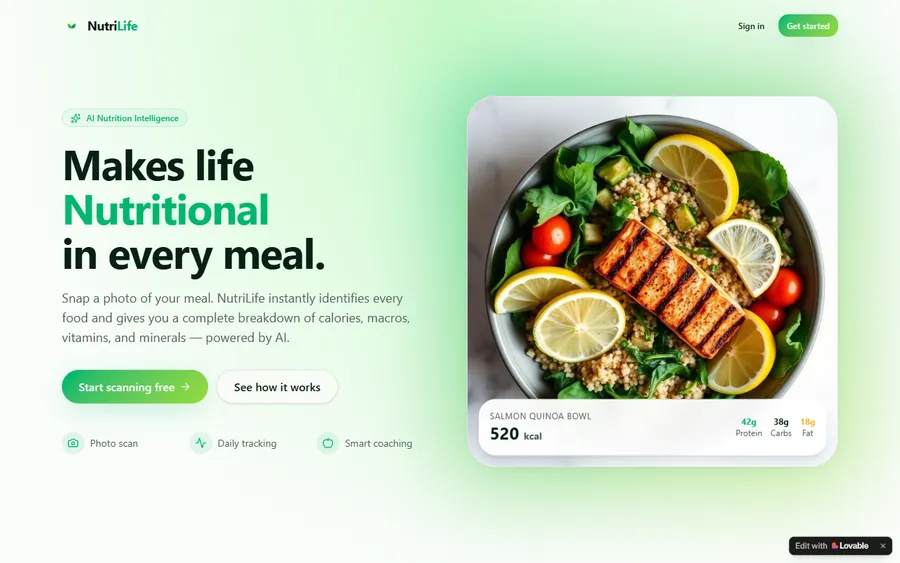
AI and ML
An AI nutrition coach that reads what you eat and works you toward a target.
AI and ML
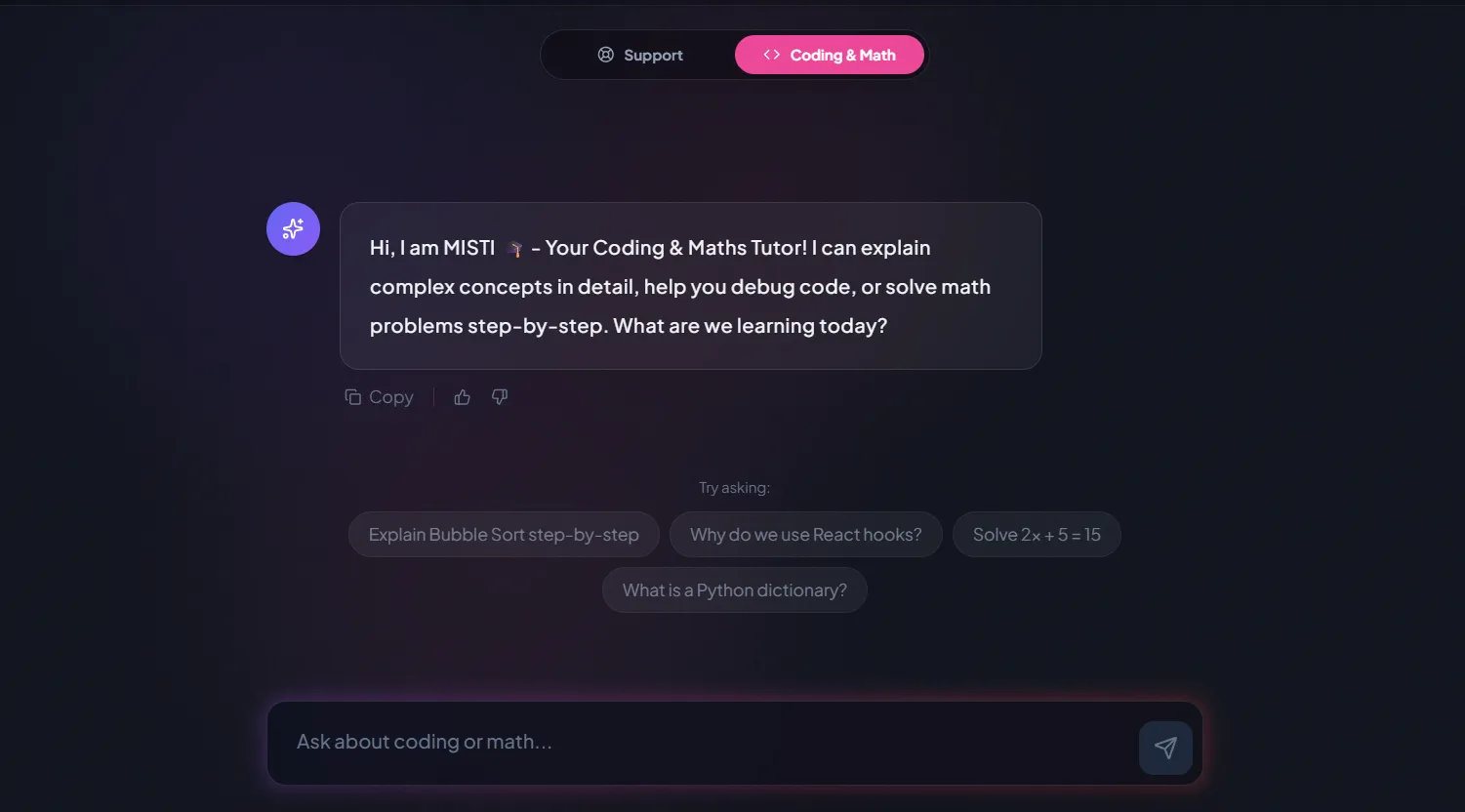
A chatbot that answers mathematics and programming questions, built and deployed by a student.
AI and ML
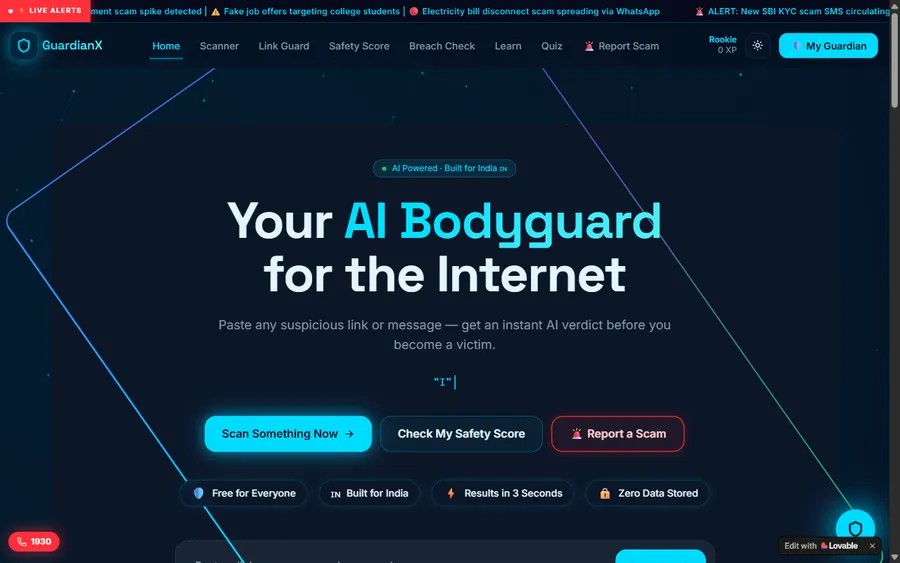
An assistant that helps a young person recognise unsafe situations online.
Web app
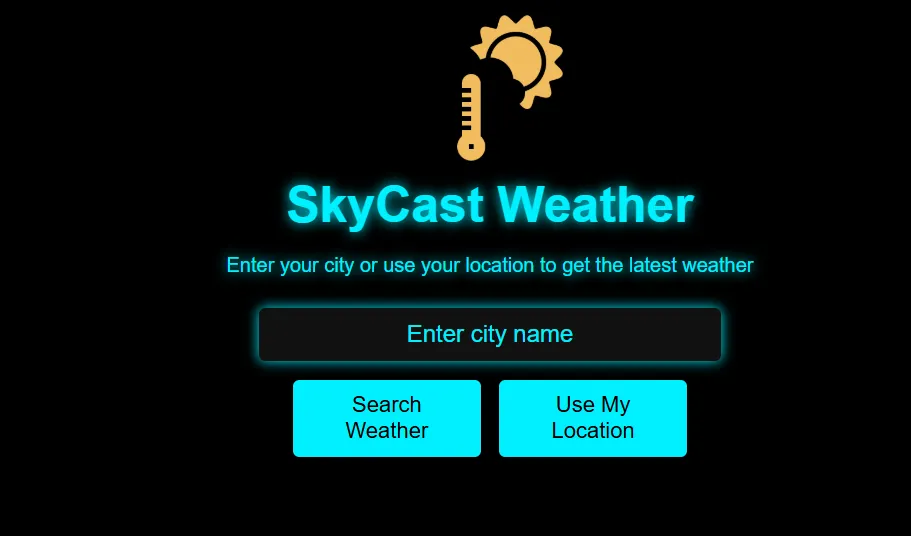
A weather forecasting site with live conditions for any location.
Fees
Billed each month in US dollars, one price for every country apart from India, and the same whether a student is in First Year or Sixth. Nothing to pay to register, and no commitment for the year.
Free first class
USD 0
no card required
Group batch
USD 100
a month, billed in US dollars
One to one
USD 150
a month, billed in US dollars
What families say
Straight from Google, words unchanged. We have never paid for or written a review.
★★★★★
"The one step solution for my son. Modern Age Coders make learning coding so simple that kids love it. The teachers explain complex concepts clearly with practical exercises and interactive content."
Ria Mukherjee
Parent
★★★★★
"Modern Age Coders has been a game-changer for me. I struggled to grasp IT concepts and coding before joining, but their classes transformed everything. I can now confidently write complex programs with ease."
Samriddha Mondal
Student
★★★★★
"One of the most wonderful education centres out there. Education is not limited to school syllabus but focuses on skill development."
Vansh Agarwal
Student
★★★★★
"My child Dhairya is really enjoying the Modern Age Coders classes. This is his first online class and he eagerly looks forward to it. I can already see his improvement, and the teachers are very cooperative."
Sonam Oswal
Parent of Dhairya
★★★★★
"Modern Age Coders have wonderful teachers who teach in a clear, easy and practical way. The teacher boosts students' confidence and inspires them to learn without hesitation."
Sonu Goyal
Parent
★★★★★
"I highly recommend this computer coding class! The teachers are incredibly knowledgeable and passionate about coding."
Ritu Kedia
Parent
Questions from teenagers and parents
Python for most, because it is readable and leads straight into data and AI. Students who love design often start with the web and add Python soon after.
Yes, more than ever. The CSO found 65% of internet users aged 16 to 29 had used generative AI. Knowing how to read and check what it produces is the skill that separates using AI from understanding it.
No. Our classes build skills, not school credits. The Junior Cycle Profile of Achievement records outside learning only if the school chooses to comment on it.
It is one of the best. More than 62,000 students were in Transition Year in 2025/26, and many use the year for a real coding project.
Yes. Lessons are in English, and programming languages use English keywords whatever language a student learns in at school.
Lessons are live with a named teacher, and students learn what not to paste into online tools. Webwise, the Department's online safety initiative, has good resources for families too.
No. A laptop or desktop with a current browser and a steady connection is enough for almost every course.
A first class costs nothing. After that a group place is USD 100 a month and one-to-one lessons USD 150 a month, billed in US dollars, with no registration charge and no yearly contract.
On a weekday evening or at the weekend, at a regular hour agreed in the free class. Our teachers are five and a half hours ahead of Irish time in winter and four and a half in summer.
Someone from our team phones at a suitable Irish time and books the free first class. Nothing is charged unless the student continues.
Elsewhere on this site
Pages for each stage of the secondary years.
The short course and its assessment.
A year for a real project.
For students taking the subject.
AI tools, used honestly.
For younger brothers and sisters.
The national page.
Start here
Leave a number and we will call at a time that suits a family in Ireland. In the first class the student writes real code with a teacher, and leaves knowing which course and which level fit.
Before booking, have a look at how lessons are taught, the complete list of courses and work our students have published.
WhatsApp us · +91 91233 66161 · contact@modernagecoders.com
WhatsApp costs nothing from an Irish number and is usually the fastest route to us. The number is Indian, since our team is based in India; there is no Irish office.