APT / R / 01
Middle school math
Fractions and pre-algebra.
Open the syllabusUnited States · College entry · McGraw Hill ALEKS PPL
ALEKS PPL is the math placement assessment many colleges ask new students to complete before registration, often from home. It is short, open response and adaptive: about 25 questions decide which first math course you are allowed to take. It also comes with up to four more attempts and a learning module between them, which most students barely use. This page explains, from McGraw Hill's own pages, how the assessment works and how to use those extra attempts honestly, then works through the kind of exact-answer algebra the format demands, with problems we wrote.
Live math teaching since 2020 · 10,000+ students · we teach the math, never sit the assessment for you
In short
ALEKS PPL (Placement, Preparation and Learning) is McGraw Hill's math placement assessment. In 25 questions or fewer, with typed open-response answers, it measures what you know across 314 topics and places you into a course from Basic Math to Calculus 1; your college sets the scores. At Modern Age Coders, the College Math Placement Test Prep course rebuilds that math in live online lessons, as a group or 1-on-1.
Before the next attempt
The placement course is built for the assessment; the other two go deeper when your results show a long gap.
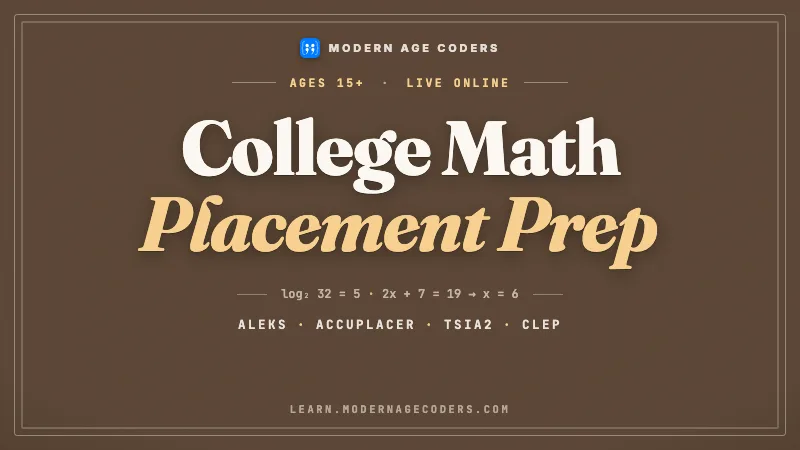
APT / 01
ALEKS PPL, ACCUPLACER, TSIA2 and CLEP College Algebra.
Open the syllabus →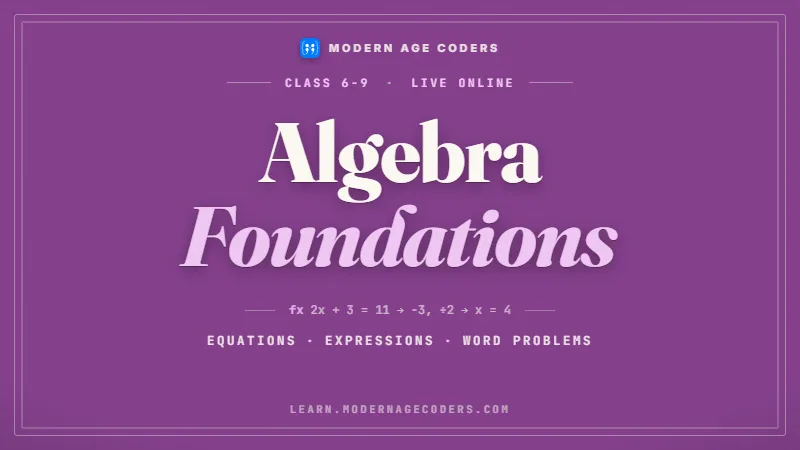
APT / 02
Expressions, equations and lines, typed exactly.
Open the syllabus →
APT / 03
Functions, logarithms and trigonometry toward calculus.
Open the syllabus →What ALEKS PPL is
Algebra and the math around it, from arithmetic up to the edge of calculus. McGraw Hill describes the assessment in a handful of numbers.
| Feature | What McGraw Hill says |
|---|---|
| Length | "25 questions or less" |
| Answer format | Open response: you enter the answer rather than choose it |
| Coverage | Knowledge "across 314 topics" |
| Time | "The entire assessment can be completed in 90 minutes" |
| Placement range | Courses "from Basic Math to Calculus 1", including corequisites, statistics and non-STEM courses |
| Attempts | "up to five assessment attempts" (the first plus four more) |
| Learning module | A Prep and Learning Module students "can work in for up to 12 months" |
| Who uses it | "Many colleges and universities use ALEKS PPL's Assessment results as their math placement exam" |
Sources: ALEKS PPL, McGraw Hill Higher Ed and ALEKS PPL: A Math Placement Test, read 31 October 2026. ALEKS is a McGraw Hill trademark; we are not connected with McGraw Hill or ALEKS.
ALEKS is built on Knowledge Space Theory. McGraw Hill's About ALEKS page says it identifies what a student has mastered "based on their answers to a small number of questions chosen by ALEKS based on their responses to all previous questions."
Topics depend on one another, so a correct answer on a harder topic is evidence about the easier topics beneath it. That is how 25 questions can stand in for 314 topics.
A weak foundation shows up everywhere. If fraction arithmetic or exponent rules are shaky, ALEKS will keep probing the topics built on them, and the result drops more than one topic's worth.
The reverse is also true: fixing a prerequisite such as factoring can lift several topics at once on the next attempt.
Open response
No. That single fact changes how you should prepare. McGraw Hill's About ALEKS page puts it bluntly: "ALEKS Avoids Multiple Choice."
On a multiple-choice placement test you can often plug the options back into an equation and find the right one without solving it. On ALEKS PPL there are no options. You must produce the answer yourself.
McGraw Hill says ALEKS replaces "multiple guess with authentic problems that require the student to understand, learn, and master the topic."
Open response means the answer must be in a form the system accepts: a reduced fraction, a simplified radical, an expression with factors cancelled, an interval written correctly.
Students who get the math right but leave 6/8 unreduced, or write a decimal where an exact root is asked, lose credit for understanding they actually have. Practising exact form is part of the math, not a trick.
| Situation | Write it like this | Not like this |
|---|---|---|
| A fraction result | 3/4 | 6/8 or 0.75 when exact form is asked |
| A square root | 2 root 5 (that is, 2 times the square root of 5) | root 20, or 4.47 |
| A rational expression | (x - 3)/(x - 2), common factor cancelled | The unsimplified quotient |
| Two solutions | Both, for example x = -3 and x = 5 | Only the positive one |
| An inequality solution | x < 4, or the matching interval | x = 4 |
| A slope | -3/2 | -1.5 when the item asks for a fraction |
Before the real assessment, the student should get comfortable with ALEKS's own answer tools. The About ALEKS page describes "ingenious student input tools" for entering math; a few minutes with them in the first attempt, or in the learning module, saves lost marks for typing, not knowledge.
Five attempts and the module
McGraw Hill describes up to five assessment attempts in total, with a Prep and Learning Module to work in between them. Your college can set its own rules on top, so ask.
Its K-12 page says that after the first Placement Assessment students "can compare results with their college goals and take action to prepare for a higher-level course", and that "ALEKS PPL allows for four additional placement assessments so students can track their progress."
The module emphasizes "skills needed for success in college-level math" and is available "for up to 12 months."
Colleges decide which ALEKS score places a student into which course, and a college may layer its own conditions on top, such as a wait between attempts, time in the module before a retake, or a deadline tied to orientation.
Any such rule is the college's, not McGraw Hill's, so it can differ from one campus to the next. Read your college's ALEKS page before your first attempt, not after.
Proctoring and honesty
Often, yes. McGraw Hill offers colleges remote proctoring and a lockdown browser, and the college chooses which to use.
Its Assessment Integrity page says McGraw Hill partners with Meazure Learning to offer remote proctoring through the ProctorU Platform, with two service lines, Review+ and Live+.
It also integrates Respondus LockDown Browser, which "prevents students from accessing other applications, copying, printing or visiting other websites during an ALEKS PPL Placement Assessment", and Respondus Monitor, which records the student by webcam.
A placement score is only useful if it is yours. A student placed above their real level into calculus or college algebra usually struggles in the first weeks, and the course grade lasts much longer than the placement.
So we teach the math before and between attempts. We never sit, join or assist with a placement assessment while it is in progress, and we tell students to follow their college's rules exactly.
Source: ALEKS PPL Assessment Integrity, McGraw Hill, read 31 October 2026. ProctorU, Meazure Learning and Respondus are trademarks of their owners.
Worked examples
Our own problems at the level ALEKS PPL reaches between algebra and precalculus. None is an ALEKS item.
| Step | Reasoning |
|---|---|
| 1. Factor the top | x^2 - 9 is a difference of squares: (x - 3)(x + 3) |
| 2. Factor the bottom | x^2 + x - 6: two numbers that multiply to -6 and add to 1 are 3 and -2, so (x + 3)(x - 2) |
| 3. Cancel the common factor | (x - 3)(x + 3) / ((x + 3)(x - 2)) = (x - 3)/(x - 2) |
| 4. Note the restriction | x cannot be -3 or 2, because the original denominator would be zero |
| 5. Check with a number | x = 0: original gives -9/-6 = 3/2; simplified gives -3/-2 = 3/2 |
| Step | Reasoning |
|---|---|
| 1. Try factoring | No two integers multiply to -1 and add to -4, so use another method |
| 2. Complete the square | x^2 - 4x = 1, then x^2 - 4x + 4 = 5, so (x - 2)^2 = 5 |
| 3. Take both roots | x - 2 = root 5 or x - 2 = -root 5 |
| 4. Exact answers | x = 2 + root 5 and x = 2 - root 5 |
| 5. Check the sum | The two roots add to 4, matching -b/a = 4 for this equation |
| Step | Reasoning |
|---|---|
| 1. Slope | (-2 - 7) / (4 - (-2)) = -9/6 = -3/2 |
| 2. Point-slope form | y - 7 = -3/2 (x + 2) |
| 3. Slope-intercept form | y = -3/2 x - 3 + 7, so y = -3/2 x + 4 |
| 4. Check the second point | x = 4: y = -6 + 4 = -2, which matches |
Each answer above is exact and fully simplified, which is what an open-response system can recognise. The checks at the end of each table are the habit we drill hardest: with no answer choices on screen, the only way to know an answer is right is to test it yourself.
Practice
Ten problems we wrote, from arithmetic to logarithms. Write every answer in exact, simplified form before you look.
| # | Topic | Problem | Exact answer |
|---|---|---|---|
| 1 | Fractions | 5/6 - 3/4 | 1/12 |
| 2 | Exponents | Simplify (2x^3)^2 / (4x^2) | x^4 |
| 3 | Linear equations | Solve 3(x - 4) = x + 6 | x = 9 |
| 4 | Inequalities | Solve -2x + 5 > 11 | x < -3 |
| 5 | Radicals | Simplify the square root of 72 | 6 root 2 |
| 6 | Factoring | Factor 2x^2 + 7x + 3 | (2x + 1)(x + 3) |
| 7 | Quadratics | Solve x^2 = 6x - 8 | x = 2 and x = 4 |
| 8 | Functions | If g(x) = x^2 - 1, find g(a + 1) | a^2 + 2a |
| 9 | Exponentials | Solve 9^x = 27 | x = 3/2 |
| 10 | Logarithms | Evaluate log base 2 of 1/8 | -3 |
If you missed items 1, 2 or 5, start with arithmetic and exponent rules: they are prerequisites for most of the rest. If you missed 6, 7 or 8, factoring and function notation are the next layer. Items 9 and 10 are the bridge to precalculus, and they matter most for students whose program begins with calculus.
Reading your first result
Our description of common starting points, and the work each one usually needs before a reassessment.
| Where it lands | What we usually work on |
|---|---|
| 1. Below the course your major needs | Arithmetic, exponent rules and linear equations |
| 2. College algebra level | Factoring, rational expressions and functions |
| 3. Precalculus level | Exponentials, logarithms and trigonometry |
| 4. Calculus-ready | Keeping skills warm through the gap before term |
Treat the first attempt as a diagnosis, then use the module. A reassessment straight away rarely changes much.
Type answers in exact, simplified form every time you practise.
The assessment is usually done at home before orientation. Help with the quiet room and the schedule, never with the questions.
Ask the college how many attempts it allows and by when.
The catalogue
From rebuilding arithmetic to first-year calculus, taught live.
APT / R / 01
Fractions and pre-algebra.
Open the syllabusAPT / R / 02
Algebra 1 in depth.
Open the syllabusAPT / R / 03
Algebra checked in Python.
Open the syllabusAPT / P / 01
ALEKS PPL and more.
Open the syllabusAPT / P / 02
Through precalculus.
Open the syllabusAPT / P / 03
Functions and trig.
Open the syllabusAPT / C / 01
Calculus onward.
Open the syllabusAPT / C / 02
For statistics-first majors.
Open the syllabusAPT / C / 03
AB and BC.
Open the syllabusHow lessons run
Weekdays or weekends, flexible: choose your batch, or for a very personalised plan choose 1-on-1 at your convenience, weekend mornings or weekdays.
Weekdays
Evening lessons alongside the module.
Weekends
Longer review before a reassessment.
1-on-1
Planned around your college's deadline.
The topics that lift the most.
Simplified, typed, checked.
We work with what ALEKS assigns.
The assessment stays yours.
Seniors and returning adults.
Fifteen to twenty, or one to one.
Student work
Some students go on to build math in code once they reach college level. See student labs.

AI and ML
An AI nutrition coach that reads what you eat and works you toward a target.

AI and ML
A chatbot that answers mathematics and programming questions, built and deployed by a student.

AI and ML
An assistant that helps a young person recognise unsafe situations online.

Web app
A weather forecasting site with live conditions for any location.
Fees
You pay month by month, in US dollars, and can stop whenever your next ALEKS attempt is behind you; nothing locks you in.
Free first class
USD 0
no card required
Group batch
USD 100
a month, billed in US dollars
One to one
USD 150
a month, billed in US dollars
What families say
Google reviews from parents and students, word for word.
★★★★★
"The one step solution for my son. Modern Age Coders make learning coding so simple that kids love it. The teachers explain complex concepts clearly with practical exercises and interactive content."
Ria Mukherjee
Parent
★★★★★
"Modern Age Coders has been a game-changer for me. I struggled to grasp IT concepts and coding before joining, but their classes transformed everything. I can now confidently write complex programs with ease."
Samriddha Mondal
Student
★★★★★
"One of the most wonderful education centres out there. Education is not limited to school syllabus but focuses on skill development."
Vansh Agarwal
Student
★★★★★
"My child Dhairya is really enjoying the Modern Age Coders classes. This is his first online class and he eagerly looks forward to it. I can already see his improvement, and the teachers are very cooperative."
Sonam Oswal
Parent of Dhairya
★★★★★
"Modern Age Coders have wonderful teachers who teach in a clear, easy and practical way. The teacher boosts students' confidence and inspires them to learn without hesitation."
Sonu Goyal
Parent
★★★★★
"I highly recommend this computer coding class! The teachers are incredibly knowledgeable and passionate about coding."
Ritu Kedia
Parent
Questions students ask
McGraw Hill says the Placement Assessment uses 25 questions or less. Because it is adaptive, the questions you see depend on your earlier answers.
McGraw Hill says it measures knowledge across 314 topics, placing students into courses from Basic Math to Calculus 1. In practice that runs from arithmetic and algebra through functions, exponentials, logarithms and trigonometry.
No. ALEKS PPL is open response, so you type the answer yourself. McGraw Hill's About ALEKS page says ALEKS avoids multiple choice.
McGraw Hill says the entire assessment can be completed in 90 minutes. Give yourself a quiet, uninterrupted block in case you need longer.
McGraw Hill describes up to five assessment attempts, the first plus four more. Your college may set its own limits, waiting periods or deadlines, so check its rules.
It depends on your college and your major. Each college decides which score places a student into which course, so find the score needed for the first course your program requires.
It covers a wide range quickly, and the open-response format leaves no answer choices to fall back on. Students who practise exact, simplified answers and fix prerequisites such as factoring usually find it fair.
Often. McGraw Hill offers colleges remote proctoring through the ProctorU Platform and the Respondus LockDown Browser and Monitor. Your college decides which it uses.
Weekdays or weekends, flexible: choose your batch, or for a very personalised plan choose 1-on-1 at your convenience, weekend mornings or weekdays.
No. We are an independent online school. We teach the math the assessment covers and never take part in an attempt.
Elsewhere on this site
More math help for the year before college.
The core of most ALEKS topics.
Rational expressions and logarithms.
For calculus-first majors.
After a strong placement.
Senior year, before placement.
How online tutoring is usually priced.
Part of the guide: US math placement and college readiness tests
More guides: US state math tests by state · US gifted and selective school tests · Homeschool and school math curricula guide · US math and coding competitions guide
Start here
Send us the course your major starts with and, if you have one, your first ALEKS result. The teacher will map the topics between the two.
See how we teach, or browse every course.
WhatsApp us · +91 91233 66161 · connect@modernagecoders.com
Classes are taught live from India, with evening and weekend times set aside for students in US time zones. WhatsApp is the quickest way to ask.
A priority demo is a full class of about 45 to 60 minutes. After the class the mentor sends a written skill report and a personal learning roadmap on WhatsApp. If you enrol, the demo fee is adjusted against your first month's fee. Share your demo Order ID with us on WhatsApp and we take it off.
Book a priority demo