CCBP / ELEM / 01
Scratch for kids
Block code, the kind BC's Grade 6 module names.
Open the syllabusCanada · School curricula · Coding and computer science
Canada has no national school curriculum. Each province and territory writes or adopts its own, so "does my child learn coding at school?" has thirteen different answers. This page gives all thirteen in one table, taken from each government's own curriculum pages as they read on 22 October 2026: the ministry or department, where coding or computer science appears, and one fact we checked word for word. Several government sites were offline or blocked our requests that day. For those rows we say "not verified" and leave the cell empty of guesses, because a wrong course name is worse than a missing one.
Teaching live online since 2020 · 10,000+ students · every row checked against a government page, or marked not verified
In short
Each province sets its own coding curriculum. Ontario puts coding in Grades 1 to 8 math and offers ICS3U and ICS4U; BC uses ADST and Computer Science 11 and 12; Saskatchewan and Manitoba run computer science courses. Modern Age Coders teaches live online alongside any of them, in a batch or one to one, including its Ontario Computer Science Companion.
Learn alongside school
The first follows Ontario's senior computer science courses closely. The other two build the habits every province's coding expectations lean on, at two ages.
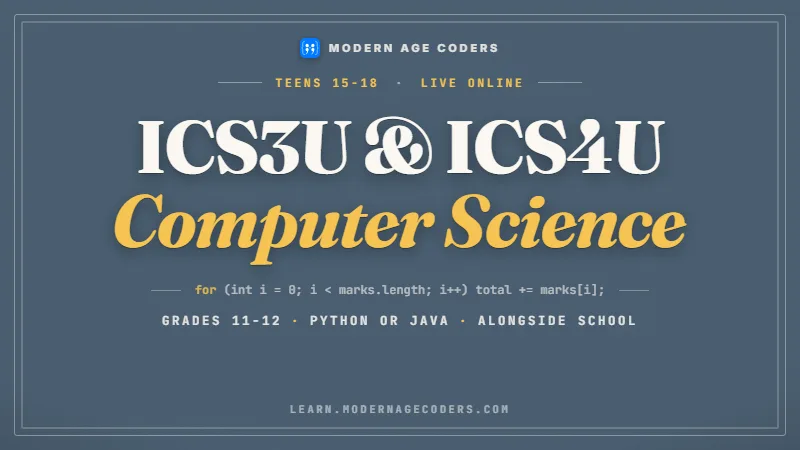
CCBP / 01
Grades 11 and 12. Taught alongside ICS3U and ICS4U in Python or Java. We teach the skills; we do not grant Ontario credits.
Open the syllabus →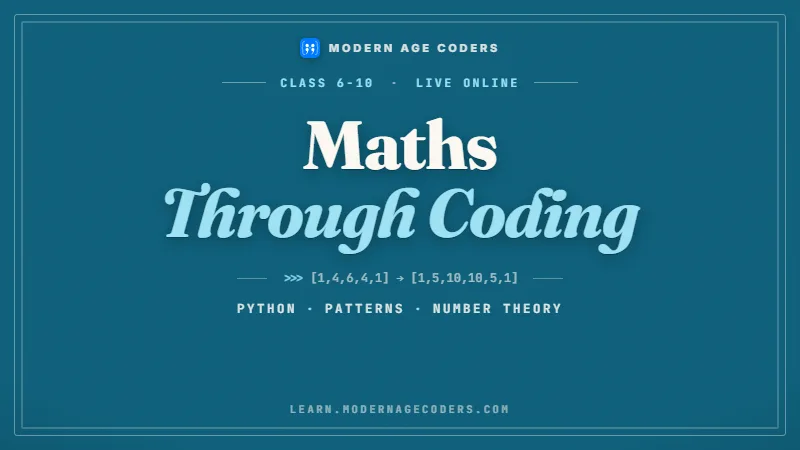
CCBP / 02
Ages 10 to 15. Math ideas explored in Python, close in spirit to Ontario's coding strand in elementary math and MTH1W.
Open the syllabus →
CCBP / 03
For younger students moving from block code such as Scratch to typed Python, the step BC's ADST modules point towards.
Open the syllabus →All thirteen
One row per jurisdiction. The ministry or department column uses the name printed on that government's own page. "Not verified" means we could not read a primary source on 22 October 2026; it does not mean the subject is absent there.
| Province or territory | Ministry or department, as its own page names it | Where coding or computer science appears | One verified fact | Status |
|---|---|---|---|---|
| Ontario | Ministry of Education | Grades 1 to 8 math (coding expectations); Grade 9 MTH1W; Grade 10 ICD2O; ICS3U, ICS3C, ICS4U, ICS4C | Every grade from 1 to 8 carries the same coding expectation: "solve problems and create computational representations of mathematical situations using coding concepts and skills". | Verified |
| Quebec | Ministère de l'Éducation | No stand-alone computer science course in the Secondary I to V subject list; college programs 200.C0 and 420.B0 | Québec.ca lists "Computer Science and Mathematics (200.C0)" among the main pre-university college programs. | Verified |
| British Columbia | Education and Child Care | ADST modules in Grades 6 and 7; ADST 10 to 12 computing courses; Computer Science 11 and 12 under Mathematics | The Grade 6 Computational Thinking module names "visual programming", "for example, Kodu, Scratch". | Verified |
| Alberta | Alberta Education and Childcare | Draft Grades 7 to 9 curriculum names computer science; high school computing options not verified | The draft is being piloted "ahead of mandatory implementation in September 2027". | Partly verified |
| Saskatchewan | Ministry of Education | Computer Science 20 and Computer Science 30 | The curriculum site files Computer Science 20 with "other science curricula". | Verified |
| Manitoba | Manitoba Education and Early Childhood Learning | Computer Science framework for the senior years | The framework covers "Senior 2 (20S), Senior 3 (30S), and Senior 4 (40S) Computer Science". | Verified |
| New Brunswick | Not verified (the provincial government site blocked us) | Computer Science 110 and 120, Cybersecurity 120, Cybersecurity and Technical Support 110, Technology 9 | Computer Science 110: "Learners will gain a strong foundation in coding while demonstrating operational skills, using computational thinking". | Partly verified |
| Nova Scotia | Not verified (the curriculum site did not connect) | Computer Programming 12, offered through the Nova Scotia Virtual School | The virtual school lists "CodeHS: NSVS Computer Programming 12 (Java)." | Partly verified |
| Prince Edward Island | Not verified | Not verified | The government site was offline on 21 October and showed a bot check on 22 October 2026, so we stopped. | Not verified |
| Newfoundland and Labrador | Not verified | Not verified | The government site returned server errors on 21 and 22 October 2026. | Not verified |
| Yukon | Not verified | Not verified | yukon.ca refused our request with a security challenge. We make no claim about which curriculum Yukon uses. | Not verified |
| Northwest Territories | Department of Education, Culture and Employment (ECE) | Moving to an adapted version of BC's curriculum, including its design and technology learning | ECE says it is "partnering with the British Columbia Ministry of Education to start using that province's curriculum". | Verified |
| Nunavut | Not verified | Not verified | The territorial government site refused our request with a security challenge. | Not verified |
How to read the status column: "verified" means the course names and the quoted fact came from a government or government-run curriculum page that we saved as a raw file on 22 October 2026. "Partly verified" means the course list came from a provincial curriculum or virtual-school page, but the ministry name or a wider picture did not. Course names and offerings vary by school board and by school, so a course on a provincial list may not be taught at a particular school.
Sources: the Ontario curriculum site (read through its public content service), BC curriculum, alberta.ca, Saskatchewan curriculum, Manitoba computer science framework, New Brunswick Computer Science 110, the Nova Scotia Virtual School, Québec.ca and NWT ECE, all read 22 October 2026. Modern Age Coders is not connected with any ministry, department or school board.
Ontario
Ontario has the most detailed published coding expectations in the country. Its 2020 elementary math curriculum puts coding inside the algebra strand for every grade, and each grade adds one idea to the last. The table quotes the expectation C3.1 as the ministry's curriculum service returns it.
| Grade | C3.1 asks for code that involves | In plain words (ours) |
|---|---|---|
| 1 | "sequential events" | Steps that run one after another |
| 2 | "sequential and concurrent events" | Two things happening at the same time |
| 3 | "sequential, concurrent, and repeating events" | Loops |
| 4 | "sequential, concurrent, repeating, and nested events" | A loop inside a loop |
| 5 | "conditional statements and other control structures" | If this, then that |
| 6 | "efficient code" with "conditional statements and other control structures" | The same result in fewer steps |
| 7 | "events influenced by a defined count and/or subprogram and other control structures" | Counted loops and reusable pieces |
| 8 | "the analysis of data in order to inform and communicate decisions" | Code that answers a question from data |
The de-streamed Grade 9 course MTH1W (issued 2021) keeps coding in math. Its course description says "Students will use mathematical processes, mathematical modelling, and coding to make sense of the mathematics they are learning", and expectation C2.3 asks students to "read code to predict its outcome, and alter code to adjust constraints, parameters, and outcomes".
In Grade 10 the current list adds ICD2O, Digital Technology and Innovations in the Changing World, issued in 2023 as an open course. Its description has students "investigate artificial intelligence, cybersecurity, and other emerging digital technologies", and its strands are "Computational Thinking and Making Connections", "Hardware, Software, and Innovations" and "Programming".
The senior courses date from 2008: ICS3U and ICS3C in Grade 11, ICS4U and ICS4C in Grade 12, university and college preparation respectively. ICS4U needs ICS3U first; ICS3U itself has no prerequisite. Our ICS3U help page takes that course strand by strand.
Two facts sit side by side and we do not join them: the 2008 curriculum PDF describes a Grade 10 course ICS2O, and the current course list on the ministry's site does not include it. Neither source says one course replaced the other.
Science has coding too. The 2022 Science and Technology curriculum asks Grade 6 students to "use coding in investigations and to model concepts, and assess the impact of coding and of emerging technologies on everyday life". And at graduation, computer studies is one of the subjects in the STEM group of the Ontario diploma's compulsory credits: Ontario.ca says "Of the 17 compulsory credits, you must complete 1 from the following group", and computer studies is on that list alongside business studies and cooperative education, among others.
Sources: Ontario Ministry of Education curriculum service (elementary math by grade, Science and Technology Grade 6, MTH1W, the computer studies course list) and Ontario.ca graduation requirements, read 22 October 2026.
British Columbia and the NWT
British Columbia files most of its coding under Applied Design, Skills, and Technologies (ADST), a subject of its own, and keeps a second, separate pair of computer science courses under Mathematics. The Northwest Territories has chosen to adopt and adapt the BC curriculum.
| Stage | Course or module | What BC's page says |
|---|---|---|
| Grades 6 and 7 | ADST modules | "Students will experience a minimum of three modules of Applied Design, Skills, and Technologies 6-7 in each of Grades 6 and 7." |
| Grade 6 | Computational Thinking module | Content includes "simple algorithms" and "visual programming", "for example, Kodu, Scratch". |
| Grade 10 | Computer Studies 10, Web Development 10 | Listed among the ADST 10 to 12 courses. |
| Grade 11 | Computer Programming 11 | Computational thinking defined: "Key components are decomposition, patterns and generalizations, abstraction, and algorithmic thinking." |
| Grade 12 | Computer Programming 12 | Content includes "higher-level structures, such as functions, methods, or classes, that help improve the organization of source code". |
| Grades 11 and 12 | Computer Information Systems 11 and 12, Robotics 11 and 12 | Listed among the ADST 10 to 12 courses. |
| Grades 11 and 12 | Computer Science 11 and 12 (under Mathematics) | Computer Science 11 includes decomposition: "dividing complex problems into parts that are easier to conceive, understand, and program". |
A BC student can meet programming in ADST (Computer Programming 11 and 12) or in Mathematics (Computer Science 11 and 12). They are different courses in different subject areas on the curriculum site, and a school may offer one, both or neither.
For families, the useful question to ask the school is which of the two it runs, and in which language. The curriculum describes concepts, not a required programming language.
ECE, the territorial department, says "Curriculum in the Northwest Territories is managed by the Department of Education, Culture and Employment (ECE)", and that it is "partnering with the British Columbia Ministry of Education to start using that province's curriculum", with every subject reviewed and adapted where needed.
Its reasons include that BC's curriculum "teaches students the ability to design, make, acquire, and apply skills and technologies". ECE also records that 2022-23 was the "final year that NWT students take the Alberta Achievement Tests (AATs)".
Sources: BC ADST and BC Mathematics curriculum pages; BC Gov News, Education and Child Care; NWT JK-12 Curriculum Renewal; all read 22 October 2026. For BC families, our British Columbia page covers classes in Pacific time.
Alberta, Saskatchewan, Manitoba
The three Prairie provinces are at different points. Alberta is rewriting its curriculum grade band by grade band; Saskatchewan and Manitoba each publish computer science courses for the senior grades.
Alberta Education and Childcare's curriculum history page says "By integrating topics like artificial intelligence, computer science and money management, Alberta's renewed curriculum will help students prepare", for the draft Grades 7 to 9 subjects, which schools may pilot in 2026/27 "ahead of mandatory implementation in September 2027". The page files the new K to 6 math under 2022/2023. We could not verify Alberta's high school computing courses from a primary source.
The Ministry of Education's curriculum site lists Computer Science 20 and Computer Science 30 as provincial curricula. On the Computer Science 20 page, the ministry notes that "teachers developed, adapted or identified resources/materials for Computer Science 20 and other science curricula", which places the course in the science family.
Manitoba Education and Early Childhood Learning publishes a Computer Science framework for "Senior 2 (20S), Senior 3 (30S), and Senior 4 (40S) Computer Science". The department also posted, on 14 September 2026, that two new Grade 9 math courses are in pilot for 2026/27, "with full implementation planned for school year 2027/28".
The course numbers follow each province's own system. Manitoba's framework spells its own labels out: Senior 2 is 20S, Senior 3 is 30S and Senior 4 is 40S. The Saskatchewan pages we read give course names without a grade beside them. We print the names exactly as the ministries do and leave the grade mapping to each school's course calendar, which is the document a student actually registers from.
Sources: Alberta, curriculum: how we got here; Saskatchewan Computer Science 20; Manitoba Computer Science framework; all read 22 October 2026. Alberta families: see our Alberta page.
Quebec and the Atlantic provinces
East of Ontario the published picture is thinner, partly because of the curricula and partly because several government sites could not be read on the day.
The Québec Education Program at secondary level, Québec.ca says, "comprises programs of study for students from Secondary I to Secondary V". Its subject list, read on 22 October 2026, groups mathematics with science and technology courses and names no stand-alone computer science course.
Programming appears formally at college. Québec.ca's list of pre-university programs includes "Computer Science and Mathematics (200.C0)", and its technical programs include "420.B0 - Computer Science Technology". Both are CEGEP programs that follow secondary school.
New Brunswick's curriculum site lists Computer Science 110, Computer Science 120, Cybersecurity 120, Cybersecurity and Technical Support 110 and Technology 9. The Computer Science 110 page also mentions AI-assisted debugging tools alongside coding environments, one of the few provincial pages we read that does.
Nova Scotia's Virtual School describes Computer Programming 12 by its "Modules: Problem Solving in Computer Programming, Fundamentals of Programming, Applied Problem Solving, Project Development." and lists it on CodeHS in Java. The province's own curriculum site did not connect, so we cannot say how widely schools offer it.
Prince Edward Island and Newfoundland and Labrador: not verified. On 21 October 2026 the PEI government site showed an offline notice, and on 22 October it put up a bot check, so we stopped rather than work around it. Newfoundland and Labrador's government site returned server errors on both days. We print nothing about either province's coding courses until a primary page can be read.
Sources: Québec Education Program, secondary and pre-university programs; New Brunswick Computer Science 110; Nova Scotia Virtual School, Computer Programming 12; all read 22 October 2026.
A worked example
Ontario's Grade 6 expectation asks students to "describe how changes to the code affect the outcomes and the efficiency of the code", and BC's Computer Programming 11 names decomposition, patterns, abstraction and algorithmic thinking. This example is ours, written for this page, and shows both ideas on a very Canadian data set: days that thaw by afternoon and freeze again overnight.
The task (ours). Given ten days of high and low temperatures, count the freeze-thaw days (high above zero, low below zero), then find the longest run of them in a row. We solve the run question twice, once slowly and once efficiently, and count how many checks each version makes.
# Our worked example: freeze-thaw days (written by Modern Age Coders)
highs = [3, -2, 4, 1, 0, 5, 2, -6, 1, 3]
lows  = [-4, -9, -1, -3, -5, -2, 1, -11, -2, -1]

def is_freeze_thaw(high, low):
    # above zero by day, below zero by night
    return high > 0 and low < 0

def mark_days(highs, lows):
    return [is_freeze_thaw(h, l) for h, l in zip(highs, lows)]

def longest_run_slow(flags):
    longest, checks = 0, 0
    for start in range(len(flags)):
        run = 0
        for i in range(start, len(flags)):
            checks += 1
            if not flags[i]:
                break
            run += 1
        longest = max(longest, run)
    return longest, checks

def longest_run_fast(flags):
    longest, run, checks = 0, 0, 0
    for f in flags:
        checks += 1
        run = run + 1 if f else 0
        longest = max(longest, run)
    return longest, checks

flags = mark_days(highs, lows)
print("freeze-thaw days:", sum(flags))
print("slow:", longest_run_slow(flags))
print("fast:", longest_run_fast(flags))

# a 120-day winter where every day is freeze-thaw
winter = [True] * 120
print("checks on 120 days:", longest_run_slow(winter)[1], "vs", longest_run_fast(winter)[1])freeze-thaw days: 6 slow: (2, 16) fast: (2, 10) checks on 120 days: 7260 vs 120
Both versions give the same answer, a longest run of 2, so the outcome is unchanged. The efficiency is not: on ten days the slow version makes 16 checks and the fast one 10. On a 120-day winter where every day freeze-thaws, the slow version makes 7260 checks, which is 120 x 121 / 2 (our arithmetic), against 120 for the fast one.
Decomposition: the job is split into three functions, one to judge a day, one to mark every day, one to find the run. Pattern: the same test runs on every day. Abstraction: is_freeze_thaw hides the rule, so changing "below zero" to "below minus two" touches one line.
Algorithm: the fast version keeps a running count and resets it on a non-freeze-thaw day, so it looks at each day once. That one idea is the difference between 7260 checks and 120.
Predict the output before running anything. Then change one value, say the high on day 5 from 0 to 1, and predict again. Day 5 becomes a freeze-thaw day, days 3 to 6 join into one run, and the longest run jumps from 2 to 4 (we ran it: the slow version then makes 22 checks, the fast one still 10).
That habit, predicting and then checking, is close to what Ontario's MTH1W calls reading code "to predict its outcome", and it is how we teach in every class: think it through first, then let the computer confirm or correct you.
For parents
A provincial curriculum says what may be taught. A school's course calendar says what is. Four steps, in the order we suggest them to families.
| Grade band | What provinces commonly expect, from the pages above | What we suggest alongside |
|---|---|---|
| Grades 1 to 5 | Sequences, loops and conditions, often in block code (Ontario C3; BC modules from Grade 6) | Short daily puzzles; explaining each step aloud before running it |
| Grades 6 to 8 | Efficiency, subprograms, simple data (Ontario Grades 6 to 8; BC Computational Thinking) | A first typed language, usually Python, and small programs that answer real questions |
| Grade 9 and 10 | Coding inside math (MTH1W) and first digital technology courses (ICD2O, Computer Studies 10) | Reading other people's code, and writing tests for their own |
| Grades 11 and 12 | Named computer science courses: ICS3U and ICS4U, Computer Programming 11 and 12, Computer Science 20 and 30, 30S and 40S | Larger projects with structure: functions, classes, version control |
What we could not check
A reference page is only useful if its blank cells are honest. These are the claims we chose not to make, and why.
Any coding or computer science course name for Prince Edward Island, Newfoundland and Labrador, Yukon or Nunavut. Any claim about which curriculum Yukon follows. The departmental names for New Brunswick and Nova Scotia.
Alberta's Career and Technology Studies computing courses: the old provincial PDF now shows a "We've Moved" notice, the new curriculum site needs JavaScript to show any text, and the open-data host refused us.
Ontario's ICS2O and ICD2O are given as two separate facts, without a claim that one replaced the other. Saskatchewan and Manitoba course levels are given as the ministries name them, without our own grade mapping in the main table.
We will update a row when its government site can be read. If you work in one of these systems and can point to the official page, the contact details at the foot of this page reach us.
Where a student starts
Our stages, not a ministry's. The teacher uses them in the free class to decide where a new student begins.
| Stage | What it looks like |
|---|---|
| 1. Following steps | Can run and change a block or typed program someone else wrote |
| 2. Building small programs | Writes loops and conditions from a blank screen, with a little help |
| 3. Splitting problems | Breaks a task into functions and tests each one |
| 4. Designing software | Plans a program before writing it, and can explain why one version is faster |
The provincial course name matters less than the stage. A Grade 9 student at stage 1 needs the same first months as a Grade 6 student at stage 1.
Stage 3 is the turning point for senior courses such as ICS3U or Computer Programming 11, which assume a student can split a problem up.
Say what a program will print before you run it. Being wrong is useful: it shows you exactly what you misread.
Keep your old programs. Rewriting one a year later, faster and shorter, is the clearest proof of progress you will have.
The catalogue
Every course is taught live online by a regular teacher, in a batch or one to one, for students in any province or territory.
CCBP / ELEM / 01
Block code, the kind BC's Grade 6 module names.
Open the syllabusCCBP / ELEM / 02
Number sense under the coding strand.
Open the syllabusCCBP / ELEM / 03
A first typed language for keen 9 to 12 year olds.
Open the syllabusCCBP / MID / 01
The language many Canadian classrooms start with.
Open the syllabusCCBP / MID / 02
For Web Development 10 and similar courses.
Open the syllabusCCBP / MID / 03
What AI is, before ICD2O asks about it.
Open the syllabusCCBP / SNR / 01
For classes and the virtual school course taught in Java.
Open the syllabusCCBP / SNR / 02
Data structures for Grade 12 work.
Open the syllabusCCBP / SNR / 03
The national computing contest, written at school.
Open the syllabusHow lessons run
Weekdays or weekends, flexible: choose your batch, or for a very personalised plan choose 1-on-1 at your convenience, weekend mornings or weekdays.
Weekdays
After-school slots, converted to your province's clock.
Weekends
Morning classes that leave school nights for homework.
1-on-1
Fitted around the school's own course and its deadlines.
We use the course names on your school calendar.
Python, Java or JavaScript, as the school chose.
Every program is reasoned through before it runs.
Homework is explained, never written for the student.
The same face each week, who knows the student.
Fifteen to twenty in a batch, or one to one.
Student work
Coursework is only part of it. A sample of finished projects is below, and our student labs hold many more.

AI and ML
An AI nutrition coach that reads what you eat and works you toward a target.

AI and ML
A chatbot that answers mathematics and programming questions, built and deployed by a student.

AI and ML
An assistant that helps a young person recognise unsafe situations online.

Web app
A weather forecasting site with live conditions for any location.
Fees
The school course belongs to the school, and we do not replace it. Our classes are an extra, paid as a monthly fee for eight live classes a month, with no contract, so you can stop when the school course no longer needs support.
Free first class
Free
no card required
Group batch
$100 USD
a month, eight live classes
One to one
$150 USD
a month, eight live classes
What families say
What parents wrote on Google, unedited.
★★★★★
"The one step solution for my son. Modern Age Coders make learning coding so simple that kids love it. The teachers explain complex concepts clearly with practical exercises and interactive content."
Ria Mukherjee
Parent
★★★★★
"Modern Age Coders has been a game-changer for me. I struggled to grasp IT concepts and coding before joining, but their classes transformed everything. I can now confidently write complex programs with ease."
Samriddha Mondal
Student
★★★★★
"One of the most wonderful education centres out there. Education is not limited to school syllabus but focuses on skill development."
Vansh Agarwal
Student
★★★★★
"My child Dhairya is really enjoying the Modern Age Coders classes. This is his first online class and he eagerly looks forward to it. I can already see his improvement, and the teachers are very cooperative."
Sonam Oswal
Parent of Dhairya
★★★★★
"Modern Age Coders have wonderful teachers who teach in a clear, easy and practical way. The teacher boosts students' confidence and inspires them to learn without hesitation."
Sonu Goyal
Parent
★★★★★
"I highly recommend this computer coding class! The teachers are incredibly knowledgeable and passionate about coding."
Ritu Kedia
Parent
Questions from Canadian families
It depends on the province or territory, because each sets its own curriculum. Ontario includes coding in math for every grade from 1 to 8; BC teaches it through Applied Design, Skills, and Technologies and Computer Science 11 and 12; Saskatchewan and Manitoba publish computer science courses for the senior grades.
Among the curricula we could read, Ontario's is the earliest in writing: its 2020 elementary math curriculum includes a coding expectation from Grade 1, starting with code that involves sequential events.
The current Ontario course list shows ICD2O in Grade 10, ICS3U and ICS3C in Grade 11, and ICS4U and ICS4C in Grade 12. ICS4U requires ICS3U. Schools choose which of these they run.
Yes. BC lists Computer Programming 11 and 12, Computer Information Systems 11 and 12 and Robotics 11 and 12 under Applied Design, Skills, and Technologies, plus Computer Science 11 and 12 under Mathematics. Computer Studies 10 and Web Development 10 come earlier.
Alberta's draft Grades 7 to 9 curriculum integrates computer science and artificial intelligence, with mandatory implementation planned for September 2027. We could not verify Alberta's current high school computing courses from a primary source on 22 October 2026.
The Québec Education Program subject list for Secondary I to V names no stand-alone computer science course. Computer science appears as a college program after secondary school, for example Computer Science and Mathematics (200.C0) at CEGEP.
On 22 October 2026 the government sites for Prince Edward Island, Newfoundland and Labrador, Yukon and Nunavut were offline, returned errors or refused automated requests. We stopped rather than work around a block, and we print nothing we could not read at the source.
Not ours. We teach alongside the school course and do not grant Ontario credits or any other provincial credit. Credits come from the school, under each province's rules.
Ask the teacher which language the class uses. Provincial curricula describe concepts rather than one language. Python is a common first typed language; Nova Scotia's virtual school course runs in Java.
Weekdays or weekends, flexible: choose your batch, or for a very personalised plan choose 1-on-1 at your convenience, weekend mornings or weekdays. We confirm the time in your own province's clock.
No. We teach students to reason a program through and then check it. AI tools can explain an error, but the thinking has to be the student's. ChatGPT needs a parent's permission for anyone under 18.
Elsewhere on this site
More for Canadian families working out where coding fits.
Every page we keep for Canadian students.
Classes in Eastern time for Ontario students.
Ontario's Grade 11 course, strand by strand.
For students on BC's ADST and computer science courses.
For families waiting on the renewed curriculum.
The national contest students write at school.
For students drawn to the AI that ICD2O mentions.
The skill behind predicting what code will do.
The same question, answered state by state.
Start here
Tell us the province and the course name on the school calendar. The first class starts from that course, and by the end the teacher can place the student on our four stages and suggest what to learn next.
Curious about the method before you book? Our teaching method page shows a lesson from the inside, and every syllabus sits in the full course list.
WhatsApp us · +91 91233 66161 · connect@modernagecoders.com
Classes are taught by our teachers in India over live video, so families anywhere from Victoria to St. John's join the same way, with no centre to visit.
A priority demo is a full class of about 45 to 60 minutes. After the class the mentor sends a written skill report and a personal learning roadmap on WhatsApp. If you enrol, the demo fee is adjusted against your first month's fee. Share your demo Order ID with us on WhatsApp and we take it off.
Book a priority demo