Skip to content
Home/United States/California/San Francisco Bay Area
San Francisco Bay Area, California

AI and Python classes for teens in the San Francisco Bay Area

Where can a Bay Area teen learn Python and AI from a live teacher?

Modern Age Coders teaches Bay Area teens Python and AI live online, on Pacific Time: Python from scratch, then data science and machine learning built by hand, in batches of fifteen to twenty or one to one. The first class is free. Our signature project uses DataSF, where San Francisco Public Works publishes its street tree inventory, to teach the unglamorous skill of trusting dates carefully.

Plenty of Bay Area teens already know what an AI model is; many have used one to finish homework. Fewer have built one, and fewer still have spent an hour discovering that the data a model would learn from is quietly broken. That hour is what this page is about. It describes a project on a public San Francisco dataset whose dates are stored as text, mostly missing, and occasionally from the future, and it explains how our Python and AI courses lead a teenager from first syntax to models they can defend.

Facts last verified 18 October 2026. Teaching is online; no San Francisco Bay Area branch is claimed.

Courses for Bay Area teens

Four routes into Python and AI

Teens start where their skills are, not where their grade is. The free class decides which one fits.

Browse the course atlas for more than one hundred options and use the coding roadmap to check prerequisites.

The four we are known for

Python, AI, vibe coding and agentic coding

These run underneath everything above. Every one is live and online, placed by ability rather than by age, and the first class is free.

Signature project

When was each San Francisco street tree planted? A project in trusting dates

DataSF is the open data portal of the City and County of San Francisco. Its Street Tree Inventory, published by San Francisco Public Works, has a planting date column. Teens find out how much of it they can actually use.

The planteddate column in the San Francisco Street Tree Inventory, dataset tkzw-k3nq (our counts, queried 18 October 2026)
What we checkedResult
Records in the inventory144,519
Records with no planting date105,867
Records with a planting date38,652
Column typetext, always written YYYY-MM-DD
Earliest planting year1955
Dated after the extract date of 2026-10-178
Planting years with the most dated records (our count)
YearRecords
20182,261
20241,927
20171,734
20251,725

Text is not a date

The planting date arrives as text. Before any filtering, teens parse each value with datetime.strptime and the format %Y-%m-%d, so that comparing two dates compares time rather than characters.

Most values are missing

Fewer than three in ten records carry a date. A chart of plantings per year therefore describes the dated trees only, and the caption has to say so in plain words.

Some dates are impossible

The newest data_as_of value was 2026-10-17, yet eight records were planted after it, the latest on 2026-10-20. A filter that drops dates later than the extract is the honest fix.

Why would a record carry a planting date three days in the future? Possibly a planned planting entered ahead of time, possibly a typing slip; the dataset does not say, and we do not guess for it. What teens practise is the decision: state the rule, apply it in code, report how many rows it removed. Their final chart shows 17,312 dated plantings from 2015 onward, peaking in 2018, with the eight future rows excluded and named in a footnote.

The inventory also carries a legal status for each tree. Teens group by it and find 136,258 trees maintained by Public Works, 2,156 marked Significant Tree and 232 marked Landmark tree. That small table becomes the first feature a teen ever chooses for a model, and the first time they ask whether a label means what its name suggests.

Ours, and dated

The counts above are ours, taken on 18 October 2026. Public Works updates the inventory daily and noted on 9/9/2026 that it corrected the data in place after moving to a new asset management system in December 2024, so tomorrow’s numbers may differ. The dataset is released under the Open Data Commons Public Domain Dedication and License.

California schools

Where California high school computer science stands

A short trend line, from one published source.

In the Code.org (2025). 2025 State of AI + CS Education data, the share of California high schools offering computer science rises from 40% in 2018 to 2019 and 45% in 2022 to 2023 to about 58% in the most recent California value. The source for that latest figure is school catalogs and teacher surveys, and the two tabs of the sheet assign it different school years, so we leave the year off. The California Department of Education site turned away our automated reading on 18 October 2026, so we quote no state rule here; our California page has the statewide overview.

Even at the high end, a school offering one computer science course is not the same as a teen getting to machine learning. Most Bay Area students who want to build AI, rather than use it, end up learning outside the timetable.

Scheduling

After-school Pacific Time, with teachers in India

A Bay Area late afternoon is early morning in India, which is how classes fit around high school.

Flexible by design

Weekdays or weekends, flexible: choose your batch, or for a very personalised plan choose 1-on-1 at your convenience, weekend mornings or weekdays.

The offset

While daylight time lasts, the Bay Area trails India by twelve and a half hours; on standard time the lag is thirteen and a half, since India keeps one clock all year.

This year’s switches

Bay Area clocks change on November 1, 2026 and again on March 14, 2027. Class times are stated in Pacific Time, and we resend them around both dates.

Time zones are dates too

The date project has a sequel. The IANA database files the Bay Area under America/Los_Angeles, and a teen who converts the planting dates to timestamps learns why zone-aware datetimes beat naive ones once a clock change sits in the range.

Teen pathway

From first Python to models a teen can defend

Grade bands are rough. Some ninth graders are ready for the AI course; some seniors need the foundation first.

Grades 7 to 8

Foundations

Python syntax, loops, functions and small programs that read files.

Python for TeensJavaScript for Teens
Grades 9 to 10

Data

Cleaning, grouping and charting real datasets such as the tree inventory.

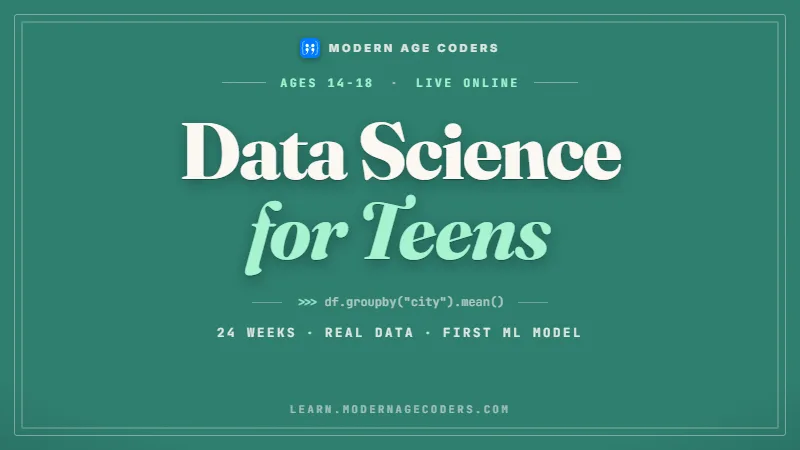
Data Science for TeensGit & GitHub Course for Teens
Grades 10 to 11

Algorithms

Data structures, complexity and problem solving for contests and AP.

Problem Solving for TeensAP Computer Science A
Grades 11 to 12

Machine learning

Models trained and evaluated in Python, with honest reports of their limits.

AI and Machine Learning for TeensCompetitive Programming for Teens
Building, not just prompting

Why a Bay Area teen should build AI rather than only use it

Models are only as honest as the data cleaning behind them.

Feed the raw tree inventory to a model that predicts planting year and it will learn from 38,652 dated rows while silently treating the other 105,867 as something else. It will also learn from eight dates that have not happened. Nothing in the output warns you. A teen who did the cleaning by hand knows to look.

That is why our AI course begins with data and ends with evaluation. Teens use AI coding tools where the provider’s own age rules allow, but they are graded on whether they can explain each step, including what the model cannot know.

In a region full of AI products, the scarce skill is the person who asks what the training data got wrong. The longer argument is in why learning to code still pays off.

How classes run

One live class for the whole Bay

Whether home is in the city, across the bridge or down the Peninsula, the class is the same distance away.

Anywhere around the Bay

A teen in the Richmond District and another in Oakland can share a batch without either crossing a bridge.

Code reviewed live

The teacher reads the student’s code on a shared screen and asks why, rather than pasting a correction.

A free first class

One real task, then a recommended course and time. We never take card details at that stage.

Batches by level

Fifteen to twenty teens at the same stage, from the Bay Area and the rest of the US.

One to one

A single teacher for a single teen, for competition training, AP review or a faster pace.

Honest about schoolwork

We teach concepts and projects. Graded assignments and exam work stay the student’s own.

Online, from India

There is no Modern Age Coders office in the Bay Area, and none is claimed. Classes are live online; a teen needs a laptop or desktop, a headset and a steady connection.

Fees

Fees for Bay Area families

A free start, then one of two monthly plans.

First classUSD 0

A full first class with a teacher at no cost, ending in a suggested course and schedule.

Group tuitionUSD 100

A month of live classes in a level-matched batch of fifteen to twenty teens.

Private tuitionUSD 150

A month of one-to-one classes, scheduled around school and activities.

Bay Area families pay in US dollars at the same rate as every other US family. Billing begins only after the free class, when course and time are agreed; the pricing page covers breaks and missed classes.

Reviews

Google reviews from students and parents

Rated 4.9 across 547 Google reviews. These are real reviews, reproduced as written.

★★★★★

"The one step solution for my son. Modern Age Coders make learning coding so simple that kids love it. The teachers explain complex concepts clearly with practical exercises and interactive content."

Ria Mukherjee

Parent

★★★★★

"Modern Age Coders has been a game-changer for me. I struggled to grasp IT concepts and coding before joining, but their classes transformed everything. I can now confidently write complex programs with ease."

Samriddha Mondal

Student

★★★★★

"One of the most wonderful education centres out there. Education is not limited to school syllabus but focuses on skill development."

Vansh Agarwal

Student

★★★★★

"My child Dhairya is really enjoying the Modern Age Coders classes. This is his first online class and he eagerly looks forward to it. I can already see his improvement, and the teachers are very cooperative."

Sonam Oswal

Parent of Dhairya

★★★★★

"Modern Age Coders have wonderful teachers who teach in a clear, easy and practical way. The teacher boosts students' confidence and inspires them to learn without hesitation."

Sonu Goyal

Parent

★★★★★

"I highly recommend this computer coding class! The teachers are incredibly knowledgeable and passionate about coding."

Ritu Kedia

Parent

Free placement class

Book a free Python or AI class

Tell us where the teen is now: never coded, comfortable with Python, or already training models. The first task is matched to that.

+1

FAQ

Bay Area teen and parent questions

What Bay Area families ask before the first Python or AI class.

Is there an in-person class anywhere in the Bay Area?

No. All classes are live online, so a teen joins from home anywhere around the Bay.

Does my teen need to know Python before the AI course?

Yes, the basics. Teens new to code start with the Python course, and the teacher moves them to AI when their projects show they are ready.

What time are the classes?

Weekdays or weekends, flexible: choose your batch, or for a very personalised plan choose 1-on-1 at your convenience. Times are confirmed in Pacific Time.

What is the street tree date project?

Teens query the DataSF Street Tree Inventory, parse its text planting dates, handle the many blank ones, and remove dates later than the extract date before charting plantings by year.

Which portal does the project use?

Only DataSF, the open data portal of the City and County of San Francisco. Other Bay Area cities publish their own data, which this page does not use.

Can my teen use AI chatbots and coding assistants in class?

Where the provider allows it for their age, as a helper after they can write and check the code themselves. We teach the reasoning first.

Do you prepare students for AP Computer Science?

Yes, AP Computer Science A and Principles, alongside the school course. School assignments and exams always remain the student's own work.

How large are the batches?

Fifteen to twenty teens at the same level. One-to-one classes are available instead.

What equipment is needed?

A laptop or desktop that can run Python, a headset and a reliable connection. Chromebooks work for some courses; the free class checks.

Are you connected with DataSF or San Francisco Public Works?

No. We teach with public data they publish, but we are not connected with the City and County of San Francisco or any school district.

Keep exploring

More for Bay Area teens

For a broader look at AI study paths, read AI and machine learning classes in the USA and AI projects for high school students. Contest-minded teens can see USACO preparation, and the California page covers the state.

Free classPriority demoCall us

Keep exploring Modern Age Coders

Coding classes in nearby places

Learn more

Free resources

From the blog

Start here