CSP / MTH / 01
High school mathematics
Algebra to calculus, for gaps before Grade 12.
Open the syllabusFive universities · Three provinces of origin · Checked 22 October 2026
Every university writes its computer science requirements its own way, in its own course names, on its own website, and they change between admission cycles. We read five universities’ official pages on 22 October 2026 and set their lists side by side for students applying from Ontario, British Columbia and Alberta. Each row names its source. Universities we could not read are listed as not read rather than filled in from memory. Use the tables to plan a timetable, then confirm every line on the university’s own site in the year of application.
10,000+ students since 2020 · Grade 12 math in Ontario and western course names · Taught live
In short
Checked at each university’s own site on 22 October 2026: Waterloo, all three U of T campuses and McMaster listed Calculus and Vectors (MCV4U) for Ontario computer science applicants, and UBC Science listed Advanced Functions and a Grade 12 science instead; every list named English. Modern Age Coders teaches that math live online in Ontario Grade 12 University Math and its western counterpart, as a batch class or one to one.
The math every list asks for
Grade 12 math appears in every list below, in Ontario names or western ones, and computer science background helps in every first year. One course for each.
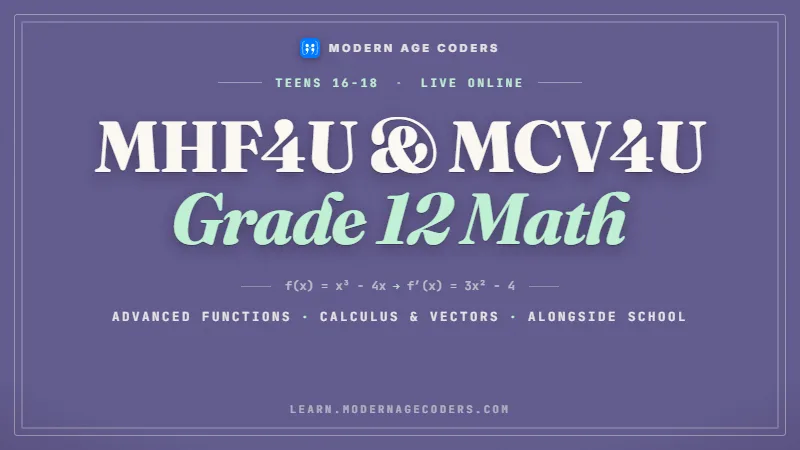
CSP / 01
MHF4U and MCV4U, the two codes that recur across the Ontario rows, taught alongside the school course.
Open the syllabus →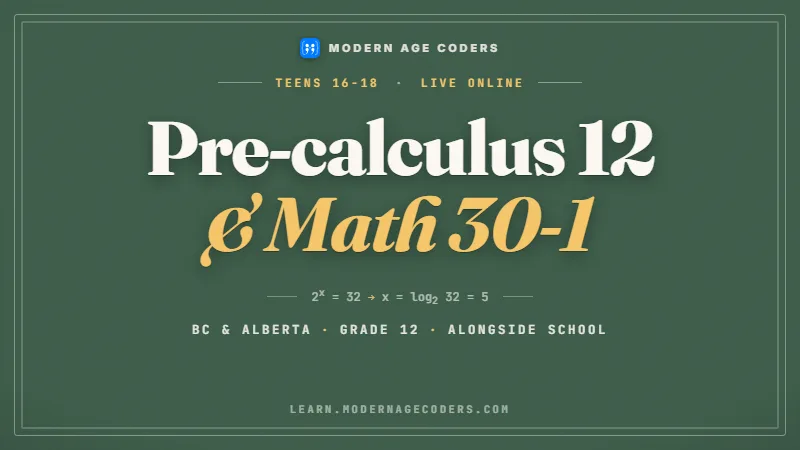
CSP / 02
Pre-calculus 12 and Math 30-1 for students in British Columbia, Alberta and the Prairies.
Open the syllabus →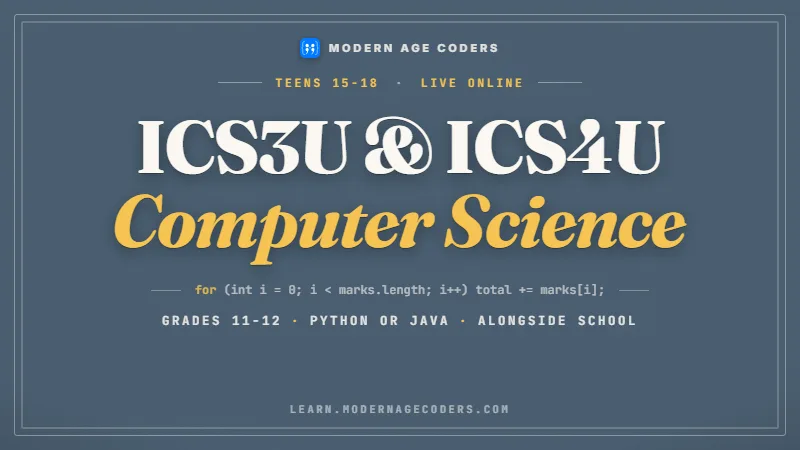
CSP / 03
For students taking school computer science: design, tracing and testing habits first year relies on.
Open the syllabus →Applying from Ontario
Six computer science routes, four universities, one date. The cells hold course codes or short labels; the university pages hold the full wording.
| Program | English | MHF4U | MCV4U | Also listed | Source |
|---|---|---|---|---|---|
| Waterloo, Computer Science | Any Grade 12 U English | Yes | Yes | One other Grade 12 U course; AIF | uwaterloo.ca requirements tool |
| U of T St. George (TAD) | ENG4U / EAE4U | Not named | Yes | Supplemental application | future.utoronto.ca |
| U of T Mississauga (TMX) | ENG4U / EAE4U | Yes | Yes | MDM4U recommended | future.utoronto.ca |
| U of T Scarborough (TXC) | ENG4U / EAE4U | Yes | Yes | None | future.utoronto.ca |
| McMaster, Computer Science (B.A.Sc.) | ENG4U | Not named | Yes | OUAC code MC / MCC; a supplementary application deadline of January 28, 2027 | future.mcmaster.ca requirements tool |
| UBC Vancouver, Science (entry route to CS) | ENG4U | Yes | Not named | One of SBI4U, SCH4U or SPH4U; Grade 11 SCH3U and SPH3U | you.ubc.ca requirements tool |
Not named means the course does not appear in that university’s published list of required courses for that program on that day. It does not mean the university considers the course unimportant, and it does not mean a student can skip it. Ontario’s own math curriculum (revised 2007) says “Advanced Functions (MHF4U) must be taken prior to or concurrently with Calculus and Vectors (MCV4U).” So any student with MCV4U on the transcript has MHF4U too, whichever course a university chooses to name.
Every row also sits inside a general rule about how many Grade 12 U or M courses a student needs. Waterloo and McMaster both say six, and the central U of T page asks for six 4U or M subjects with English among them.
UBC’s computer science department states it directly: “there is no direct admission into the Computer Science program”. Students first join a faculty with computer science specializations, such as Science, and seek the computer science specialization later. The row above is therefore UBC’s Science list for Ontario students, the usual first step toward computer science there.
Hence the science courses, at both Grade 12 and Grade 11 level, in that row. UBC says the Grade 11 courses “may be waived with scores of 86% or higher in senior-level Math and Chemistry”.
Sources, all read 22 October 2026: Waterloo, Computer Science requirements for Ontario; U of T Future Students, Computer Science; McMaster admission requirements tool (Computer Science, Ontario); UBC requirements for Canadian high schools (Vancouver, Ontario, Science); UBC Computer Science, admission processes. We have no affiliation with any of these universities.
The calculus question
It is one of the most searched questions about Ontario computer science admission, and the honest answer depends on the program. Here is what each list we read said about Calculus and Vectors.
| Program | MCV4U in the published list? | How it is written |
|---|---|---|
| Waterloo, Computer Science | Yes | Calculus and Vectors 4U |
| U of T, all three campuses | Yes | Calculus & Vectors, MCV4U |
| McMaster, Computer Science | Yes | MCV4U |
| UBC Vancouver, Science | No | The list names MHF4U and a Grade 12 science instead |
Five of the six Ontario routes we read name MCV4U outright. A student who leaves it off the Grade 12 timetable closes those five doors at once, and keeps only the UBC Science route among the ones we checked. For a student who is serious about computer science and still choosing universities, that makes MCV4U the course to protect.
This is our planning inference from the published lists, not any university’s advice. Universities we could not read may differ, and any of these lists can change.
Waterloo’s first-year computer science schedule contains two calculus courses, and U of T’s and McMaster’s lists treat MCV4U as a prerequisite rather than a recommendation. Rates of change, limits and vectors run through algorithms, graphics, machine learning and simulation.
The practice problems further down show where each Grade 12 topic reappears in computing, with worked answers. They are ours, written to make the link concrete rather than to imitate any school’s exam.
Applying from BC or Alberta
Universities translate their requirements into each province’s courses. We read the British Columbia and Alberta versions for the programs whose tools offered them.
| Program | English | Math | Science | Grade 11 | Source |
|---|---|---|---|---|---|
| Waterloo, Computer Science | English Studies 12 or English First Peoples 12 | Pre-Calculus 12; Calculus 12 or AP Calculus | None listed | None listed | uwaterloo.ca |
| McMaster, Computer Science | English Studies 12, English 12 or English 12 First Peoples | Calculus 12 or AP Calculus | None listed | None listed | future.mcmaster.ca |
| UBC Vancouver, Science | English Studies 12 or English First Peoples 12 | Pre-Calculus 12 | Anatomy and Physiology 12, Chemistry 12 or Physics 12 | Chemistry 11; Physics 11 | you.ubc.ca |
| SFU, Computing Science | English Studies 12 or English First Peoples 12 | At least one of Pre-Calculus 12 or Calculus 12 | At least one of Anatomy and Physiology 12 (Biology 12), Chemistry 12, Physics 12 | No specific Grade 11 course requirements | sfu.ca |
| Program | English | Math | Science | Grade 11 | Source |
|---|---|---|---|---|---|
| Waterloo, Computer Science | English Language Arts 30-1 | Mathematics 30-1; Mathematics 31 | None listed | None listed | uwaterloo.ca |
| McMaster, Computer Science | English Language Arts 30-1 | Math 31 or AP Calculus | None listed | None listed | future.mcmaster.ca |
| UBC Vancouver, Science | English Language Arts 30-1 | Math 30-1 or Math 31 (5 credits) | Biology 30, Chemistry 30, or Physics 30 | Chemistry 20; Physics 20 | you.ubc.ca |
For students in British Columbia and Alberta the calculus course is the swing factor. Waterloo asks for Calculus 12 or AP Calculus in British Columbia and Mathematics 31 in Alberta; McMaster asks for the same calculus courses; UBC Science and SFU accept Pre-Calculus 12 (SFU: Pre-Calculus 12 or Calculus 12) without a calculus course on their lists.
A Grade 12 science appears only on the UBC and SFU lists, because both route computer science through a science-based admission. Waterloo and McMaster list none.
Waterloo wants six Grade 12 academic courses from British Columbia applicants and five academic courses, each at 30 or 31 level, from Alberta applicants. McMaster asks for five in each province, and in British Columbia excludes most applied design, career, physical education and faith-based courses. SFU asks for at least five approved academic Grade 12 courses.
SFU also sets a general rule for every program: a minimum of 70 per cent in Language Arts 11, English 12 or an equivalent. UBC’s general requirements for British Columbia include a 70 per cent minimum in senior English.
Sources, read 22 October 2026: Waterloo’s requirements tool, Computer Science, British Columbia and Alberta; McMaster’s requirements tool, Computer Science, both provinces; UBC’s requirements tool, Vancouver, Science, both provinces; SFU Computing Science requirements (BC high school). SFU’s Alberta page was not read.
What is missing, and why
A comparison is only as honest as its gaps. These universities are absent from the tables because we could not read their requirement pages at the source on 22 October 2026, not because their requirements are unimportant or similar to the others.
| University | What happened | What families should do |
|---|---|---|
| Queen’s University | The site returned an access-denied response (403); we stopped there | Read the Computing program requirements on queensu.ca |
| University of Alberta | The site returned an access-denied response (403); we stopped there | Read the Computing Science requirements on ualberta.ca |
| University of Calgary | The page loaded, but its requirement fields showed template placeholders rather than courses | Open the Computer Science page in a browser, where the list renders |
| McGill University | No program page found at the addresses tried; the listing builds itself in the browser | Use McGill’s undergraduate admissions program finder |
| University of Ottawa | No program page found at the addresses tried | Use uOttawa’s undergraduate program pages |
| U of T Arts & Science page | A bot-verification screen; not retried | The central U of T page in the Ontario table was read instead |
We do not fill a gap from memory or from third-party summaries, because a requirement list quoted wrongly does real damage to a student’s timetable. If your teen is considering one of these universities, its own page is the only source to plan from.
A planning table, ours
Undecided students often ask a simpler question: which courses keep all of these doors open at once? This table is our answer, built by combining the lists above. It is a planning aid, not any university’s requirement.
| Applying from | Courses that cover every list we read | Why each is there |
|---|---|---|
| Ontario | ENG4U; MHF4U; MCV4U; one of SBI4U, SCH4U or SPH4U; SCH3U and SPH3U in Grade 11; MDM4U if room allows | ENG4U satisfies every English line; MCV4U for Waterloo, U of T and McMaster; MHF4U for Waterloo, Mississauga, Scarborough and UBC, and before MCV4U under the Ontario curriculum; the sciences for UBC Science; MDM4U is a Mississauga recommendation, not a requirement |
| British Columbia | English Studies 12; Pre-Calculus 12; Calculus 12; one of Anatomy and Physiology 12, Chemistry 12 or Physics 12; Chemistry 11 and Physics 11 | English Studies 12 is named on all four lists; Calculus 12 for Waterloo and McMaster; Pre-Calculus 12 for Waterloo and UBC; a Grade 12 science for UBC and SFU; the Grade 11 sciences for UBC |
| Alberta | English Language Arts 30-1; Mathematics 30-1; Mathematics 31; one of Biology 30, Chemistry 30 or Physics 30; Chemistry 20 and Physics 20 | English Language Arts 30-1 is on all three lists; Math 31 for Waterloo and McMaster; Math 30-1 for Waterloo; a 30-level science and the 20-level sciences for UBC |
For each province we took every course or course group that any list named, then removed duplicates. Where a list offered a choice, such as one of three sciences, we kept the choice. The result is the smallest set we could find that covers every line in this page’s tables for that province.
It is bigger than any single university’s list, which is the point: it is the cost of not deciding yet. A student who settles on two universities can drop whatever only the others needed.
It ignores averages, supplementary forms and the total number of courses each university counts, all of which matter. It also covers only the universities we could read. Add each new university’s list to it by hand before relying on it.
A computer science course appears in none of the required lists we read, so it is not in the combined list. It still belongs in a future computer science student’s timetable where the school offers it, for the skill it builds rather than for admission.
Published ranges
Several of the pages we read print an average or range. We list the exact words, without converting, ranking or interpreting them.
| Program | Label used | Wording |
|---|---|---|
| Waterloo, Computer Science | Admission average | Individual selection from the low to mid-90s |
| McMaster, Computer Science | Anticipated Admission Range | min. 90% |
| U of T Mississauga | Competitive Average | Mid to High 80s |
| U of T Scarborough | Approximate grade requirements | Low 90s overall; High 90s overall (co-op) |
| UBC, SFU, U of T St. George | No range on the pages we read | Not stated |
Each label means something slightly different: an individual-selection range, an anticipated range, a competitive average, an approximate requirement. None is a promise in either direction, several programs also read supplementary forms, and every one can move from year to year. Nobody here will turn a range into a forecast for your teen, and we never promise an admission result.
Practice, ours
These eight problems are ours, written for this page. Each one takes a Grade 12 topic from the lists above and shows where it reappears in computing. Questions 1 to 3 use Advanced Functions and Pre-calculus ideas; 4 to 8 use Calculus and Vectors. Try them before reading the answers.
Answers, ours
Each answer shows the reasoning, because the reasoning is what first-year courses build on. Three answers are also checked by a short program at the end.
# Checking three of the practice answers by brute force (ours)
import math

def search_steps(n):
    """Worst-case comparisons for binary search on n sorted items."""
    steps, size = 0, n
    while size > 0:
        steps += 1
        size //= 2                 # each comparison keeps at most half
    return steps

def nested_count(n):
    count = 0
    for i in range(n):
        for j in range(i):         # j runs 0 .. i-1
            count += 1
    return count

def descend(x, rate, steps):
    """Gradient descent on f(x) = x**2 - 6x + 10, whose derivative is 2x - 6."""
    path = [x]
    for _ in range(steps):
        x = x - rate * (2 * x - 6)
        path.append(x)
    return path

print("Q1:", search_steps(1_000_000), "comparisons; log2 gives", math.ceil(math.log2(1_000_001)))
print("Q3:", nested_count(100), "and n(n-1)/2 gives", 100 * 99 // 2)
print("Q7:", descend(0, 0.25, 4))
Output: Q1: 20 comparisons; log2 gives 20. Q3: 4950 and n(n-1)/2 gives 4950. Q7: [0, 1.5, 2.25, 2.625, 2.8125]. The brute-force counts agree with the formulas, which is the point of checking a formula with code.
None of them needs advanced code; all of them need the math to be understood rather than memorised. A student who can say why binary search takes 20 steps, or why the nested loop gives a triangular number, is doing first-year computer science reasoning already.
That is the standard we teach to. In our Grade 12 math classes, a formula comes with its reason and a second way to check it, and the checking is often a three-line program.
Students can work them as written, then change the numbers: a list of a billion items, a loop that starts at 1, a learning rate of 0.6 instead of 0.25. Predict first, then run the code above with the new values.
Question 7 with a learning rate of 1.1 is worth trying in particular. Predict what happens, then run it. The result explains why choosing that number carefully matters in machine learning.
Where your teen stands
Our stages, from teaching Grade 12 students in Ontario and the western provinces who went on to computing degrees.
| Stage | What a teacher notices |
|---|---|
| 1. Calculator | Gets numerical answers, but cannot say what they would mean in a program |
| 2. Translator | Writes a formula as code and code as a formula, for simple cases |
| 3. Estimator | Predicts roughly how long an algorithm will take before running it |
| 4. Modeller | Chooses the math a problem needs: logs, sums, rates or vectors |
Ask your teen to estimate how many steps a search through a million items takes. Their answer, and how they reach it, shows the stage quickly.
Stage 2 is the hinge. Once a student can move between a formula and a loop, both subjects start reinforcing each other.
Every time you learn a formula, write a five-line program that tests it on real numbers. You will catch your own mistakes and remember the idea.
Practise estimating before calculating. Within a factor of ten is a good first target; then get closer.
The catalogue
Taught live by one regular teacher, to a class or to a single student, wherever in Canada you live.
CSP / MTH / 01
Algebra to calculus, for gaps before Grade 12.
Open the syllabusCSP / MTH / 02
Contest reasoning from Gauss to Euclid, with our own problems.
Open the syllabusCSP / MTH / 03
For schools where AP Calculus stands in for provincial calculus.
Open the syllabusCSP / ALG / 01
Canada’s programming contest, practised with original problems.
Open the syllabusCSP / ALG / 02
Searching, sorting and the analysis behind them.
Open the syllabusCSP / ALG / 03
Faster, harder problem sets after the basics.
Open the syllabusCSP / LNG / 01
The language used for the checks on this page.
Open the syllabusCSP / LNG / 02
Strong typing and objects, common in first year.
Open the syllabusCSP / LNG / 03
Gradient descent and models, built by hand.
Open the syllabusHow classes run
Weekdays or weekends, flexible: choose your batch, or for a very personalised plan choose 1-on-1 at your convenience, weekend mornings or weekdays.
Weekdays
After school in your own zone, from Newfoundland to British Columbia.
Weekends
Mornings in Eastern time, or later for western families.
1-on-1
Fitted to your school’s exam calendar.
MCV4U, Pre-calculus 12 or Math 31, as your school calls it.
The same person every week.
Each rule explained, then checked.
Small programs alongside the math.
We teach skills, not applications.
Fifteen to twenty in a class, or a private teacher.
Student work
Student projects that started as an idea and a small amount of math. More on the student labs page.

AI and ML
An AI nutrition coach that reads what you eat and works you toward a target.

AI and ML
A chatbot that answers mathematics and programming questions, built and deployed by a student.

AI and ML
An assistant that helps a young person recognise unsafe situations online.

Web app
A weather forecasting site with live conditions for any location.
Fees
Your first class is on us. Families who carry on pay a single monthly fee for eight live classes, priced in the currency code shown, and can end it after any month with nothing to cancel.
Free first class
Free
no card required
Group batch
$140 CAD
a month, eight live classes
One to one
$210 CAD
a month, eight live classes
What families say
Parents and students on Google, in their own words.
★★★★★
"The one step solution for my son. Modern Age Coders make learning coding so simple that kids love it. The teachers explain complex concepts clearly with practical exercises and interactive content."
Ria Mukherjee
Parent
★★★★★
"Modern Age Coders has been a game-changer for me. I struggled to grasp IT concepts and coding before joining, but their classes transformed everything. I can now confidently write complex programs with ease."
Samriddha Mondal
Student
★★★★★
"One of the most wonderful education centres out there. Education is not limited to school syllabus but focuses on skill development."
Vansh Agarwal
Student
★★★★★
"My child Dhairya is really enjoying the Modern Age Coders classes. This is his first online class and he eagerly looks forward to it. I can already see his improvement, and the teachers are very cooperative."
Sonam Oswal
Parent of Dhairya
★★★★★
"Modern Age Coders have wonderful teachers who teach in a clear, easy and practical way. The teacher boosts students' confidence and inspires them to learn without hesitation."
Sonu Goyal
Parent
★★★★★
"I highly recommend this computer coding class! The teachers are incredibly knowledgeable and passionate about coding."
Ritu Kedia
Parent
Families ask
In the lists we read on 22 October 2026, every program named a senior English course and Grade 12 math. For Ontario applicants, Waterloo, U of T and McMaster named Calculus and Vectors, and UBC Science named Advanced Functions and a Grade 12 science. Each university and province has its own list.
For five of the six Ontario routes we read, yes: Waterloo, all three U of T campuses and McMaster listed MCV4U. UBC Science's Ontario list named MHF4U and a Grade 12 science, not MCV4U. Universities we could not read may differ.
Waterloo, U of T Mississauga, U of T Scarborough and UBC Science listed MHF4U for Ontario applicants. U of T's central page did not name it for St. George, and McMaster's list named ENG4U and MCV4U. Ontario's math curriculum requires MHF4U to be taken before or at the same time as MCV4U, so in practice students who take MCV4U take MHF4U as well.
None of the required-course lists we read named one. Waterloo describes its recommended computer science courses as helpful background that does not affect the likelihood of admission. Taking one where the school offers it still makes first-year programming easier.
Calculus 12 or AP Calculus appears on the Waterloo and McMaster lists we read, and Waterloo adds Pre-Calculus 12. UBC Science and SFU name Pre-Calculus 12 instead, with SFU taking Calculus 12 as the alternative, and both add a Grade 12 science. English Studies 12 is accepted on all four lists.
Math 31 is on the Waterloo and McMaster lists, McMaster also taking AP Calculus, and Waterloo adds Mathematics 30-1. UBC Science accepts Math 30-1 or Math 31 together with a 30-level science and the 20-level chemistry and physics courses. English Language Arts 30-1 is on all three lists.
UBC's computer science department says it does not. Students first join a faculty with computer science specializations, usually Science, and seek the specialization once first year is under way.
Their websites refused our request on 22 October 2026, so we stopped and did not use them. We also could not read usable requirement pages for Calgary, McGill or uOttawa that day. Please check those universities' own pages.
Because first-year computing uses it immediately: logarithms in searching, sums in counting loop steps, rates of change in training models, vectors in graphics. The eight practice problems on this page show each link with a worked answer.
Weekdays or weekends, flexible: choose your batch, or for a very personalised plan choose 1-on-1 at your convenience, weekend mornings or weekdays. The hour is fixed in your own province's clock, from British Columbia and Alberta through Ontario and Quebec to the Atlantic provinces and Newfoundland.
Elsewhere on this site
Pages for students in every part of Canada.
Our home page for Canadian families.
Classes for Ontario learners.
Classes timed for families in BC.
Classes timed for Alberta families.
Tutoring that uses each province’s own course names.
Ontario’s Grade 11 computer science course.
The national programming contest.
Where gradient descent leads next.
Problem solving before code.
Start here
Tell us the province, the Grade 12 math course by its school name, and whether your teen codes. The teacher starts from the topic they are on now.
Want details first? See the western Grade 12 math syllabus or the Ontario Grade 12 math syllabus, and how we teach.
WhatsApp us · +91 91233 66161 · connect@modernagecoders.com
Teaching is live on video, by teachers working from India, so it works the same in Halifax, Toronto, Calgary or Vancouver. WhatsApp is the quickest way to reach us.
A priority demo is a full class of about 45 to 60 minutes. After the class the mentor sends a written skill report and a personal learning roadmap on WhatsApp. If you enrol, the demo fee is adjusted against your first month's fee. Share your demo Order ID with us on WhatsApp and we take it off.
Book a priority demo