Skip to content
Edmonton, Alberta

Coding and AI classes in Edmonton

Where can an Edmonton student study coding, data and AI with a live teacher?

With Modern Age Coders, live online. We teach Edmonton learners from age 6 to adult, in a live group of fifteen to twenty or one to one: children in Python and AI for Kids, teens in Data Science for Teens or our CCC preparation course, and Grade 12 students in Western Canada Grade 12 Math. Your first lesson costs nothing.

Alberta's Legislative Assembly gives its address as 9820 - 107 Street NW, Edmonton, so the capital is where the province's school rules are debated. One detail in its school tests surprises most parents: the Grade 6 science test already reports on computational thinking, alongside matter, ecosystems and the solar system. A draft Grade 7 to 9 program goes further and brings computer science and artificial intelligence into the middle years, with mandatory use planned for September 2027. So an Edmonton child is expected to think like a programmer before high school, whether or not anyone teaches them to program. This page sets out those Alberta facts with their dates, the CEMC contests that lead an Edmonton teen toward the Canadian Computing Olympiad, and a lesson we teach on the city's pet licence file, where the most important line is in the description, not the data.

Facts last verified 22 October 2026. Teaching is online; no Edmonton branch is claimed.

Course picks for Edmonton

Four places an Edmonton learner can begin

Each pick matches a stage of Alberta school, and the free first lesson confirms the fit before anything is booked.

Browse the course atlas for more than one hundred options and use the coding roadmap to check prerequisites.

The four we are known for

Python, AI, vibe coding and agentic coding

These run underneath everything above. Every one is live and online, placed by ability rather than by age, and the first class is free.

Alberta tests and curriculum

Computational thinking on the Grade 6 test, and AI in the draft Grade 7 to 9 program

Edmonton schools follow Alberta's curriculum and write its Provincial Achievement Tests (PATs). Everything here was checked against Alberta's bulletins and web pages on 22 October 2026; quoted phrases are the province's own and the rest is our summary.

Provincial Achievement Test sittings in 2027 for Grades 6 and 9, as scheduled in the 2026-2027 General Information Bulletin for Grades 6 and 9 (times are Alberta time)
TestWhen Alberta schedules itWorth knowing
Grade 6 ScienceFriday 11 June 2027, 9 to 10 am50 questions; Computational Thinking is one of six reporting categories
Grade 6 Mathematics, Part AMonday 14 June 2027Number questions, no calculator
Grade 6 Mathematics, Part BWednesday 16 June 2027Questions from across the Grade 6 math curriculum
Grade 9 Mathematics, Part AFriday 22 January or Tuesday 15 June 2027The bulletin lists a January and a June sitting
Grade 9 ScienceTuesday 26 January or Tuesday 22 June 2027Also offered in January and June

The Grade 6 parent guide names the six reporting categories of the science test: Matter and Energy Resources, Interactions, Climate and Ecosystems, Solar Systems, Computational Thinking, and Scientific Method. In other words, an Edmonton eleven-year-old is assessed on reasoning in steps, spotting patterns and following an algorithm, in the same sitting as questions about ecosystems. Alberta adds that the tests are taken on screen, and that every student registered in Grade 6 or 9 is expected to write them.

The draft Grade 7 to 9 program

Alberta describes its renewed middle-years curriculum as integrating topics like artificial intelligence, computer science and money management. Classrooms may pilot it in 2026 to 2027, ahead of mandatory implementation in September 2027.

Science in Grades 4 to 6

Alberta lists new Grades 4 to 6 science as implemented in schools in 2024 to 2025. A child in Grade 6 in Edmonton this year is studying from that newer program, computational thinking included.

No drilling for the test

The Grade 6 parent guide says plainly that Alberta Education and Childcare discourages test rehearsal and coaching. We agree, and we do not drill PAT formats; we teach the reasoning, and a test becomes one more place to use it.

Our role beside Edmonton schools

We teach alongside a student's Alberta courses and we do not grant Alberta credits, PAT results or diploma marks. We are not connected with Alberta Education and Childcare, any Edmonton school board or the City of Edmonton.

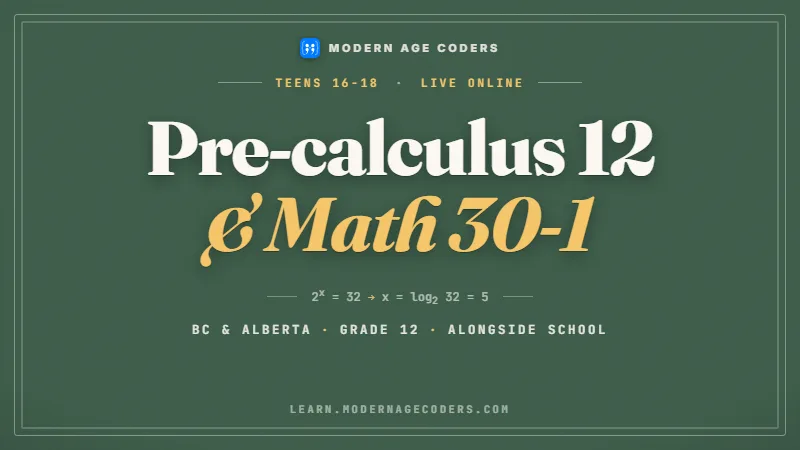
Families preparing for those tests can read our Grade 6 math PAT practice and Grade 9 math PAT practice pages, and older students our Math 30-1 tutoring page. For the province-wide coding picture, see coding classes in Alberta.

Edmonton data project

Did Edmonton's pets multiply in 2026? Read the description before the chart

The City of Edmonton publishes its current pet licences by neighbourhood as open data, refreshed daily. It is a friendly file for a first data project, and it hides a trap that catches adults too. Every count below is ours, from the file downloaded on 22 October 2026.

Our counts from the City of Edmonton Pet Licenses by Neighbourhood file (85,368 rows, one licensed animal per row; downloaded 22 October 2026). YEAR is the year in the licence date
What we countedRows
PET_TYPE Dog56,140
PET_TYPE Cat28,917
PET_TYPE Hens143
PET_TYPE Pigeons97
PET_TYPE Bees69
YEAR 20241,923
YEAR 202524,131
YEAR 2026 (to October)59,281

Put the last three rows on a bar chart and it looks as if licensed pets more than doubled in a year. They did not, or at least this file cannot say so. The city's own description explains that the dataset is a snapshot of pets licensed as of its last update, so an animal whose licence lapsed has dropped out, and it states that it is not possible to use this dataset to see trends in pet licensing over time. The 2026 rows are mostly recent renewals and the older years are the survivors. This is the beginner script that produced the table, standard-library Python run beside the downloaded CSV:import csv from collections import Counter kinds = Counter() years = Counter() dog_breeds = Counter() with open("pet-licenses-by-neighbourhood.csv", encoding="utf-8-sig") as pets: for row in csv.DictReader(pets): kinds[row["PET_TYPE"] or "(blank)"] += 1 years[row["YEAR"]] += 1 if row["PET_TYPE"] == "Dog": dog_breeds[row["BREED"]] += 1 print(kinds.most_common()) for year in sorted(years)[-4:]: print(year, years[year]) print(dog_breeds.most_common(3))

1. Count what is there

A Counter over PET_TYPE gives five animal types and two blank rows. Every row has a COUNT of 1, so counting rows and adding the COUNT column give the same answer here, which is worth checking rather than assuming.

2. Compare with the description

The metadata says the file covers cats, dogs and pigeons. The file also holds 143 hens and 69 bees. A description is a claim about the data, and a careful student tests it like any other claim.

3. Refuse the tempting chart

The YEAR column runs back to 2013 on a single row, with only 33 rows dated before 2024. A student who reads the city's note writes “licences still active, by year issued” on the axis, or does not draw the chart at all.

Further checks our students run on the same City of Edmonton file (our results)
CheckResult
Most common dog breeds recordedLABRADOR RETRIEVER 5,015; GERMAN SHEPHERD 3,444; UNKNOWN 2,822
Named neighbourhoods in the file336, plus 12 rows with no neighbourhood
Rows dated October 20263,271, a partial month at download
Value of COUNT on every row1

What the file cannot tell you

It cannot say how many pets live in Edmonton, only how many hold a current licence, and it cannot show a trend. The third most common dog breed is UNKNOWN, which is a fact about the form, not about dogs. Writing those limits down is as much a part of the project as the code.

The data is used under the Open Government Licence - Edmonton, which permits commercial reuse provided the city is credited. Contains information licensed under the Open Government Licence - City of Edmonton (licence, dataset page). Our counts are our own, and the City of Edmonton is not endorsing this page or these classes.

Contests from Edmonton

From high school contests to the Canadian Computing Olympiad, 2026 to 2027

Edmonton schools order most of their contests from CEMC at the University of Waterloo. For a teenager who already codes, the ladder runs from the CCC Senior paper to an invitation-only olympiad. Each date below is the one CEMC publishes for the Americas, as it stood on 22 October 2026.

CEMC contests on the high school and olympiad path, 2026 to 2027 (CEMC dates and wording)
StepWhat CEMC saysDate
CCC SeniorFor intermediate to advanced programmers; the last question is an “IOI level question”Wednesday 17 February 2027
Canadian Computing Olympiad (CCO)About 20 top official CCC Senior participants from Canadian schools are invited; C++ onlySpring 2027, by invitation
Pascal, Cayley and FermatMath contests for Grades 9, 10 and 1123 and 24 February 2027
Fryer, Galois and HypatiaFull-solution math contests for Grades 9, 10 and 11Wednesday 7 April 2027
EuclidFor students in their final year of secondary schoolTuesday 6 April 2027

Through a school only

CEMC's wording is that all students must participate through their school; nobody signs up alone. If an Edmonton student's school does not take part, CEMC suggests finding another local school that will host them.

Why C++ matters later

CEMC allows Python and Java at the CCC but requires C++ at the CCO, and warns that a perfect CCC score may not always be possible in Python or Java. Senior hopefuls usually learn C++ alongside Python.

Past papers stay free

Ten years of CEMC contests can be downloaded free with no account. Students practise on that archive, and our lessons use problems we write ourselves.

The pet file is a gentle start on the same road: count, group, check a claim. Senior problems ask for the same discipline on inputs too large for anything but an efficient method. Our CCC preparation page explains how we build that up, and the Waterloo contests page covers the math side. Modern Age Coders is independent of CEMC and the University of Waterloo.

Class times

Edmonton keeps UTC-6 all year: what that means for class times

Alberta's official time is fixed at six hours behind UTC, so Edmonton never changes its clocks. India, where our teachers work, does not change either, which makes the gap between them the same in every month.

Two Edmonton example hours with their India and Vancouver equivalents (Alberta UTC-6 and British Columbia UTC-7 all year; India UTC+5:30; our arithmetic)
In EdmontonIn IndiaIn Vancouver
Monday 6 to 7 pmTuesday 5:30 to 6:30 amMonday 5 to 6 pm
Sunday 9 to 10 amSunday 8:30 to 9:30 pmSunday 8 to 9 am

Eleven and a half hours

India is always eleven and a half hours ahead of Edmonton, so a time we agree in September is still right in January. Only families comparing with Ontario see a difference, because Ontario changes on 1 November 2026.

Manitoba moves closer

From 1 November 2026 Manitoba stays on UTC-5 all year, so Winnipeg will always be one hour ahead of Edmonton, and Vancouver always one hour behind.

Edmonton phone numbers

Edmonton numbers use 780, plus the Alberta-wide overlays 587, 825 and 368. The form accepts any of them as ten digits after the +1.

Learning ladder

From a Grade 1 sequence to the CCC Senior paper

Grades are a starting guess; the free lesson decides.

Grades 1 to 3

Sequences and patterns

Block coding and puzzles where a child predicts what happens, then checks.

Coding for KidsScratch Coding for Kids
Grades 4 to 7

Algorithms in Python

Typed code, loops and conditions, the habits behind the Computational Thinking category on the Grade 6 test.

Python and AI for KidsProblem Solving and Computational Thinking for Kids
Grades 8 to 10

Data and contests

Python with real files, the first CCC Junior paper, and data work like the pet licence lesson.

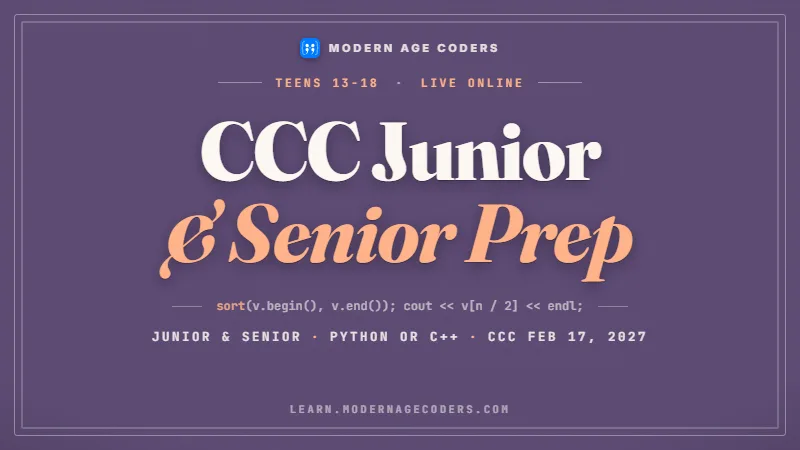
Data Science for TeensCCC Junior and Senior Preparation (Canadian Computing Competition)
Grades 11 and 12

Senior level

C++ for the CCC Senior and beyond, and Math 30-1 alongside the school course.

C++ for TeensWestern Canada Grade 12 Math
Coding and AI

Would an AI assistant have drawn the misleading pet chart?

Quite possibly, if nobody told it to read the description first.

Ask an AI tool to chart Edmonton pet licences by year and you will likely get a tidy bar chart that climbs steeply to 2026. The code will run. The chart will be wrong in the way that matters, because the city says the file is a snapshot and cannot show trends. The tool did what it was asked; the asking was the mistake.

That is the habit we build: read the source, plan the steps, write the code, then question the result. Students meet AI tools as they get older, under the age rules we follow, and they learn to treat them as assistants to be checked, not authorities to be copied.

Alberta reports on computational thinking in Grade 6 because thinking in clear steps is the skill underneath everything else, AI tools included. The longer argument is in the full case for learning to program in an age of AI assistants.

Delivery

How classes work for Edmonton and the capital region

Lessons are live and online, so a student in Sherwood Park, St. Albert or the south side shares the same teacher and screen.

When classes run

Weekdays or weekends, flexible: choose your batch, or for a very personalised plan choose 1-on-1 at your convenience, weekend mornings or weekdays.

Class or private

Join a class of fifteen to twenty students at the same level, or work privately with one teacher for CCC Senior training or extra pace.

Planned in Alberta grades

Teachers know the PAT calendar and the Grade 12 diploma sittings, and they never schedule a new topic on the eve of a test.

Your own work stays yours

Teachers explain and question; they do not complete school assignments. Marked school work is always the student's own.

Equipment

A laptop or desktop with sound, a microphone and a stable connection. A physical keyboard is essential for writing code.

First lesson free

The first lesson is a real class at no cost. It ends with a suggested level, course and time, and no card is needed.

No Edmonton building

Modern Age Coders has no office or classroom in Edmonton or elsewhere in Alberta, and claims none. Every class is taught live online from India.

Fees

What Edmonton families pay

Each figure below carries its currency code.

First classFree

A full live lesson, free, ending with a suggested level, course and class time.

Group tuition$140 CAD

The monthly fee for one place in a class of fifteen to twenty students at the same level.

Private tuition$210 CAD

The monthly fee for private teaching, one student and one teacher.

Edmonton families pay the same monthly fee as families anywhere in Canada. Payment begins after the free lesson, and only once the course and time suit you; holidays and missed classes are set out on the pricing page.

Reviews

Reviews from families and students on Google

Rated 4.9 across 547 Google reviews. These are real reviews, reproduced as written.

★★★★★

"The one step solution for my son. Modern Age Coders make learning coding so simple that kids love it. The teachers explain complex concepts clearly with practical exercises and interactive content."

Ria Mukherjee

Parent

★★★★★

"Modern Age Coders has been a game-changer for me. I struggled to grasp IT concepts and coding before joining, but their classes transformed everything. I can now confidently write complex programs with ease."

Samriddha Mondal

Student

★★★★★

"One of the most wonderful education centres out there. Education is not limited to school syllabus but focuses on skill development."

Vansh Agarwal

Student

★★★★★

"My child Dhairya is really enjoying the Modern Age Coders classes. This is his first online class and he eagerly looks forward to it. I can already see his improvement, and the teachers are very cooperative."

Sonam Oswal

Parent of Dhairya

★★★★★

"Modern Age Coders have wonderful teachers who teach in a clear, easy and practical way. The teacher boosts students' confidence and inspires them to learn without hesitation."

Sonu Goyal

Parent

★★★★★

"I highly recommend this computer coding class! The teachers are incredibly knowledgeable and passionate about coding."

Ritu Kedia

Parent

Free placement class

Tell us about your Edmonton student

The first task fits the level: a pattern puzzle in blocks for a young child, a Python dice game for a Grade 5 or 6 student, or the pet licence file for a teenager who likes real data.

+1

FAQ

Edmonton coding and AI questions

What Edmonton families tend to ask before booking.

Can my child take coding for kids classes in Edmonton?

Yes, from age 6, live online. Your child joins a real teacher from home, in a group of fifteen to twenty children or alone with the teacher. We do not have an Edmonton location.

Does Alberta test coding in Grade 6?

Not coding itself, but the Grade 6 Science test lists Computational Thinking as one of its six reporting categories. Alberta schedules that test for Friday 11 June 2027.

Is AI part of the Alberta curriculum?

Alberta says its renewed Grade 7 to 9 curriculum integrates topics like artificial intelligence and computer science. It is a draft, with mandatory implementation planned for September 2027.

Will you coach my child for the PATs?

We do not drill PAT formats; Alberta itself discourages test rehearsal and coaching. We teach the math and reasoning the tests draw on.

Do your classes give Alberta credits?

They do not, because we do not grant Alberta credits, test results or diploma marks; those come only from school and from Alberta Education and Childcare.

Do you teach robotics classes in Edmonton?

Only the programming side: Python, logic, sensors as data and careful debugging. For building robots, pair our classes with a school or community robotics team.

Is there a Python or data course for Edmonton teens?

Yes. Data Science for Teens uses Python on real files, such as the city's pet licence list, and teaches students to check what a dataset can honestly show.

Which AI tools are used with Edmonton teenagers?

Age-appropriate ones only. Anything rated 18 and over, such as Claude, is kept out of lessons for under-18s, and ChatGPT needs a parent's permission for a teenager.

What hours suit Edmonton families?

Weekdays or weekends, flexible: choose your batch, or for a very personalised plan choose 1-on-1 at your convenience, weekend mornings or weekdays. Alberta keeps one clock all year, so the agreed time never shifts.

Does a 780 number work in the booking form?

Yes. Any 780 number works, as do the Alberta-wide 587, 825 and 368 codes; enter ten digits after the +1.

How can I see the fees?

Look at the fees section above the reviews. It shows the free first lesson and the two monthly fees, for a class place and for private teaching, each with its currency code.

More for Canada

More pages for Edmonton and Alberta students

For the whole province, see our Alberta coding page. Math help is on Math 30-1 diploma preparation and Alberta's new math curriculum, and the national overview is on coding classes in Canada.

Free classPriority demoCall us

Keep exploring Modern Age Coders

Coding classes in nearby places

Learn more

Free resources

From the blog

Start here