★★★★★
"The one step solution for my son. Modern Age Coders make learning coding so simple that kids love it. The teachers explain complex concepts clearly with practical exercises and interactive content."
Ria Mukherjee
Parent
CBSE Class 12 · Informatics Practices, code 065 · Practice paper for 2027
Here is a class 12 IP sample paper for 2026-27 that you have not seen before: 37 new questions, 70 marks, five sections, with choices in the same seven questions as the official CBSE paper. Every pandas program was run, the histogram in Question 33 was drawn by the answer beside it, and the SQL outputs came from MySQL. Keep the worked answers folded until your three hours are over.
Live one to one · a complete 065 paper · pandas, Matplotlib and MySQL answers run · marks shown part by part · your own timing
Start here
Fifty of the seventy marks are pandas, charts and SQL. The IP course teaches all four units; the other two add depth to one half.

All four units / 065
Series, DataFrame, Matplotlib, MySQL functions and joins, networks and societal impacts, with mock papers in the final months.
Open the course →
If Unit 1 is the weak half
A good deal more pandas and Matplotlib than the syllabus, on real datasets, for students who enjoy that side of IP.
Open the course →
If Unit 2 is the weak half
Text, number and date functions, aggregates, grouping and joins, taught from the first query and practised on full databases.
Open the course →Ans. The short version
The Class 12 IP sample paper 2026-27 (CBSE Informatics Practices, code 065) has 37 compulsory questions for 70 marks in three hours: 21 of one mark, seven of two, four of three, two of four and three of five, with an internal choice in seven questions. pandas with charts and SQL carry 25 marks each, networks and societal impacts 10 each. This page is a full original paper in that design with solutions. Modern Age Coders marks such papers live, personalised one to one; start with a priority demo or a free demo class.
Before you begin
CBSE's sample question paper for Informatics Practices has five sections and no overall choice, and a footnote on its pages says the question paper design has not changed for 2026-27.
| Section | Questions | Marks | What you meet there |
|---|---|---|---|
| A | 1 to 21 | 21 x 1 | 15 MCQs, 2 true or false, 2 blanks, 2 assertion and reason |
| B | 22 to 28 | 7 x 2 | Definitions, differences, two-line code |
| C | 29 to 32 | 4 x 3 | A society case, pandas, SQL queries, SQL output |
| D | 33 and 34 | 2 x 4 | A Matplotlib program, then two tables |
| E | 35 to 37 | 3 x 5 | A network case, a DataFrame, five SQL commands |
| All | 37 | 70 | Choice in 22, 25, 28, 30, 32, 34 and 37 |
| Unit | Where it sits in the official paper | Marks |
|---|---|---|
| pandas and data visualization | 1, 4, 8, 12, 15, 18, 20, 22, 24, 28, 30, 33, 36 | 25 |
| Database query using SQL | 2, 6, 9, 11, 14, 17, 19, 21, 26, 31, 32, 34, 37 | 25 |
| Computer networks | 5, 10, 16, 25, 35 | 10 |
| Societal impacts | 3, 7, 13, 23, 27, 29 | 10 |
We sorted the 37 official questions one at a time, and they add up to the syllabus split exactly. The paper below keeps each unit at the same question numbers, so your marks on it can be read unit by unit.
The official paper and marking scheme are free on cbseacademic.nic.in. For exam rules, dates and the practical, read the IP syllabus and paper pattern.
Read this after the official scheme
The scheme is short, and it answers questions that students usually argue about.
| In the official scheme | What we take from it |
|---|---|
| Question 37 (B) (ii), names ending with s, is answered with RIGHT(PName, 1) | LIKE is not in the 065 list of SQL keywords. The listed text functions are enough |
| Question 30 (A) (ii) shows three lines of output and no dtype line | pandas does print dtype: float64 below them. Write it; it is what the screen shows |
| Question 33 gives one mark to the import, one to the plot with its label, and half marks to the rest | A chart program that only plots still earns. Title, axes, legend and show are four easy halves |
| Question 36 gives three marks to making the DataFrame and one each to the next two parts | Read how it must be made: "dictionary of series" is part of the question |
| Question 34 gives two marks to each query | Two tables, so write the joining condition before anything else |
| Question 35 (v) gives the reason with the place, a distance above about 100 m | Server, switch, repeater: each needs its reason in the same sentence |
In an MCQ the general instructions ask for the text of the correct answer too, so write "B. Trademark" and not "B".
Section A, 21 x 1 = 21 marks
Every question carries one mark. Give this section about 28 minutes. In 20 and 21: A, both true and R explains A; B, both true but R does not explain A; C, A true and R false; D, A false and R true.
S.tail() raises an error, because the default number is five. tail() returns all of them. Here it returns the four values.SUM(Phone) COUNT(*) COUNT(Phone) LENGTH(Phone) plt.plot() plt.bar() plt.hist() plt.legend() import pandas as pd
s = pd.Series({"x": 3, "y": 5})
print(s["y"] ** 2 - s["x"])SELECT * FROM RESULT ORDER BY Section, Marks DESC; which column is sorted in descending order? price * 1.05 price + "5%" price[1.05] price.raise(5) SELECT INSTR('Kanyakumari', 'kum'); return? index=False sep=None header=None names=0 AVG(Bonus)? df.loc[2:5] gives four rows. Reason (R): A loc slice includes both its first and its last label. LENGTH(' Goa ') returns 3. Reason (R): LENGTH() counts every character in the string, including spaces. Want forty more one-mark questions with reasons? Use the Class 12 IP MCQ test.
Section B, 7 x 2 = 14 marks
Two marks means two points. Four or five lines are plenty, and 32 minutes should cover all seven.
iterrows() used on a DataFrame? (ii) Which two things does it hand over in each pass of the loop? OR (B) Both del df["Min"] and df.drop(columns=["Min"]) remove a column. State one difference, with a small example. import pandas as pd
boats = pd.DataFrame({"Boat": ["Asha", "Megh"], "Seats": [12, 8]})
for label, row in boats.iterrows():
print(label, row["Boat"], row["Seats"])del changes df itself at once. drop() returns a new DataFrame and leaves df as it was, unless inplace=True is given.import pandas as pd
t = pd.DataFrame({"Day": ["Sat", "Sun"], "Min": [11, 9], "Max": [24, 26]})
u = t.drop(columns=["Min"])
print(list(t.columns)) # ['Day', 'Min', 'Max'] t is unchanged
del t["Max"]
print(list(t.columns)) # ['Day', 'Min'] t has changedbins argument of hist() decide? SELECT LEFT(Code, 4) FROM ITEM; (ii) SELECT MOD(47, 6); which returns 5. One mark each. SUBSTR(Code, 1, 4) is equally right for the first.| Runs | Wickets | |
|---|---|---|
| Ganga | 187 | 6 |
| Kaveri | 142 | 10 |
to_csv() and read_csv()? Write a statement that saves the DataFrame score in rain.csv with a semicolon between the values. import pandas as pd
teams = {"Runs": pd.Series([187, 142], index=["Ganga", "Kaveri"]),
"Wickets": pd.Series([6, 10], index=["Ganga", "Kaveri"])}
score = pd.DataFrame(teams)
print(score)Runs Wickets Ganga 187 6 Kaveri 142 10
to_csv() writes a DataFrame out to a CSV file; read_csv() loads a CSV file into a DataFrame. score.to_csv("rain.csv", sep=";") One mark each.Section C, 4 x 3 = 12 marks
Each question has three parts of one mark, apart from 30 (A). Keep 28 minutes for this section.
print(Rain[Rain > 100]). OR (B) Study the DataFrame df. | Stall | Adults | Children | |
|---|---|---|---|
| 0 | Pottery | 60 | 25 |
| 1 | Puppets | 35 | 40 |
| 2 | Kites | 48 | 52 |
import pandas as pd
import numpy as np
mm = np.array([182, 240, 96, 31])
Rain = pd.Series(mm, index=["Jun", "Jul", "Aug", "Sep"])
print(Rain)
Jun    182
Jul    240
dtype: int64
df["Total"] = df["Adults"] + df["Children"]
df.loc[1, "Children"] = 45
df.drop(2, axis=0, inplace=True)
     Stall  Adults  Children  Total
0  Pottery      60        25     85
1  Puppets      35        45     75
| PNo | Sender | City | Booked |
|---|---|---|---|
| 501 | Ira Menon | Mysuru | 2026-08-03 |
| 502 | Gurpreet Gill | Amritsar | 2026-06-19 |
| 503 | Lalit Rao | Mysuru | 2026-09-27 |
| 504 | Noor Jahan | Lucknow | 2026-06-05 |
| 505 | Tenzin Bhutia | Gangtok | 2026-08-21 |
SELECT PNo, LEFT(City, 3) FROM PARCEL WHERE Booked > '2026-07-31';

SELECT PNo, MONTHNAME(Booked) FROM PARCEL;

SELECT Sender, Booked FROM PARCEL ORDER BY Booked DESC;
| PID | Tree | Planted |
|---|---|---|
| 1 | Neem | 2025-07-06 |
| 2 | Gulmohar | 2026-01-19 |
| 3 | Arjun | 2025-11-30 |
SELECT MID(Tree, 2, 3), INSTR(Tree, 'j') FROM PLANTING WHERE PID = 3; SELECT DAYNAME(Planted), MONTH(Planted) FROM PLANTING WHERE PID = 2; (19 January 2026 was a Monday.) SELECT YEAR(Planted), COUNT(*) FROM PLANTING GROUP BY YEAR(Planted); SELECT ROUND(386.47, -1), ROUND(386.47, 1); SELECT LOWER(LEFT('Coral Reef', 7)); SELECT INSTR(LTRIM(' Lakshadweep'), 'dw'); +-----------------+------------------+ | MID(Tree, 2, 3) | INSTR(Tree, 'j') | +-----------------+------------------+ | rju | 3 | +-----------------+------------------+ +------------------+----------------+ | DAYNAME(Planted) | MONTH(Planted) | +------------------+----------------+ | Monday | 1 | +------------------+----------------+ +---------------+----------+ | YEAR(Planted) | COUNT(*) | +---------------+----------+ | 2025 | 2 | | 2026 | 1 | +---------------+----------+
If 30 took long, go back to DataFrame for Class 12 IP. If 32 did, work through the IP SQL question set.
Section D, 2 x 4 = 8 marks
Question 33 has no choice. In Question 34 pick the side you can finish, queries or outputs. About 22 minutes for both.
import matplotlib.pyplot as plt

minutes = [4, 13, 7, 19, 10, 23, 8, 15, 12, 27,
           3, 14, 6, 18, 11, 9, 21, 16, 13, 8]
plt.hist(minutes, bins=[0, 5, 10, 15, 20, 25, 30],
         edgecolor="black", label="Patients")
plt.title("Waiting Time at the Clinic")
plt.xlabel("Minutes")
plt.ylabel("Number of patients")
plt.legend()
plt.show()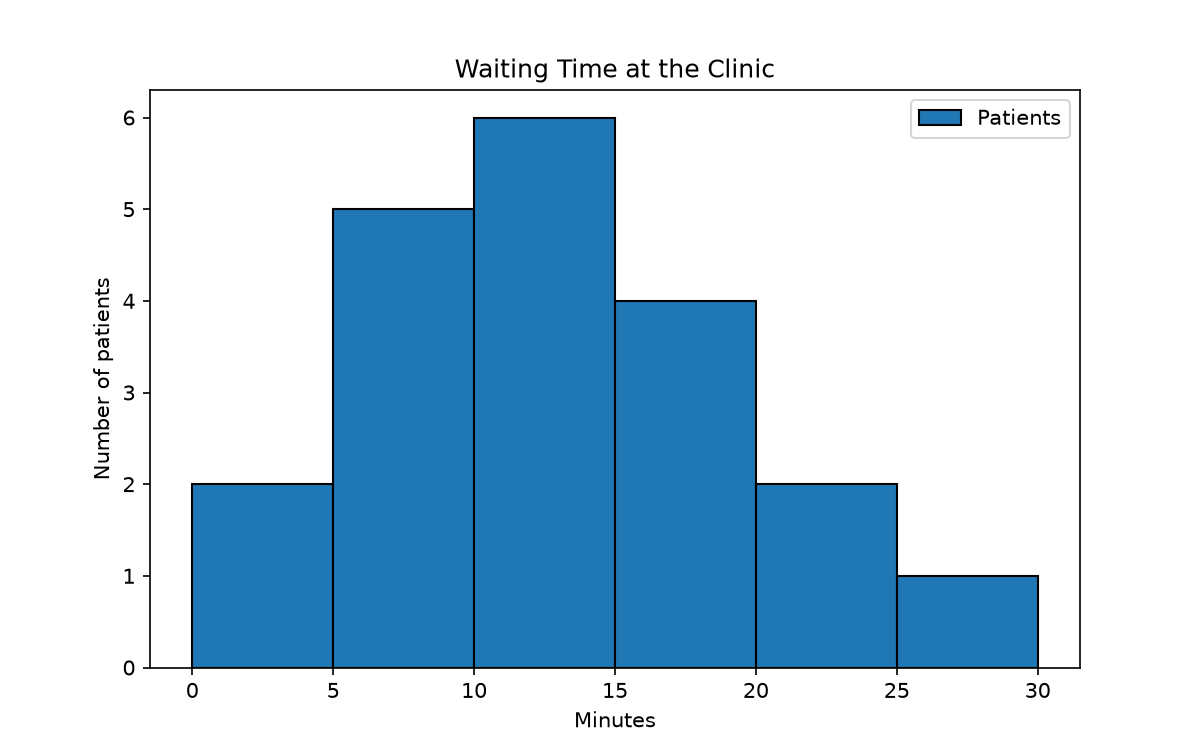
| TripNo | Driver | RouteID | Fare |
|---|---|---|---|
| 1 | Bashir | R1 | 40 |
| 2 | Savita | R2 | 65 |
| 3 | Bashir | R1 | 40 |
| 4 | Murugan | R3 | 90 |
| 5 | Savita | R2 | 70 |
| 6 | Deepa | R1 | 35 |
| RouteID | Place | Km |
|---|---|---|
| R1 | Bus Stand | 4 |
| R2 | Fort Gate | 7 |
| R3 | Airport | 12 |
| FID | Title | LangID | Minutes |
|---|---|---|---|
| F1 | Monsoon Post | L1 | 118 |
| F2 | The Kite Maker | L2 | 96 |
| F3 | Salt Road | L1 | 132 |
| F4 | Ladder | L3 | 88 |
| F5 | Two Harbours | L2 | 105 |
| LangID | LName |
|---|---|
| L1 | Malayalam |
| L2 | Hindi |
| L3 | Assamese |
SELECT LangID, COUNT(*), MIN(Minutes) FROM FILM GROUP BY LangID HAVING COUNT(*) > 1 ORDER BY LangID DESC; SELECT Title, LName FROM FILM, LANG WHERE FILM.LangID = LANG.LangID AND Minutes < 100; SELECT Driver, COUNT(*) FROM TRIP GROUP BY Driver HAVING COUNT(*) > 1; SELECT Driver, Place, Fare FROM TRIP, ROUTE WHERE TRIP.RouteID = ROUTE.RouteID AND Km > 5;
+--------+----------+--------------+
| LangID | COUNT(*) | MIN(Minutes) |
+--------+----------+--------------+
| L2     |        2 |           96 |
| L1     |        2 |          118 |
+--------+----------+--------------+

+----------------+----------+
| Title          | LName    |
+----------------+----------+
| The Kite Maker | Hindi    |
| Ladder         | Assamese |
+----------------+----------+
All three plot types, with their code and pictures, are on Matplotlib charts for Class 12 IP.
Section E, 3 x 5 = 15 marks
Three questions, 15 marks, about 38 minutes. Only Question 37 has a choice.
| From | To | Distance |
|---|---|---|
| Office | Lab | 70 m |
| Office | Store | 45 m |
| Office | Training | 130 m |
| Lab | Store | 55 m |
| Lab | Training | 90 m |
| Store | Training | 110 m |
| Building | Computers |
|---|---|
| Office | 35 |
| Lab | 80 |
| Store | 12 |
| Training | 28 |
 Office ----- 70 m ----+
                       |
 Store ------ 55 m --- Lab (server)
                       |
Training --- 90 m ----+| Sweet | Boxes | Price | |
|---|---|---|---|
| 0 | Peda | 40 | 220 |
| 1 | Ladoo | 65 | 180 |
| 2 | Barfi | 30 | 260 |
import pandas as pd
data = {"Sweet": pd.Series(["Peda", "Ladoo", "Barfi"]),
        "Boxes": pd.Series([40, 65, 30]),
        "Price": pd.Series([220, 180, 260])}
SweetDF = pd.DataFrame(data)
print(SweetDF)

SweetDF["Value"] = SweetDF["Boxes"] * SweetDF["Price"]

print(SweetDF[SweetDF["Price"] > 200])Sweet Boxes Price 0 Peda 40 220 1 Ladoo 65 180 2 Barfi 30 260 Sweet Boxes Price Value 0 Peda 40 220 8800 2 Barfi 30 260 7800
| ICode | IName | Family | Rent |
|---|---|---|---|
| 12 | Tabla | Drum | 300 |
| 13 | Bansuri | Wind | 150 |
| 14 | Mridangam | Drum | 380 |
CREATE TABLE INSTRUMENT (ICode INT PRIMARY KEY, IName VARCHAR(20),
                         Family VARCHAR(15), Rent INT);
INSERT INTO INSTRUMENT VALUES (11, 'Veena', 'String', 450);
UPDATE INSTRUMENT SET Rent = Rent + 30 WHERE Family = 'Wind';
DELETE FROM INSTRUMENT WHERE Rent BETWEEN 300 AND 400;
ALTER TABLE INSTRUMENT ADD Keeper VARCHAR(25);+-------+---------+--------+------+--------+ | ICode | IName | Family | Rent | Keeper | +-------+---------+--------+------+--------+ | 11 | Veena | String | 450 | NULL | | 13 | Bansuri | Wind | 180 | NULL | +-------+---------+--------+------+--------+
SELECT HName, LENGTH(HName) FROM HOMESTAY;
SELECT UPPER(LEFT(State, 3)) FROM HOMESTAY;
SELECT HName, State FROM HOMESTAY WHERE YEAR(Opened) >= 2024;
SELECT MAX(Tariff), MIN(Tariff) FROM HOMESTAY;
SELECT HName, Tariff FROM HOMESTAY ORDER BY Tariff DESC;
Pens down
Mark it unit by unit, not section by section, because a weak unit is hidden when its questions are spread over five sections.
| Unit | Add the marks of questions | Out of | If you scored under two thirds |
|---|---|---|---|
| pandas and charts | 1, 4, 8, 12, 15, 18, 20, 22, 24, 28, 30, 33, 36 | 25 | Type five outputs a day and predict each before running it |
| SQL | 2, 6, 9, 11, 14, 17, 19, 21, 26, 31, 32, 34, 37 | 25 | One small table, one query for each listed function |
| Networks | 5, 10, 16, 25, 35 | 10 | Two cases with the layout drawn, and the device list |
| Society | 3, 7, 13, 23, 27, 29 | 10 | Differences in pairs, one line each |
| Step | Minutes |
|---|---|
| Reading the paper, choosing sides of each OR | 10 |
| Sections A and B | 60 |
| Sections C and D | 50 |
| Section E | 38 |
| Reading back: quotes, brackets, semicolons, labels | 22 |
This is how we teach the time, not a CBSE rule. Some students do Section E second, while the DataFrame is easy to think about.
Then move to IP important questions for the unit that lost most.
In class your handwritten pandas answer is typed letter for letter and run. A missing bracket around a condition is remembered after one ValueError.
Your SQL is tried on a small table, so you see the 18 rows that a forgotten joining condition brings back.
Theory answers of ten lines are cut to the two sentences that carry the marks, and you rewrite them from memory next time.
One to one, at your own timing
Paper practice is done with one student at a time, on the days and at the hour you choose. A priority demo is a simple way to begin: a full class on a paper you have written, with its fee adjusted against the first month if you enrol. A free demo class is offered as well.
Before you enrol · Try a class
a full live class of about 45 to 60 minutes
The classes · Choose your own timing
₹4,999
per month, 4 private classes, fully flexible timingtwo private classes a week, at a time set with you
If your school pre-board is near, we mark that paper too once it comes back, since a real script says more than a mock. The fee is charged monthly, there is no admission fee, and you can stop at any month end.
Studying outside India?
The 065 theory paper is the same for CBSE schools in India and abroad. Write it on your weekend and bring it to a class in your own evening.
| Where you live | Time difference | Usual class window, local time | Format |
|---|---|---|---|
| India every Indian city | Indian time | Any time you choose | Personalised 1-on-1 |
| UAE and Oman Dubai, Abu Dhabi, Sharjah, Muscat | 1 h 30 min behind India | 3:00 PM to 9:00 PM | Personalised 1-on-1 |
| Saudi Arabia, Qatar, Kuwait, Bahrain Riyadh, Jeddah, Dammam, Doha, Kuwait City, Manama | 2 h 30 min behind India | 3:00 PM to 9:00 PM | Personalised 1-on-1 |
| Nepal Kathmandu | 15 min ahead of India | 4:30 PM to 9:00 PM | Personalised 1-on-1 |
| Ethiopia and East Africa Addis Ababa and East Africa Time | 2 h 30 min behind India | 4:30 PM to 9:00 PM | Personalised 1-on-1 |
| Singapore and Malaysia Singapore, Kuala Lumpur | 2 h 30 min ahead of India | 3:30 PM to 9:00 PM | Personalised 1-on-1 |
Send clear photographs of the pages before the class so that the time goes into marking. If your school uses another edition of the textbook, nothing changes, because the paper follows the syllabus.
What families say
Real reviews from real families. We neither write nor commission them.
★★★★★
"The one step solution for my son. Modern Age Coders make learning coding so simple that kids love it. The teachers explain complex concepts clearly with practical exercises and interactive content."
Ria Mukherjee
Parent
★★★★★
"Modern Age Coders has been a game-changer for me. I struggled to grasp IT concepts and coding before joining, but their classes transformed everything. I can now confidently write complex programs with ease."
Samriddha Mondal
Student
★★★★★
"One of the most wonderful education centres out there. Education is not limited to school syllabus but focuses on skill development."
Vansh Agarwal
Student
★★★★★
"My child Dhairya is really enjoying the Modern Age Coders classes. This is his first online class and he eagerly looks forward to it. I can already see his improvement, and the teachers are very cooperative."
Sonam Oswal
Parent of Dhairya
★★★★★
"Modern Age Coders have wonderful teachers who teach in a clear, easy and practical way. The teacher boosts students' confidence and inspires them to learn without hesitation."
Sonu Goyal
Parent
★★★★★
"I highly recommend this computer coding class! The teachers are incredibly knowledgeable and passionate about coding."
Ritu Kedia
Parent
The rest of the Class 12 series
Every page in the CBSE Class 12 Informatics Practices series, grouped by what you need.
CBSE Class 12 Computer Science (083): Class 12 CS viva questions Class 12 CS sample paper practice Class 12 CS project with source code Class 12 CS important questions
CBSE Class 12 Information Technology (802): IT 802 practical and project file IT 802 Java notes and programs IT 802 notes
CBSE Class 11 CS, IP and AI: Class 11 CS practical file Class 11 IP practical file CS or IP in Class 11
ISC Computer Science (868): ISC Class 12 CS syllabus 2027 ISC Class 12 CS practice paper ISC Class 12 practical questions solved ISC Boolean algebra and K-maps
Program lists with output: Class 12 practical file programs Python programs for Class 11 CS and IP
Questions about the IP sample paper
Yes. The sample question paper and marking scheme for Informatics Practices (065), Class XII 2026-27, are on cbseacademic.nic.in. The paper is for 70 marks and three hours, and it notes that there is no change in the question paper design and assessment pattern for this session.
Thirty-seven, all compulsory. Section A has 21 questions of 1 mark, Section B seven of 2, Section C four of 3, Section D two of 4 and Section E three of 5. Seven of them offer an internal choice in the 2026-27 sample paper.
This page has an original 70-mark paper with a worked answer under each question. The official paper and its marking scheme are separate files on the CBSE academic site. Solve the official one first, then this one, so that you meet two papers of the same design.
Questions 22, 25, 28, 30, 32, 34 and 37 in the 2026-27 paper. There is no choice in Section A, in the society case, the single-table queries of Section C, the Matplotlib program, the network case or the DataFrame question of Section E, so prepare those fully.
It is different. Both have 37 questions and 70 marks, but IP gives 25 marks each to pandas with charts and to SQL, and 10 to societal impacts. Computer Science gives 40 marks to Python programming with files and stack. Choose by the work you like, not by a rumour about difficulty.
No. The 2026-27 syllabus names line plot, bar graph and histogram only, and SQL up to functions, GROUP BY, HAVING, ORDER BY and an equi-join of two tables. The sample paper stays inside that, with a line graph program and no subquery.
In the chart question the import alone is one mark, so never skip it there. In the DataFrame answers the scheme prints the import line but gives the marks for correct creation as a whole. Writing it every time costs five seconds.
Only when the question asks for output. When it does, copy the shape pandas uses: labels on the left, values on the right, NaN where a value is missing, and the dtype line under a Series. For SQL, write the heading row as well as the values.
Informatics Practices (065) is on Wednesday 31 March 2027, 10:30 AM to 1:30 PM, according to the CBSE date sheet of 6 November 2026. Computer Science (083) and Information Technology (802) are in the same slot.
Yes. Modern Age Coders marks your own script live in a personalised one to one class, runs your pandas and SQL answers, and shows which unit to repair. You can begin with a priority demo, which ends with a written skill report, or with a free demo class.
Start
Write the paper above in one sitting. Then book a priority demo at a time that suits you: in a full live class of about 45 to 60 minutes the teacher marks a section with you, runs one of your programs and sends a written skill report. If you enrol, the demo fee is adjusted against the first month.
Only want to look first? Choose the free demo class. To rehearse the other 30 marks, use the IP viva questions.
WhatsApp us · +91 91233 66161 · connect@modernagecoders.com
Every class is live video. The form requests a callback and reserves nothing.
A full live class of about 45 to 60 minutes at a slot you pick, with a written skill report and learning roadmap on WhatsApp afterwards. The fee is adjusted against your first month if you enrol.
Book a priority demo