★★★★★
"The one step solution for my son. Modern Age Coders make learning coding so simple that kids love it. The teachers explain complex concepts clearly with practical exercises and interactive content."
Ria Mukherjee
Parent
CBSE Class 12 · Informatics Practices 065 · The last months before 2027
Informatics Practices is four subjects in one paper, and few students are weak in all four. So this class 12 IP crash course begins with a short check for each unit and gives the live sessions to the units that need them. You will find the check here, the dated plan for 16, 10, 6 or 3 sessions, one table worked in pandas and SQL side by side, and a one-page revision sheet.
One teacher, one student · a demo before you enrol · dates up to 31 March 2027 · your hour, your weekday
Start here
The plan below borrows lessons from the IP course. The other two suit a student whose check shows a gap that began before Class 12.

065 / Two years
The whole subject at its own speed, Class 11 Python and SQL included. Choose this over a crash plan if you are still in Class 11.
Open the course →
Weak on data
Six months of tables and charts on real data. Better for a student with time who wants pandas to become easy, and more.
Open the course →
Weak on queries
Starts at the first SELECT and stays long on grouping and joins, the two ideas that decide the SQL unit for many students.
Open the course →Ans. The short version
A class 12 IP crash course should first find the weak unit, then cover CBSE Informatics Practices (065) by marks: pandas with charts 25, SQL 25, networks 10 and societal impacts 10. A full plan is 16 live sessions from the week of 7 December 2026, with the practical rehearsed on the way; 10, 6 or 3 sessions suit later starts. The theory paper is on Wednesday 31 March 2027. Modern Age Coders teaches it online, personalised one to one at your own timing, and a priority demo, with a written skill report, shows which version you need.
1. Where are you losing marks?
Twenty-four marks in about 35 minutes: eight each for pandas and SQL, four each for networks and society. Write first, open the answers afterwards, and keep four separate scores.
print((s * s)[1]) display? df.tail(3).import pandas as pd a = pd.Series([2, 3], index=["x", "y"]) b = pd.Series([10, 20], index=["y", "z"]) print(a * b)
x     NaN
y    30.0
z     NaN
dtype: float64
df = df.drop(3) and df = df.rename(columns={"Bus": "Route"}). Without the assignment, or inplace=True, nothing changes.plt.plot(x, y, label="Unit tests") and plt.legend().LEFT(RIGHT('Palakkad', 4), 2)? Phone IS NULL. Phone = NULL finds nothing.DAYNAME('2027-03-31') and DAY('2027-03-31') return? | CampNo | LID | Place | Days |
|---|---|---|---|
| 1 | L1 | Coorg | 4 |
| 2 | L2 | Ooty | 3 |
| 3 | L1 | Coorg | 5 |
| 4 | L3 | Munnar | 6 |
| LID | LName |
|---|---|
| L1 | Sita |
| L2 | Imran |
| L3 | Paul |
SELECT Place, SUM(Days) FROM CAMP
GROUP BY Place HAVING SUM(Days) > 5;

SELECT LName, Place FROM CAMP, LEADER
WHERE CAMP.LID = LEADER.LID;
+--------+-----------+
| Place  | SUM(Days) |
+--------+-----------+
| Coorg  |         9 |
| Munnar |         6 |
+--------+-----------+

+-------+--------+
| LName | Place  |
+-------+--------+
| Sita  | Coorg  |
| Imran | Ooty   |
| Sita  | Coorg  |
| Paul  | Munnar |
+-------+--------+
| Unit | Low score | What it usually means | First thing done in class |
|---|---|---|---|
| 1. pandas, charts | 0 to 4 of 8 | Labels are being read as positions | Outputs traced by hand, then run |
| 2. SQL | 0 to 4 of 8 | Grouping is used without knowing what a group is | One table grouped with a pencil |
| 3. Networks | 0, 1 of 4 | Terms known by sound only | Pairs of devices told apart |
| 4. Society | 0, 1 of 4 | Never revised, as it looks easy | Ten short cases answered aloud |
A student with 8, 2, 3, 4 does not need a crash course in IP. That student needs four sessions of SQL, and we will say so. These bands are a teaching guide and make no forecast of marks.
2. What happens, and when?
In IP the practical and most of the paper are the same work, pandas and SQL on a computer. So the first six sessions serve both, and the rest turn to the written paper. Dates are Mondays of the week; the day and the hour are yours to choose.
| No. | Week of | In class | Serves |
|---|---|---|---|
| 1 | 7 Dec | The check taken apart. Series: making, arithmetic, NaN | Lab and paper |
| 2 | 14 Dec | DataFrame from Series, from dictionaries, from a file; head, tail, shape | Lab and paper |
| 3 | 21 Dec | Add, select, delete, rename; labels; Boolean indexing | Lab and paper |
| 4 | 28 Dec | CSV in and out; one line plot, one bar graph, one histogram | Lab and paper |
| 5 | 4 Jan | SQL from Class 11: create, insert, alter, update, delete, conditions | Lab and paper |
| 6 | 11 Jan | Practical rehearsal: a program, a set of queries, viva on your own file and project | Lab |
| 7 | 18 Jan | Math and text functions, with outputs on paper | Paper |
| 8 | 25 Jan | Date functions, aggregate functions, NULL | Paper |
| 9 | 1 Feb | GROUP BY, HAVING, ORDER BY | Paper |
| 10 | 8 Feb | Two tables: the join condition, rows counted before running | Paper |
| 11 | 15 Feb | pandas outputs and error questions against the clock | Paper |
| 12 | 22 Feb | The chart program and the five-mark DataFrame question | Paper |
| 13 | 1 Mar | Networks: devices, topologies, web terms, one case | Paper |
| 14 | 8 Mar | Society: cases and two-mark answers cut to length | Paper |
| 15 | 15 Mar | A paper you wrote at home, marked with you | Paper |
| 16 | 22 Mar | What that paper lost; the sheet below, from memory | Paper |
| Start by | Sessions | Which ones |
|---|---|---|
| Week of 18 January | 10 | 1 with 2, 3, 4, 7, 8, 9, 10, 13 with 14, 15, 16 |
| Week of 15 February | 6 | 3 with 4, 8 with 9, 10, 13 with 14, 15, 16 |
| Week of 8 March | 3 | One written paper a week, each marked and repaired |
These dates spread the classes evenly through the weeks; in India the four classes in the monthly fee are fully flexible. With two a week, as in our plan outside India, the sixteen fit the eight weeks from 1 February.
CBSE has scheduled practicals for 2026-27 from 1 January 2027, and winter-bound schools have an earlier window, 9 November to 19 December 2026. Each school sets its own day. Tell us yours in the first class: sessions 5 and 6 move in front of it, whatever their number.
The practical is 30 marks: pandas and Matplotlib programs 8, SQL queries 7, file 5, project 5 and viva 5. If the file is thin, open the IP practical file. For the spoken part there are IP viva questions.
The paper is on Wednesday 31 March 2027, 10:30 AM to 1:30 PM. Class XII exams begin on 16 February, so look at your other dates before fixing sessions 11 to 16.
3. Can it be done in one sitting?
You can see the shape of the two large units in one sitting if you stop treating pandas and SQL as two subjects. Take six bicycle repairs, one of them with no cost entered, and ask every question twice: once in pandas, once in MySQL.
import pandas as pd
df = pd.read_csv("repairs.csv")
print(df)JobNo Part Place Cost Minutes 0 1 Chain Ring Road 180.0 25 1 2 Brake Old Bazaar 120.0 20 2 3 Tube Ring Road 90.0 15 3 4 Chain Lake Gate 210.0 30 4 5 Tube Old Bazaar NaN 15 5 6 Brake Ring Road 150.0 20
print(df[df["Cost"] > 130])
   JobNo   Part      Place   Cost  Minutes
0      1  Chain  Ring Road  180.0       25
3      4  Chain  Lake Gate  210.0       30
5      6  Brake  Ring Road  150.0       20
quick = df["Minutes"] < 25
road = df["Place"] == "Ring Road"
print(df.loc[quick & road, ["JobNo", "Part"]])
   JobNo   Part
2      3   Tube
5      6  Brake
df["Rate"] = df["Cost"] / df["Minutes"]
print(df[["Part", "Rate"]])
    Part  Rate
0  Chain   7.2
1  Brake   6.0
2   Tube   6.0
3  Chain   7.0
4   Tube   NaN
5  Brake   7.5
df.loc[4, "Cost"] = 95
df = df.drop(1)
df.loc[6] = [7, "Tube", "Lake Gate", 100, 15]
print(df)
   JobNo   Part       Place   Cost  Minutes
0      1  Chain   Ring Road  180.0       25
2      3   Tube   Ring Road   90.0       15
3      4  Chain   Lake Gate  210.0       30
4      5   Tube  Old Bazaar   95.0       15
5      6  Brake   Ring Road  150.0       20
6      7   Tube   Lake Gate  100.0       15
SELECT * FROM REPAIR;
+-------+-------+------------+------+---------+
| JobNo | Part  | Place      | Cost | Minutes |
+-------+-------+------------+------+---------+
|     1 | Chain | Ring Road  |  180 |      25 |
|     2 | Brake | Old Bazaar |  120 |      20 |
|     3 | Tube  | Ring Road  |   90 |      15 |
|     4 | Chain | Lake Gate  |  210 |      30 |
|     5 | Tube  | Old Bazaar | NULL |      15 |
|     6 | Brake | Ring Road  |  150 |      20 |
+-------+-------+------------+------+---------+
SELECT * FROM REPAIR WHERE Cost > 130;
+-------+-------+-----------+------+---------+
| JobNo | Part  | Place     | Cost | Minutes |
+-------+-------+-----------+------+---------+
|     1 | Chain | Ring Road |  180 |      25 |
|     4 | Chain | Lake Gate |  210 |      30 |
|     6 | Brake | Ring Road |  150 |      20 |
+-------+-------+-----------+------+---------+
SELECT JobNo, Part FROM REPAIR
WHERE Minutes < 25 AND Place = 'Ring Road';
+-------+-------+
| JobNo | Part  |
+-------+-------+
|     3 | Tube  |
|     6 | Brake |
+-------+-------+
SELECT Part, Cost / Minutes FROM REPAIR;
+-------+----------------+
| Part  | Cost / Minutes |
+-------+----------------+
| Chain |         7.2000 |
| Brake |         6.0000 |
| Tube  |         6.0000 |
| Chain |         7.0000 |
| Tube  |           NULL |
| Brake |         7.5000 |
+-------+----------------+
UPDATE REPAIR SET Cost = 95 WHERE JobNo = 5;
DELETE FROM REPAIR WHERE JobNo = 2;
INSERT INTO REPAIR VALUES (7, 'Tube', 'Lake Gate', 100, 15);
+-------+-------+------------+------+---------+
| JobNo | Part  | Place      | Cost | Minutes |
+-------+-------+------------+------+---------+
|     1 | Chain | Ring Road  |  180 |      25 |
|     3 | Tube  | Ring Road  |   90 |      15 |
|     4 | Chain | Lake Gate  |  210 |      30 |
|     5 | Tube  | Old Bazaar |   95 |      15 |
|     6 | Brake | Ring Road  |  150 |      20 |
|     7 | Tube  | Lake Gate  |  100 |      15 |
+-------+-------+------------+------+---------+
SELECT Part, SUM(Minutes) FROM REPAIR GROUP BY Part;
+-------+--------------+
| Part  | SUM(Minutes) |
+-------+--------------+
| Chain |           55 |
| Brake |           40 |
| Tube  |           30 |
+-------+--------------+
import matplotlib.pyplot as plt
parts = ["Chain", "Brake", "Tube"]
minutes = [55, 40, 30]
plt.bar(parts, minutes, width=0.5, label="Minutes")
plt.title("Time Spent on Each Part")
plt.xlabel("Part")
plt.ylabel("Minutes")
plt.legend()
plt.show()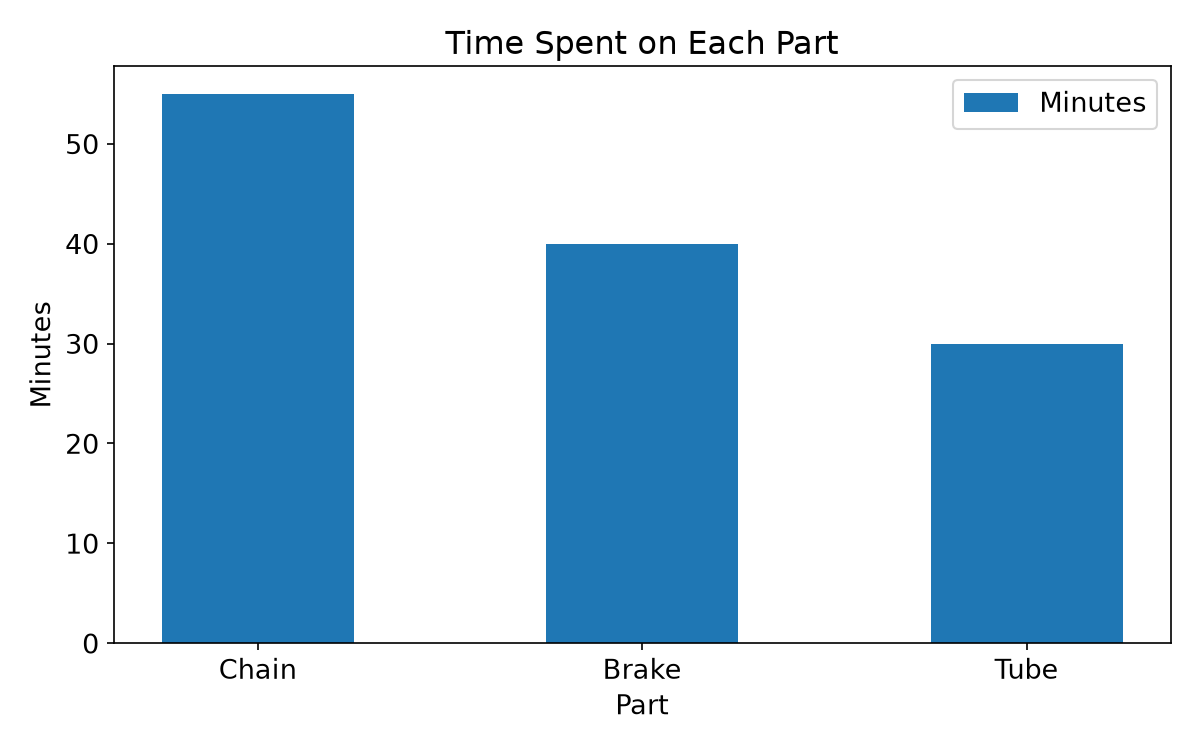
One sitting shows you the map. The marks come from doing each of the seven steps on new data until the right word arrives first. Chapter by chapter: DataFrame and SQL questions.
4. Revision
Cover the right-hand column and say it. Any line you cannot say is tomorrow's work. The values were run, so you can trust them while you check yourself.
| To do this | Write this |
|---|---|
| Series from one value | pd.Series(0, index=["a", "b"]) |
| Values above 10 | s[s > 10] |
| Rows 1 to 3 by label | df.loc[1:3] |
| Two columns | df[["A", "B"]] |
| New column | df["C"] = df["A"] + df["B"] |
| New row | df.loc["z"] = [4, 5] |
| Remove a column | df.drop("A", axis=1) |
| Rename | df.rename(columns={"A": "X"}) |
| Every row in a loop | for i, r in df.iterrows(): |
| Read, with a separator | pd.read_csv("f.csv", sep=";") |
| Save, without labels | df.to_csv("f.csv", index=False) |
| The three plots | plt.plot() plt.bar() plt.hist() |
| Expression | Value |
|---|---|
POWER(3, 4) | 81 |
ROUND(58.27, 1) | 58.3 |
ROUND(58.27, -1) | 60 |
MOD(58, 9) | 4 |
MID('Kalimpong', 5, 4) | mpon |
LEFT('Kalimpong', 4) | Kali |
RIGHT('Kalimpong', 4) | pong |
INSTR('Kalimpong', 'pong') | 6 |
LENGTH('Kalimpong') | 9 |
MONTHNAME('2027-03-31') | March |
YEAR('2027-03-31') | 2027 |
DATE('2027-03-31 10:30:00') | 2027-03-31 |
Clause order: SELECT, FROM, WHERE, GROUP BY, HAVING, ORDER BY.
Objective practice for any spare half hour: the 40-question IP MCQ test. To write answers at full length: IP important questions. For the syllabus lines themselves: IP syllabus and paper pattern.
5. Before you pay anyone
Ask to see a class before you pay for a month. Any honest tutor will agree, and half an hour of watching your child type answers most of the questions below.
| Ask | A good sign |
|---|---|
| Who types during the class? | The student, for most of it |
| Which pandas and MySQL do you use? | A clear answer, and the student can install them |
| What if only SQL is weak? | The plan shrinks to SQL |
| Do you follow the 2026-27 syllabus? | Pie charts and subqueries are left out |
| Will you finish the project for us? | No. The student writes it, with guidance |
| How do we stop? | A date, without an argument |
Your check from this page, or five minutes of the same kind of questions.
Taught from the beginning, on your screen, with you at the keyboard.
The same idea on a table you have not seen, without help.
A written skill report for the family, with the number of sessions we would suggest.
The demo fee is adjusted against the first month if you enrol. A free demo class is the other way to begin.
If you want lessons for the rest of the year and not a last stretch, read about Class 12 tuition.
One to one, at your own timing
Every class is personalised one to one, on the days and at the time that suit your house. Begin with a priority demo, a whole live class at the slot you pick, and have its fee set against the first month if you join. The free demo class costs nothing. You pay monthly, no admission fee is charged, and you may end with any month.
Before you enrol · Try a class
a full live class of about 45 to 60 minutes
The classes · Choose your own timing
₹4,999
per month, 4 private classes, fully flexible timingtwo private classes a week, at a time set with you
What decides a crash course is the work between classes: an hour of outputs and queries for each session. A student who cannot give that hour should choose fewer topics and finish them. The fee appears in the currency of the country you are in.
Studying outside India?
Schools in Abu Dhabi, Riyadh, Muscat or Singapore sit the same 065 paper. With two private classes a week, as is usual abroad, the sixteen sessions take two months.
| Where you live | Time difference | Usual class window, local time | Format |
|---|---|---|---|
| India every Indian city | Indian time | Any time you choose | Personalised 1-on-1 |
| UAE and Oman Dubai, Abu Dhabi, Sharjah, Muscat | 1 h 30 min behind India | 3:00 PM to 9:00 PM | Personalised 1-on-1 |
| Saudi Arabia, Qatar, Kuwait, Bahrain Riyadh, Jeddah, Dammam, Doha, Kuwait City, Manama | 2 h 30 min behind India | 3:00 PM to 9:00 PM | Personalised 1-on-1 |
| Nepal Kathmandu | 15 min ahead of India | 4:30 PM to 9:00 PM | Personalised 1-on-1 |
| Ethiopia and East Africa Addis Ababa and East Africa Time | 2 h 30 min behind India | 4:30 PM to 9:00 PM | Personalised 1-on-1 |
| Singapore and Malaysia Singapore, Kuala Lumpur | 2 h 30 min ahead of India | 3:30 PM to 9:00 PM | Personalised 1-on-1 |
Say in the form which city you are in and when your school holds its practical. We answer with free hours on your own clock.
What families say
Real reviews from real families. We neither write nor commission them.
★★★★★
"The one step solution for my son. Modern Age Coders make learning coding so simple that kids love it. The teachers explain complex concepts clearly with practical exercises and interactive content."
Ria Mukherjee
Parent
★★★★★
"Modern Age Coders has been a game-changer for me. I struggled to grasp IT concepts and coding before joining, but their classes transformed everything. I can now confidently write complex programs with ease."
Samriddha Mondal
Student
★★★★★
"One of the most wonderful education centres out there. Education is not limited to school syllabus but focuses on skill development."
Vansh Agarwal
Student
★★★★★
"My child Dhairya is really enjoying the Modern Age Coders classes. This is his first online class and he eagerly looks forward to it. I can already see his improvement, and the teachers are very cooperative."
Sonam Oswal
Parent of Dhairya
★★★★★
"Modern Age Coders have wonderful teachers who teach in a clear, easy and practical way. The teacher boosts students' confidence and inspires them to learn without hesitation."
Sonu Goyal
Parent
★★★★★
"I highly recommend this computer coding class! The teachers are incredibly knowledgeable and passionate about coding."
Ritu Kedia
Parent
The rest of the Class 12 series
Every page in the CBSE Class 12 Informatics Practices series, grouped by what you need.
CBSE Class 12 Computer Science (083): Class 12 CS viva questions Class 12 CS sample paper practice Class 12 CS project with source code Class 12 CS important questions
CBSE Class 12 Information Technology (802): IT 802 practical and project file IT 802 Java notes and programs IT 802 notes
CBSE Class 11 CS, IP and AI: Class 11 CS practical file Class 11 IP practical file CS or IP in Class 11
ISC Computer Science (868): ISC Class 12 CS syllabus 2027 ISC Class 12 CS practice paper ISC Class 12 practical questions solved ISC Boolean algebra and K-maps
Program lists with output: Class 12 practical file programs Python programs for Class 11 CS and IP
Questions about the IP crash course
Yes. Modern Age Coders runs a one to one crash course for CBSE 065 that counts back from the paper on 31 March 2027. It has 16 live sessions in full, or 10, 6 or 3 for later starts, and it can be cut to a single unit. A demo class comes first.
A month is enough to revise IP if you have already met pandas and SQL at school. Give about ten days to pandas and charts, ten to SQL, four to networks and society, and the rest to written papers. Learning both languages from nothing in a month is hard, so start earlier if you can.
The one of the two 25-mark units in which you scored less. pandas with charts and SQL make 50 of the 70 marks. Keep networks and societal impacts, 10 marks each, for the last three weeks, since they are short and easy to forget.
It can be, because outputs and queries are either right or wrong and you can check them yourself on a computer. Marks are lost on labels, NULL, HAVING and unfinished case answers more than on hard ideas. Regular typing helps more than reading notes.
Yes. Ours are live and one to one only. The student shares the screen, types pandas and SQL, and is corrected while doing it, at a day and an hour the family picks.
It is enough to remind you of what is in the syllabus. It cannot tell you that your own query groups the wrong column. Watch one if it helps, then do the seven steps on this page with different data, and find out what you can write without the video.
Yes, if you begin before your school date. The first six sessions of the full plan cover pandas and Matplotlib programs, SQL queries, your file, your project and the viva. The student writes the programs and the project; the teacher explains and corrects.
Yes, a computer with Python, pandas, Matplotlib and MySQL makes the class useful. If they are not installed, say so when you book. Networks and societal impacts can be studied without them.
One topic an evening: pandas outputs, chart programs, SQL functions with grouping, joins with a DataFrame question, then networks and society aloud. On the evening before the paper read one sheet only. The paper is on Wednesday 31 March 2027 at 10:30 AM.
The monthly one to one fee is shown on this page in your own currency. There is no admission fee and no separate price for the crash plan, and you can stop at the end of any month. The priority demo has its own fee, adjusted against the first month if you enrol.
No, and please be careful with anyone who does. The class can show you which marks you are losing, teach those topics and check your written work. The practical is marked by your school and its examiner, and the paper by the board.
Start
Write down your four check scores and the day of your school practical, and book a priority demo at a slot you like. The teacher begins with the lowest score, teaches for a full class, and sends a written skill report with the version of the plan to follow. If you enrol, the demo fee comes off month one.
Prefer a shorter look? Ask for the free demo class. A complete paper to try afterwards is here: IP sample paper with solutions.
WhatsApp us · +91 91233 66161 · connect@modernagecoders.com
Every class is live video. The form requests a callback and reserves nothing.
A full live class of about 45 to 60 minutes at a slot you pick, with a written skill report and learning roadmap on WhatsApp afterwards. The fee is adjusted against your first month if you enrol.
Book a priority demo