★★★★★
"The one step solution for my son. Modern Age Coders make learning coding so simple that kids love it. The teachers explain complex concepts clearly with practical exercises and interactive content."
Ria Mukherjee
Parent
CBSE Class 12 · Informatics Practices, code 065 · Viva voce 2026-27
In an Informatics Practices viva the proof is already on the screen: a column full of decimals, one NaN, a line that stops halfway across a chart. Somebody points at it and asks why. These 72 class 12 IP viva questions with answers begin there, then move through pandas, Matplotlib, MySQL, networks, societal impacts and your project. Answer in your own words first. The folded reply is there to compare with, not to learn by heart.
Live online, one to one · 72 original questions · pandas, charts and MySQL all run · your own days and timing
Start here
You can only explain what you have built a few times. The first course is the board subject itself; the other two are for a student who wants more hours with data or with SQL.

065 / Both years
The IP course for both years: pandas, Matplotlib, MySQL, networks and societal impacts, with practical file, project and viva preparation.
Open the course →
pandas / Beyond the board
Loading, cleaning and charting real datasets with pandas and Matplotlib, then statistics and first models. Useful if your IP project needs better data.
Open the course →
SQL / More practice
Functions, grouping and joins in the early months, database design later. For a student who can read a query but hesitates to write one.
Open the course →Ans. The short version
Class 12 IP viva questions with answers cover six areas: pandas, Matplotlib, MySQL, computer networks, societal impacts, and your own practical file and project. The viva is 5 of the 30 practical marks in CBSE Informatics Practices (065) for 2026-27, beside pandas and Matplotlib programs (8), SQL queries (7), the file (5) and the project (5). Good answers read the output first, then name the rule behind it. Modern Age Coders rehearses this live, personalised one to one, at your own timing; a priority demo lets you try a full class first.
Q. What is at stake?
The viva voce is 5 marks out of 30 in the CBSE Informatics Practices practical for 2026-27, exactly as much as the project and exactly as much as the practical file.
| Head in the 065 syllabus | Share | Marks |
|---|---|---|
| Programs using pandas and Matplotlib | 8 | |
| SQL queries | 7 | |
| Practical file: 15 pandas, 4 Matplotlib, 15 SQL | 5 | |
| Project work | 5 | |
| Viva voce | 5 | |
| Practical total | 30 |
CBSE does not publish a list of IP viva questions, and it does not say how the 5 marks are split. What it does fix is the syllabus, so every question below stays inside it.
Three short sentences, then silence. Students lose marks in a viva by going on talking after a right answer.
When it happens. CBSE's circular of 5 November 2026 schedules practical, project and internal assessment from 1 January 2027 for all affiliated schools, with 9 November to 19 December 2026 for winter-bound schools. Your own date comes from your school.
Q. Can you read your own output?
This twelve-question set uses a single short program, because that is how a practical viva usually feels: one page of your file, and somebody pointing at it.
Day,Made,Used
Mon,31,26
Tue,28,30
Wed,35,27
Thu,33,
Fri,22,24
Units of electricity made by a school roof, and units the school used. Thursday's meter was not read.
import pandas as pd
import matplotlib.pyplot as plt

solar = pd.read_csv("solar.csv")
solar["Extra"] = solar["Made"] - solar["Used"]
print(solar)

surplus = solar[solar["Extra"] > 0]
print(surplus)

plt.figure(figsize=(8, 5))
plt.bar(solar["Day"], solar["Made"], label="Units made")
plt.plot(solar["Day"], solar["Used"], marker="o",
         color="black", label="Units used")
plt.title("Rooftop solar, one school week")
plt.xlabel("Day")
plt.ylabel("Units (kWh)")
plt.ylim(0, 45)
plt.legend()
plt.savefig("solar.png", dpi=150)
plt.show()Day Made Used Extra 0 Mon 31 26.0 5.0 1 Tue 28 30.0 -2.0 2 Wed 35 27.0 8.0 3 Thu 33 NaN NaN 4 Fri 22 24.0 -2.0 Day Made Used Extra 0 Mon 31 26.0 5.0 2 Wed 35 27.0 8.0
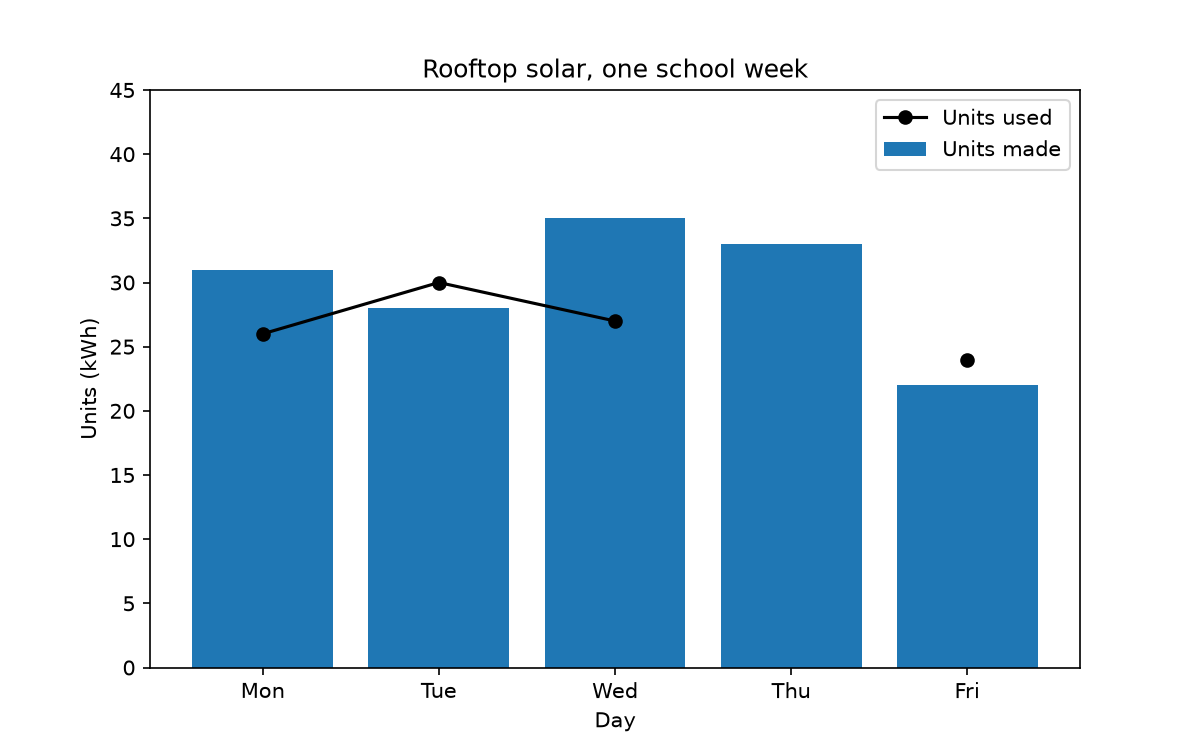
The saved chart, exactly as this program drew it.
read_csv() did. An empty field in a numeric column is read as NaN, not as 0.solar["Used"].count() gives 4, because count() skips NaN. len(solar) gives 5.marker="o". What vanishes? label given to each plotting call. Call legend() with no labels and Matplotlib warns that it found nothing to list.ylim(0, 45) do here? savefig() stores a blank picture. Saving first is safe everywhere.Programs of this kind, in the number the board asks for, are on the Class 12 IP practical file.
Q. Do you know the two structures?
A Series is a one-dimensional labelled array; a DataFrame is a two-dimensional table with labelled rows and columns. Nearly every pandas question in a viva is about the labels.
[40, 55], list times 2 repeats it: [40, 55, 40, 55]. A Series of the same two gives 80 and 110.pd.Series(5, index=[10, 20]).s["a":"b"] and s[0:1]. Same result? s.add(t, fill_value=0) treats the missing side as 0.head() and tail(2) return? s[1] = 9 changes the value at label 1. A Series is value-mutable.s[s > 20] do in two steps? More of these, with slicing outputs: pandas Series for Class 12.
df["Made"], and of df[["Made"]]? loc[1:3] and iloc[1:3]: how many rows each? loc uses labels and includes 3. iloc uses positions and stops before 3.df.drop("Made") gives a KeyError. Why? axis=1 or columns=["Made"].drop() returned a new DataFrame and I did not keep it. Assign the result, or pass inplace=True. rename() behaves the same way.df.loc[5] = ["Sat", 18, 9]. If the list is shorter than the columns, ValueError: mismatched columns.df[(df["Made"] > 25) & (df["Used"] > 25)]. Each side in brackets, and &, not and, which raises ValueError.iterrows() gives the row label and the row as a Series. items() gives the column name and the column.to_csv and read_csv you have a column called Unnamed: 0. From where? index=False.shape, size and ndim say about the solar data as read? Operations on rows and columns are drilled on DataFrame for Class 12 IP.
If your lab has a newer pandas. Version 3 prints the type of a text column as str; older versions print object. Say which one your screen shows and you are right in both.
Q. Can you defend a query?
Keep two small tables in mind and prove each answer on them. These are the stalls of a school fest and the houses that ran them; every value below was returned by MySQL.
+-----+--------------+------+---------+------------+
| sid | sname        | hid  | takings | opened     |
+-----+--------------+------+---------+------------+
|   1 | Chaat Corner | H1   | 4250.75 | 2026-11-13 |
|   2 | Book Swap    | H2   | 1180.50 | 2026-11-14 |
|   3 | Ring Toss    | H1   |    NULL | 2026-11-14 |
|   4 | Plant Nook   | H2   | 2620.25 | 2026-11-13 |
|   5 | Face Paint   | H1   | 1975.00 | 2026-11-15 |
+-----+--------------+------+---------+------------+
+-----+--------+---------+
| hid | hname  | captain |
+-----+--------+---------+
| H1  | Ganga  | Nandita |
| H2  | Kaveri | Zubin   |
| H3  | Teesta | Harleen |
+-----+--------+---------+
sid and hid are the primary keys. Ring Toss has not handed in its cash yet.
ROUND(4250.75, -2) return? ROUND(4250.75, 1) is 4250.8, and with no second argument 4251.MID("Chaat Corner", 7, 3)? Where does counting begin? INSTR when the text is not there? DAYNAME(opened). DAY(opened) gives the number 14 and MONTHNAME(opened) gives November.NOW() gives the current date and time. DATE() takes a date-time value and keeps its date part.COUNT(*) is 5 and COUNT(takings) is 4. Who is missing? takings = NULL finds nothing and takings IS NULL finds Ring Toss.SELECT * FROM STALL, HOUSE? WHERE STALL.hid = HOUSE.hid keeps the 5 that match. That is an equi-join.Write the full queries on Class 12 IP SQL questions.
Q. What about Units 3 and 4?
These answers are one or two sentences long. Use the school, the phone in your bag and the browser in the lab as your examples.
Full unit: computer networks for Class 12 IP.
Case answers are on societal impacts for Class 12 IP.
Q. Is the work yours?
Seven questions with no textbook answer. The samples belong to an invented project on tap-water use in a hostel; change every fact to your own.
pd.read_sql()." Moving data between SQL and pandas is among the 065 learning outcomes.Need the project first? See a Class 12 IP project with source code or choose from IP project topics.
A parent or friend opens any page of the file and asks only "why?" about three things on it.
"Show only the rows above 30." "Make it a histogram." You edit and run while they wait.
They choose an SQL page. You say what each clause does, in the order MySQL uses them.
Four questions from 51 to 65, picked blind.
Where the data came from and what you found, in four sentences.
| What students say | What is missing | Mended answer |
|---|---|---|
| "NaN is an error." | It is a value, and the program ran | "NaN marks a missing value. Here the CSV cell was blank." |
| "axis=1 means columns." | What the function then does | "With axis=1, drop looks for the label among the columns and removes that column." |
| "A histogram is a bar graph without gaps." | What the x axis holds | "A histogram groups one set of numbers into bins and counts each bin. A bar graph compares named categories." |
| "HAVING is WHERE for GROUP BY." | The order of work | "WHERE removes rows before grouping; HAVING removes groups after the totals exist." |
| "I used pandas because it is powerful." | A reason from your project | "It reads the CSV in one line and lets me filter by wing without writing a loop." |
With the viva behind you, the theory paper is on 31 March 2027. Write a full one from the IP sample paper page.
One to one, at your own timing
A viva cannot be practised in a crowd, so this is personalised one to one teaching at the days and timing you pick. Share your screen and the questions start from whatever is on it. If you want to see that before enrolling, take a priority demo, whose fee is adjusted against your first month if you join, or a free demo class.
Before you enrol · Try a class
a full live class of about 45 to 60 minutes
The classes · Choose your own timing
₹4,999
per month, 4 private classes, fully flexible timingtwo private classes a week, at a time set with you
Students with an unfinished file begin there: they write the missing programs and the teacher questions each one as it runs. Those with a complete file go straight to mock vivas. Billing is monthly with no admission fee, you may stop at any month end, and the fee appears in your own currency.
Studying outside India?
Informatics Practices 065 is the same subject in a CBSE school in Doha or Kuala Lumpur, with the same 5 marks for the viva. Your class is placed in your evening.
| Where you live | Time difference | Usual class window, local time | Format |
|---|---|---|---|
| India every Indian city | Indian time | Any time you choose | Personalised 1-on-1 |
| UAE and Oman Dubai, Abu Dhabi, Sharjah, Muscat | 1 h 30 min behind India | 3:00 PM to 9:00 PM | Personalised 1-on-1 |
| Saudi Arabia, Qatar, Kuwait, Bahrain Riyadh, Jeddah, Dammam, Doha, Kuwait City, Manama | 2 h 30 min behind India | 3:00 PM to 9:00 PM | Personalised 1-on-1 |
| Nepal Kathmandu | 15 min ahead of India | 4:30 PM to 9:00 PM | Personalised 1-on-1 |
| Ethiopia and East Africa Addis Ababa and East Africa Time | 2 h 30 min behind India | 4:30 PM to 9:00 PM | Personalised 1-on-1 |
| Singapore and Malaysia Singapore, Kuala Lumpur | 2 h 30 min ahead of India | 3:30 PM to 9:00 PM | Personalised 1-on-1 |
You need a laptop that runs Python with pandas, and MySQL if you want to practise queries on it. If installing them is the problem, tell us before the class.
What families say
Real reviews from real families. We neither write nor commission them.
★★★★★
"The one step solution for my son. Modern Age Coders make learning coding so simple that kids love it. The teachers explain complex concepts clearly with practical exercises and interactive content."
Ria Mukherjee
Parent
★★★★★
"Modern Age Coders has been a game-changer for me. I struggled to grasp IT concepts and coding before joining, but their classes transformed everything. I can now confidently write complex programs with ease."
Samriddha Mondal
Student
★★★★★
"One of the most wonderful education centres out there. Education is not limited to school syllabus but focuses on skill development."
Vansh Agarwal
Student
★★★★★
"My child Dhairya is really enjoying the Modern Age Coders classes. This is his first online class and he eagerly looks forward to it. I can already see his improvement, and the teachers are very cooperative."
Sonam Oswal
Parent of Dhairya
★★★★★
"Modern Age Coders have wonderful teachers who teach in a clear, easy and practical way. The teacher boosts students' confidence and inspires them to learn without hesitation."
Sonu Goyal
Parent
★★★★★
"I highly recommend this computer coding class! The teachers are incredibly knowledgeable and passionate about coding."
Ritu Kedia
Parent
The rest of the Class 12 series
Every page in the CBSE Class 12 Informatics Practices series, grouped by what you need.
CBSE Class 12 Computer Science (083): Class 12 CS viva questions Class 12 CS sample paper practice Class 12 CS project with source code Class 12 CS important questions
CBSE Class 12 Information Technology (802): IT 802 practical and project file IT 802 Java notes and programs IT 802 notes
CBSE Class 11 CS, IP and AI: Class 11 CS practical file Class 11 IP practical file CS or IP in Class 11
ISC Computer Science (868): ISC Class 12 CS syllabus 2027 ISC Class 12 CS practice paper ISC Class 12 practical questions solved ISC Boolean algebra and K-maps
Program lists with output: Class 12 practical file programs Python programs for Class 11 CS and IP
Questions about the IP viva
Five. In the CBSE Informatics Practices (065) syllabus for 2026-27 the practical carries 30 marks: programs using pandas and Matplotlib 8, SQL queries 7, practical file 5, project work 5 and viva voce 5. The Class 11 IP practical also gives the viva 5 marks.
CBSE does not release a list. Expect questions on the programs in your practical file and their output, Series and DataFrame operations, plot types and labels, MySQL functions, GROUP BY and joins, short questions on networks and societal impacts, and the data and charts of your project.
The difference between a Series and a list, label slices against position slices, loc against iloc, why a column became float, what NaN means, how to add, rename and delete rows or columns, Boolean indexing with two conditions, and what index=False does in to_csv. All of them are answered on this page.
Be ready for single-row against aggregate functions, COUNT(*) against COUNT(column), NULL, WHERE against HAVING, ORDER BY, the position rules of MID and INSTR, date functions such as DAYNAME, and what an equi-join returns. Use a small table of your own to prove each answer.
Very likely, because the file needs at least four Matplotlib programs and the lab test includes charts. Know when to use a line, a bar and a histogram, what bins are, how label and legend work together, and how to save a figure. Pie charts and box plots are not named in the 2026-27 syllabus.
The syllabus does not say. Programs and queries are marked under their own heads, but a question often leads to "change this and run it", so keep the project folder, CSV files and database ready on the machine you will use.
According to the CBSE circular of 5 November 2026, practicals, projects and internal assessment are scheduled from 1 January 2027, and from 9 November to 19 December 2026 for winter-bound schools. Each school fixes its own day, so ask your IP teacher.
They can be, since the viva is not limited to programs and both units are in the syllabus. Keep one-sentence answers ready for network types, devices, topologies, cookies, digital footprint, IPR, phishing, e-waste and the IT Act.
Spend three days explaining your own file aloud, one day on the project, one on MySQL, one on networks and society, and the last on two ten-minute mock vivas with somebody who does not know your code. Note every question where you paused, and repeat only those.
Yes. Modern Age Coders teaches Informatics Practices live and one to one, at your own days and timing, with mock vivas on your own programs. You can try a priority demo first, a full class with a written skill report, its fee adjusted if you enrol, or a free demo class.
Start
The free demo class is enough to hear how a viva on your file sounds: one program, a few questions, honest feedback.
For a longer look, book a priority demo at a slot you choose. In 45 to 60 minutes the teacher goes through a program, a chart, a query and your project, and a written skill report lists what to repair. The fee is adjusted against the first month if you enrol.
Unsure what the whole practical contains? Read the IP syllabus and pattern for 2026-27.
WhatsApp us · +91 91233 66161 · connect@modernagecoders.com
Every class is live video. The form requests a callback and reserves nothing.
A full live class of about 45 to 60 minutes at a slot you pick, with a written skill report and learning roadmap on WhatsApp afterwards. The fee is adjusted against your first month if you enrol.
Book a priority demo