★★★★★
"The one step solution for my son. Modern Age Coders make learning coding so simple that kids love it. The teachers explain complex concepts clearly with practical exercises and interactive content."
Ria Mukherjee
Parent
CBSE Class 12 · Informatics Practices 065 · Written practice for 2027
These 58 class 12 IP important questions are new, and each one wears its marks in front: from a single value for one mark to a whole DataFrame for five. The pandas answers were run, the two charts were drawn by the code beside them, and the SQL came back from MySQL. Work with a pen first, since the paper gives you no screen.
pandas 24 with charts · MySQL 18 · networks 8 · society 8 · live classes are one to one, at your own timing
Start here
Students rarely miss questions evenly. These three courses cover the whole subject, the pandas side and the SQL side.

Crosses everywhere
For a student with gaps in three or four units: Class 11 Python and SQL first, then pandas, Matplotlib, functions, joins and the theory units.
Open the course →
Crosses in 1 to 24
Filtering, cleaning and charting real tables until a DataFrame feels ordinary, then on to statistics and first models.
Open the course →
Crosses in 25 to 42
A slow, well-drilled route through queries, grouping and joins. Its early months contain what the 25-mark unit asks.
Open the course →Ans. The short version
Class 12 IP important questions for CBSE Informatics Practices (065) come from pandas and data visualization (25 marks), SQL (25), computer networks (10) and societal impacts (10). Prepare Series and DataFrame outputs, Boolean indexing, CSV import and export, one program for each plot, SQL functions, GROUP BY with HAVING, an equi-join, a network case and short society answers. This page has 58 original questions of 1 to 5 marks with answers; CBSE itself names no such list. Modern Age Coders practises them live, personalised one to one, and a priority demo lets you try a full class first.
1. Find your questions
The ones that match the syllabus line by line at the marks the paper uses. CBSE publishes no list of important questions, so treat any list, including this one, as practice and never as a prediction.
| Unit | 1 mark | 2 marks | 3 marks | 4 marks | 5 marks |
|---|---|---|---|---|---|
| 1. pandas | 1 to 4 | 5 to 10 | 11 to 15 | none | 16, 17 |
| 1. Data visualization | 18, 19 | 20, 21 | 22 | 23, 24 | none |
| 2. SQL | 25 to 28 | 29 to 33 | 34 to 37 | 38 to 40 | 41, 42 |
| 3. Networks | 43, 44 | 45 to 49 | none | none | 50 |
| 4. Society | 51, 52 | 53 to 56 | 57, 58 | none | none |
| Marks | What a full answer holds | Time |
|---|---|---|
| 1 | A word, a value or one line of code | 1 to 2 minutes |
| 2 | Two points, or a statement with its reason | 4 to 5 minutes |
| 3 | Three separate statements, queries or outputs | 7 to 8 minutes |
| 4 | One chart program, or two queries on two tables | 10 minutes |
| 5 | Five parts of one mark, or 3 + 1 + 1 | 12 to 13 minutes |
The paper gives 180 minutes for 70 marks, a little over two and a half minutes a mark. The times in the table are our own working figures, and they leave something for reading and for checking brackets.
In the 2026-27 sample paper, the five-mark questions were a network case, a DataFrame question and an SQL question with a choice. The four-mark ones were a chart program and two tables joined. Questions 16, 17, 23, 24, 38, 39, 41, 42 and 50 here are of those kinds. For the paper as a whole, go to the IP practice paper.
2. Unit 1, first half
Most pandas marks go on three skills: reading labels correctly, knowing where NaN appears, and changing a DataFrame in one statement. Questions 1 to 17 go from one to five marks.
tank = pd.Series(50, index=['Mon', 'Wed', 'Fri']). A single (scalar) value is repeated for every label, so the index has to be given.import pandas as pd s = pd.Series([6, 9, 2, 7, 5]) print(s.tail(3).head(1))
2    2
dtype: int64
shape and size? shape is (5, 4) and size is 20. The row count always comes first in shape.pd.Series(["ab", "c"]) * 2? import pandas as pd
d = {"Jan": 12, "Mar": 7}
print(pd.Series(d, index=["Mar", "Apr", "Jan"]))Mar 7.0 Apr NaN Jan 12.0 dtype: float64
import Pandas as pd
honey = pd.series([14, 9, 17] index=["H1", "H2", "H3"])
print(honey["H1":"H2"]
import pandas as pd                                      # 1. small p
honey = pd.Series([14, 9, 17], index=["H1", "H2", "H3"]) # 2. capital S, 3. comma
print(honey["H1":"H2"])                                  # 4. closing bracket
hive[1:3] and from hive.loc[1:3]? Why? loc goes by label and includes both ends, so it gives rows 1, 2 and 3.for label, row in hive.iterrows():
print(row["Hive"], row["Kg"])H1 14 H2 9 H3 17 H4 11
hive.to_csv("h.csv", sep=";", index=False)? sep=";" puts a semicolon between values and not a comma. index=False leaves the row labels out of the file, so that no extra unnamed column appears when the file is read again.import pandas as pd import numpy as np weights = np.array([2.4, 3.1, 1.8, 2.9]) s = pd.Series(weights, index=["Asha", "Binu", "Chan", "Devi"]) print(s[s > 2.5]) print(s + 0.5)
Binu    3.1
Devi    2.9
dtype: float64
Asha    2.9
Binu    3.6
Chan    2.3
Devi    3.4
dtype: float64
import pandas as pd
made = pd.Series({"idli": 40, "vada": 25, "bun": 30})
sold = pd.Series({"idli": 34, "bun": 30, "puff": 8})
print(made - sold)bun 0.0 idli 6.0 puff NaN vada NaN dtype: float64
import pandas as pd
rows = [{"Bee": "Cerana", "Boxes": 6},
        {"Bee": "Dorsata", "Wild": "yes"},
        {"Bee": "Mellifera", "Boxes": 15}]
df = pd.DataFrame(rows)
print(df)Bee Boxes Wild 0 Cerana 6.0 NaN 1 Dorsata NaN yes 2 Mellifera 15.0 NaN
| Hive | Village | Kg | |
|---|---|---|---|
| 0 | H1 | Thally | 14 |
| 1 | H2 | Denkani | 9 |
| 2 | H3 | Thally | 17 |
| 3 | H4 | Hosur | 11 |
hive["Jars"] = hive["Kg"] * 2
hive = hive.drop(1, axis=0)
hive = hive.rename(columns={"Kg": "Weight"})
print(hive)Hive Village Weight Jars 0 H1 Thally 14 28 2 H3 Thally 17 34 3 H4 Hosur 11 22
inplace=True in (ii) and (iii) is equally correct.print(hive[hive["Village"] == "Thally"]) print(hive.loc[hive["Kg"] > 10, ["Hive", "Kg"]]) print(hive[(hive["Village"] == "Thally") & (hive["Kg"] > 15)])
  Hive Village  Kg
0   H1  Thally  14
2   H3  Thally  17
  Hive  Kg
0   H1  14
2   H3  17
3   H4  11
  Hive Village  Kg
2   H3  Thally  17
& between two conditions, with each condition in round brackets.| Played | Won | |
|---|---|---|
| Reds | 8 | 5 |
| Blues | 8 | 3 |
| Greens | 7 | 6 |
import pandas as pd
names = ["Reds", "Blues", "Greens"]
data = {"Played": pd.Series([8, 8, 7], index=names),
        "Won": pd.Series([5, 3, 6], index=names)}
team = pd.DataFrame(data)
print(team)

team.loc["Golds"] = [7, 2]

print(team["Won"])Played Won Reds 8 5 Blues 8 3 Greens 7 6 Reds 5 Blues 3 Greens 6 Golds 2 Name: Won, dtype: int64
import pandas as pd
hive = pd.read_csv("hives.csv")
print(hive.head(2))
hive["Income"] = hive["Kg"] * 450
short = hive[["Hive", "Income"]]
short.to_csv("income.csv", index=False)
print(open("income.csv").read())Hive Village Kg 0 H1 Thally 14 1 H2 Denkani 9 Hive,Income H1,6300 H2,4050 H3,7650 H4,4950
The chapters in full: pandas Series and DataFrame.
3. Unit 1, second half
Learn one complete program for each of the three plots. The syllabus names line plot, bar graph and histogram, with label, title and legend, so pie charts and scatter plots can be left alone.
savefig(), as in plt.savefig("honey.png"). Call it before show().import matplotlib.pyplot as plt plt.plot([1, 2, 3], [18, 24, 21]) plt.xlabel = "Day" plt.legend() plt.show()
plt.xlabel("Day"): it is a function, so it is called with brackets and not assigned. plt.plot([1, 2, 3], [18, 24, 21], label="Riders"): legend() has nothing to list until a plot carries a label.plt.hist(marks, bins=[40, 50, 60, 70, 80], edgecolor="black") gives heights 3, 3, 4 and 2. A value on a boundary, such as 50 or 60, goes to the interval that begins there. One mark for the statement, two for the heights. Check that they add to 12.More drawing practice: Matplotlib charts for Class 12 IP.
import matplotlib.pyplot as plt
hives = ["H1", "H2", "H3", "H4"]
kg = [14, 9, 17, 11]
plt.bar(hives, kg, width=0.5,
        color="goldenrod", label="Honey in kg")
plt.title("Honey Collected in October")
plt.xlabel("Hive")
plt.ylabel("Kilograms")
plt.legend()
plt.show()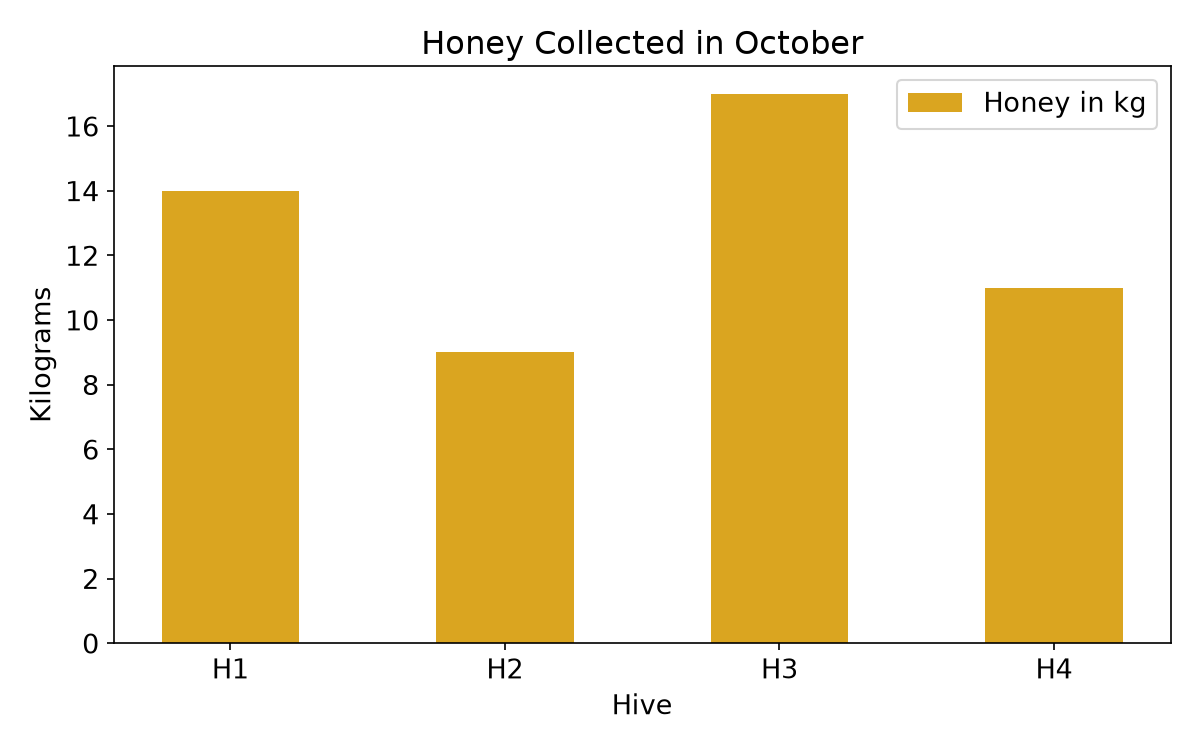
import matplotlib.pyplot as plt
week = [1, 2, 3, 4, 5]
morning = [31, 28, 34, 40, 38]
evening = [22, 27, 30, 29, 36]
plt.plot(week, morning, marker="o", label="Morning")
plt.plot(week, evening, marker="s", label="Evening")
plt.title("Visitors to the Reading Room")
plt.xlabel("Week")
plt.ylabel("Visitors a day")
plt.xticks(week)
plt.ylim(15, 45)
plt.legend()
plt.show()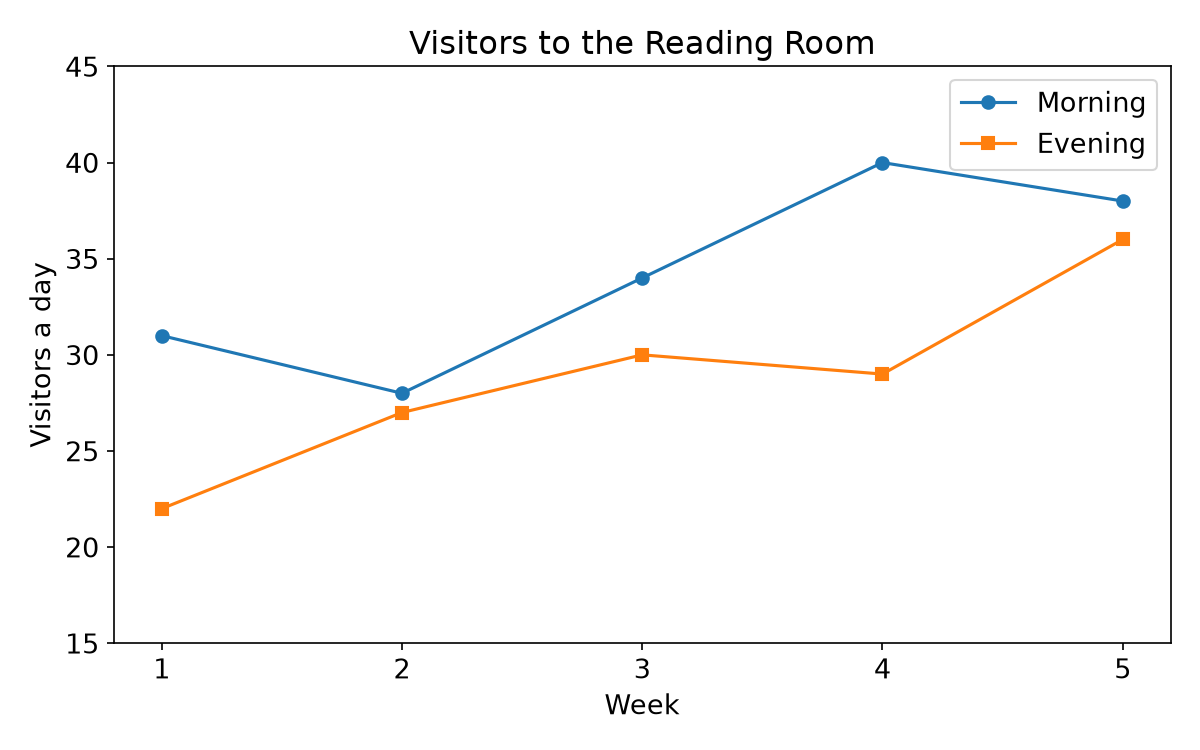
plot() before one show() put both lines on the same axes. xticks() and ylim() tidy the picture and are not needed for the marks.4. Unit 2
Every query below uses one of two small tables, so you can check a result by eye. The answers ran on MySQL (major version 26) and the grids are printed as it gave them.
| PID | Title | Lang | Minutes | Staged | Ticket |
|---|---|---|---|---|---|
| P1 | Andhera Kuan | Hindi | 95 | 2026-09-12 | 250 |
| P2 | The Lamp | English | 70 | 2026-10-03 | 300 |
| P3 | Nadi | Bengali | 120 | 2026-09-27 | 200 |
| P4 | Paper Boats | English | 85 | 2026-11-08 | NULL |
| P5 | Mitti | Hindi | 110 | 2026-10-18 | 180 |
| BNo | PID | Buyer | Seats |
|---|---|---|---|
| 1 | P1 | Irfan | 4 |
| 2 | P3 | Leela | 2 |
| 3 | P1 | Joshua | 3 |
| 4 | P5 | Leela | 5 |
| 5 | P2 | Irfan | 1 |
| 6 | P3 | Nima | 6 |
COUNT(*) and COUNT(Ticket) return? SELECT ROUND(286.47, -1); return? ALTER TABLE PLAY DROP Ticket; DELETE would be wrong, because it removes rows.DAYNAME(). DAY() gives the day of the month as a number.HAVING COUNT(*) > 1.UPPER(Title). An aggregate function works on many rows together and returns one value for the set or for each group, for example MAX(Minutes).DELETE FROM PLAY; and DROP TABLE PLAY; SELECT MOD(29, 6) + POWER(2, 3); and SELECT LENGTH(TRIM(' tea leaf ')); If joins and grouping are the trouble, there are more on IP SQL questions with answers.
SELECT UPPER(Title), LEFT(Lang, 2) FROM PLAY;
SELECT Title, INSTR(Title, 'a') FROM PLAY;
SELECT Title FROM PLAY WHERE LENGTH(Title) > 5;
+--------------+---------------+
| UPPER(Title) | LEFT(Lang, 2) |
+--------------+---------------+
| ANDHERA KUAN | Hi            |
| THE LAMP     | En            |
| NADI         | Be            |
| PAPER BOATS  | En            |
| MITTI        | Hi            |
+--------------+---------------+

+--------------+-------------------+
| Title        | INSTR(Title, 'a') |
+--------------+-------------------+
| Andhera Kuan |                 1 |
| The Lamp     |                 6 |
| Nadi         |                 2 |
| Paper Boats  |                 2 |
| Mitti        |                 0 |
+--------------+-------------------+

+--------------+
| Title        |
+--------------+
| Andhera Kuan |
| The Lamp     |
| Paper Boats  |
+--------------+
SELECT Title, DAYNAME(Staged) FROM PLAY;
SELECT Title, Staged FROM PLAY WHERE MONTH(Staged) = 10;
SELECT Title, Staged FROM PLAY ORDER BY Staged DESC;
+--------------+-----------------+
| Title        | DAYNAME(Staged) |
+--------------+-----------------+
| Andhera Kuan | Saturday        |
| The Lamp     | Saturday        |
| Nadi         | Sunday          |
| Paper Boats  | Sunday          |
| Mitti        | Sunday          |
+--------------+-----------------+

+----------+------------+
| Title    | Staged     |
+----------+------------+
| The Lamp | 2026-10-03 |
| Mitti    | 2026-10-18 |
+----------+------------+

+--------------+------------+
| Title        | Staged     |
+--------------+------------+
| Paper Boats  | 2026-11-08 |
| Mitti        | 2026-10-18 |
| The Lamp     | 2026-10-03 |
| Nadi         | 2026-09-27 |
| Andhera Kuan | 2026-09-12 |
+--------------+------------+
MONTHNAME(Staged) = 'October' is equally good in (ii).SELECT LEFT(Title, 3), LENGTH(Title) FROM PLAY WHERE Lang = 'English'; SELECT MONTH(Staged), COUNT(*) FROM PLAY GROUP BY MONTH(Staged) ORDER BY MONTH(Staged); SELECT MOD(Minutes, 60) FROM PLAY WHERE PID = 'P3';
+----------------+---------------+
| LEFT(Title, 3) | LENGTH(Title) |
+----------------+---------------+
| The            |             8 |
| Pap            |            11 |
+----------------+---------------+

+---------------+----------+
| MONTH(Staged) | COUNT(*) |
+---------------+----------+
|             9 |        2 |
|            10 |        2 |
|            11 |        1 |
+---------------+----------+

+------------------+
| MOD(Minutes, 60) |
+------------------+
|                0 |
+------------------+
SELECT Lang, COUNT(*), AVG(Minutes) FROM PLAY GROUP BY Lang;

SELECT Lang, COUNT(*), AVG(Minutes) FROM PLAY
GROUP BY Lang HAVING COUNT(*) > 1;

SELECT MAX(Ticket), MIN(Ticket) FROM PLAY;
+---------+----------+--------------+
| Lang    | COUNT(*) | AVG(Minutes) |
+---------+----------+--------------+
| Hindi   |        2 |     102.5000 |
| English |        2 |      77.5000 |
| Bengali |        1 |     120.0000 |
+---------+----------+--------------+

+---------+----------+--------------+
| Lang    | COUNT(*) | AVG(Minutes) |
+---------+----------+--------------+
| Hindi   |        2 |     102.5000 |
| English |        2 |      77.5000 |
+---------+----------+--------------+

+-------------+-------------+
| MAX(Ticket) | MIN(Ticket) |
+-------------+-------------+
|         300 |         180 |
+-------------+-------------+
SELECT Buyer, Title, Seats FROM PLAY, BOOKED
WHERE PLAY.PID = BOOKED.PID;

SELECT Title, SUM(Seats) FROM PLAY, BOOKED
WHERE PLAY.PID = BOOKED.PID
GROUP BY Title HAVING SUM(Seats) > 4;
+--------+--------------+-------+
| Buyer  | Title        | Seats |
+--------+--------------+-------+
| Irfan  | Andhera Kuan |     4 |
| Leela  | Nadi         |     2 |
| Joshua | Andhera Kuan |     3 |
| Leela  | Mitti        |     5 |
| Irfan  | The Lamp     |     1 |
| Nima   | Nadi         |     6 |
+--------+--------------+-------+

+--------------+------------+
| Title        | SUM(Seats) |
+--------------+------------+
| Andhera Kuan |          7 |
| Nadi         |          8 |
| Mitti        |          5 |
+--------------+------------+
SELECT PID, SUM(Seats), COUNT(*) FROM BOOKED
GROUP BY PID HAVING COUNT(*) = 2 ORDER BY PID;

SELECT Buyer, Title, Ticket * Seats FROM PLAY, BOOKED
WHERE PLAY.PID = BOOKED.PID AND Lang = 'Hindi'
ORDER BY BNo;
+------+------------+----------+
| PID  | SUM(Seats) | COUNT(*) |
+------+------------+----------+
| P1   |          7 |        2 |
| P3   |          8 |        2 |
+------+------------+----------+

+--------+--------------+----------------+
| Buyer  | Title        | Ticket * Seats |
+--------+--------------+----------------+
| Irfan  | Andhera Kuan |           1000 |
| Joshua | Andhera Kuan |            750 |
| Leela  | Mitti        |            900 |
+--------+--------------+----------------+
-- plays with no ticket price entered
SELECT Title FROM PLAY WHERE Ticket = NULL;

-- languages whose plays are longer than 90 on average
SELECT Lang FROM PLAY WHERE AVG(Minutes) > 90 GROUP BY Lang;

-- Hindi plays in the order of staging
SELECT Title FROM PLAY ORDER BY Staged WHERE Lang = 'Hindi';

-- who booked which play
SELECT Buyer, Title FROM PLAY, BOOKED;
SELECT Title FROM PLAY WHERE Ticket IS NULL;

SELECT Lang FROM PLAY GROUP BY Lang HAVING AVG(Minutes) > 90;

SELECT Title FROM PLAY WHERE Lang = 'Hindi' ORDER BY Staged;

SELECT Buyer, Title FROM PLAY, BOOKED
WHERE PLAY.PID = BOOKED.PID;
SELECT Title, ROUND(Minutes / 60, 1) FROM PLAY;
SELECT Title FROM PLAY WHERE RIGHT(Title, 1) = 'i';
SELECT LTRIM(Title) FROM PLAY;
SELECT SUM(Minutes) FROM PLAY;
SELECT Title, YEAR(Staged) FROM PLAY;
CREATE TABLE VOLUNTEER (VID INT PRIMARY KEY, VName VARCHAR(20),
                        Duty VARCHAR(15), Hours INT);
INSERT INTO VOLUNTEER VALUES (1, 'Farah', 'Lights', 6);
INSERT INTO VOLUNTEER VALUES (2, 'Gopal', 'Tickets', 4);
ALTER TABLE VOLUNTEER ADD Phone CHAR(10);
UPDATE VOLUNTEER SET Hours = Hours + 2 WHERE Duty = 'Tickets';
DELETE FROM VOLUNTEER WHERE Hours > 5;5. Units 3 and 4
Twenty marks of the paper need no code at all. They go to answers that use the right word and then stop: name the thing, give the reason, move on.
| From | To | Distance |
|---|---|---|
| Weaving | Dyeing | 40 m |
| Weaving | Design | 75 m |
| Weaving | Office | 140 m |
| Dyeing | Design | 60 m |
| Dyeing | Office | 125 m |
| Design | Office | 115 m |
| Building | Computers |
|---|---|
| Weaving | 45 |
| Dyeing | 12 |
| Design | 90 |
| Office | 30 |
Weaving --40m-- Dyeing --60m-- Design --115m-- Office
Notes for the unit: computer networks for Class 12 IP.
Notes for the unit: societal impacts.
How a teacher uses this bank. You bring the numbers you got wrong. We run what you actually wrote, so a missing comma shows itself, and then the data is changed: a new label, a NULL, a fourth table row. If the second answer is right too, that number is crossed off.
One to one, at your own timing
Teaching is personalised one to one, on days and at a time that you name. You can try it through a priority demo, a full live class at the slot you choose with a written skill report afterwards; enrol, and its fee comes off the first month. The free demo class is there as well. You pay month by month, there is no admission fee, and you may stop when any month ends.
Before you enrol · Try a class
a full live class of about 45 to 60 minutes
The classes · Choose your own timing
₹4,999
per month, 4 private classes, fully flexible timingtwo private classes a week, at a time set with you
Some students need five pandas lessons and no SQL, and some the reverse, so there is no set order. The monthly fee on this page appears in the currency of your country.
Studying outside India?
CBSE schools abroad sit the same 065 paper on the same morning. Choose a class hour after your own school day, and we keep to your clock.
| Where you live | Time difference | Usual class window, local time | Format |
|---|---|---|---|
| India every Indian city | Indian time | Any time you choose | Personalised 1-on-1 |
| UAE and Oman Dubai, Abu Dhabi, Sharjah, Muscat | 1 h 30 min behind India | 3:00 PM to 9:00 PM | Personalised 1-on-1 |
| Saudi Arabia, Qatar, Kuwait, Bahrain Riyadh, Jeddah, Dammam, Doha, Kuwait City, Manama | 2 h 30 min behind India | 3:00 PM to 9:00 PM | Personalised 1-on-1 |
| Nepal Kathmandu | 15 min ahead of India | 4:30 PM to 9:00 PM | Personalised 1-on-1 |
| Ethiopia and East Africa Addis Ababa and East Africa Time | 2 h 30 min behind India | 4:30 PM to 9:00 PM | Personalised 1-on-1 |
| Singapore and Malaysia Singapore, Kuala Lumpur | 2 h 30 min ahead of India | 3:30 PM to 9:00 PM | Personalised 1-on-1 |
A laptop with Python and pandas is enough for the first 24 questions. MySQL can be installed later, with help in class.
What families say
Real reviews from real families. We neither write nor commission them.
★★★★★
"The one step solution for my son. Modern Age Coders make learning coding so simple that kids love it. The teachers explain complex concepts clearly with practical exercises and interactive content."
Ria Mukherjee
Parent
★★★★★
"Modern Age Coders has been a game-changer for me. I struggled to grasp IT concepts and coding before joining, but their classes transformed everything. I can now confidently write complex programs with ease."
Samriddha Mondal
Student
★★★★★
"One of the most wonderful education centres out there. Education is not limited to school syllabus but focuses on skill development."
Vansh Agarwal
Student
★★★★★
"My child Dhairya is really enjoying the Modern Age Coders classes. This is his first online class and he eagerly looks forward to it. I can already see his improvement, and the teachers are very cooperative."
Sonam Oswal
Parent of Dhairya
★★★★★
"Modern Age Coders have wonderful teachers who teach in a clear, easy and practical way. The teacher boosts students' confidence and inspires them to learn without hesitation."
Sonu Goyal
Parent
★★★★★
"I highly recommend this computer coding class! The teachers are incredibly knowledgeable and passionate about coding."
Ritu Kedia
Parent
The rest of the Class 12 series
Every page in the CBSE Class 12 Informatics Practices series, grouped by what you need.
CBSE Class 12 Computer Science (083): Class 12 CS viva questions Class 12 CS sample paper practice Class 12 CS project with source code Class 12 CS important questions
CBSE Class 12 Information Technology (802): IT 802 practical and project file IT 802 Java notes and programs IT 802 notes
CBSE Class 11 CS, IP and AI: Class 11 CS practical file Class 11 IP practical file CS or IP in Class 11
ISC Computer Science (868): ISC Class 12 CS syllabus 2027 ISC Class 12 CS practice paper ISC Class 12 practical questions solved ISC Boolean algebra and K-maps
Program lists with output: Class 12 practical file programs Python programs for Class 11 CS and IP
Questions about this IP bank
Nobody outside the board can name them. The safe list comes from the syllabus: Series and DataFrame outputs, adding, renaming and deleting in a DataFrame, Boolean indexing, one program for each plot, SQL text, date and aggregate functions, GROUP BY with HAVING, an equi-join, a network case, and short answers on cyber safety and intellectual property.
We do not give a PDF. All 58 questions and answers are open on this page without a login, and you can print it from your browser. Practise with the answers closed, because the exam asks you to write code and queries from memory.
Data Handling using Pandas and Data Visualization is 25 of the 70 theory marks in the 2026-27 syllabus. CBSE does not split those 25 between pandas and Matplotlib. SQL carries another 25, networks 10 and societal impacts 10.
The functions the syllabus lists: POWER, ROUND and MOD; the text functions from UPPER to TRIM; NOW, DATE, MONTH, MONTHNAME, YEAR, DAY and DAYNAME; and MAX, MIN, AVG, SUM and COUNT. Add GROUP BY, HAVING, ORDER BY, the Class 11 commands and an equi-join of two tables.
No. They are original, written for the 2026-27 syllabus. Question papers of earlier years are on the CBSE website and are worth solving. Skip anything in them that the present syllabus does not name.
They are not named in the Unit 1 theory list for 2026-27, so this bank has none. One item of the suggested practical list does ask you to group rows by category and total them, so know how to do that on the computer.
Copy the form of the output as well as the values. For a Series write the label column, the value column and the dtype line. Use NaN where labels do not match, and remember that NaN turns whole numbers into decimals. For SQL write the headings above the rows.
Write it whenever the question says program. When it asks only for statements on a DataFrame that already exists, the statements are enough. Writing the import costs a few seconds and never loses a mark.
Give two days to pandas, one to charts, two to SQL and one to networks and society, and write a paper on the last day. Each day, answer ten questions from one unit on paper and correct them against a run. The IP exam is on Wednesday 31 March 2027.
Yes. Modern Age Coders teaches Informatics Practices live, one student at a time, at your own days and timing. A priority demo, a full class of about 45 to 60 minutes with a written skill report, shows how it works, and a free demo class is available too.
Start
Send us the three question numbers that beat you. In a priority demo the teacher works through them with you at a slot you choose, gives you changed versions, and writes a skill report after the class. The fee is adjusted against your first month if you enrol.
The free demo class takes one of the three. If objective questions are your worry, try the Class 12 IP MCQ test first.
WhatsApp us · +91 91233 66161 · connect@modernagecoders.com
Every class is live video. The form requests a callback and reserves nothing.
A full live class of about 45 to 60 minutes at a slot you pick, with a written skill report and learning roadmap on WhatsApp afterwards. The fee is adjusted against your first month if you enrol.
Book a priority demo