Live online · Python, ages 8 to adult
Live Python classes for students across Dubai: children from eight, teenagers, college students and working adults. Each class is an hour on a video call with one teacher and at most eight students, everyone writing and running Python while the teacher watches the actual code.
Python is the language Dubai students now meet everywhere: in CBSE computer science, in GCSE and A Level practical work, and underneath nearly every AI tool in the news. This page lays out our four Python tracks, what each one covers, and how to pick between them.
4.9 rating across 547+ Google reviews
temps = [41, 43, 39, 44, 42]
hot = [t for t in temps if t >= 42]
print(len(hot), "days at 42C or above")
# 3 days at 42C or above
An early exercise from the teens track: list comprehensions in month three, run on the kind of numbers a Dubai summer supplies for free.
01 · The Python tracks
Every track is a weekly live cohort taught in English. The cards open the full syllabus, schedule and fees. Where two tracks overlap in topic, they differ in pace and in how much the teacher assumes.
Ages 13 to 18. Starts at an empty file and works through variables, functions, lists, dictionaries, files and APIs into projects the teenager chooses. The track that overlaps most with school exams.
View syllabus

College students and adults who want the language properly: core syntax through object-oriented design, then web frameworks, databases and a grounded first pass at data science.
View syllabus
For adults whose week contains repetitive work. Scripts for files and spreadsheets first, then web scraping, browser automation and AI-assisted pipelines that keep working after office hours.
View syllabus
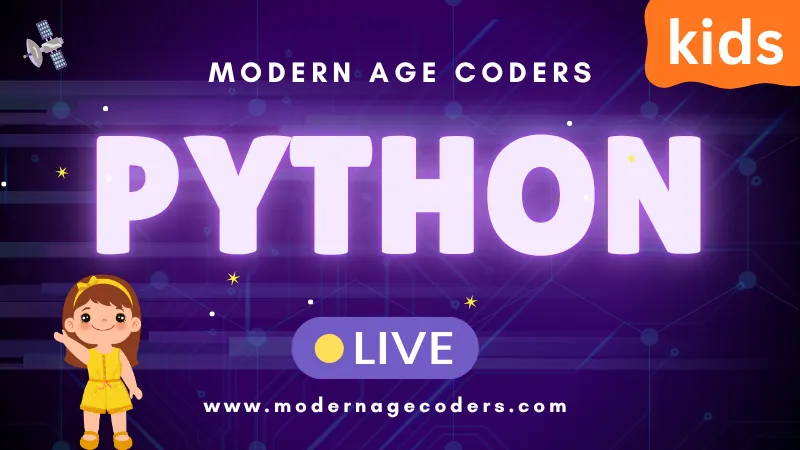
Ages 8 to 12. Typed Python from the first month, kept visual with turtle graphics and small games, plus an honest, gentle introduction to what AI actually is.
View syllabus
The natural continuation of Python for Teens. Students collect data, train real classifiers and learn to distrust a model until it has earned it.
View syllabus
For adults who finish Python Mastery and want the discipline in full: the maths kept honest, classical machine learning, deep learning, and work on datasets that misbehave.
View syllabus
Large language models handled from Python: deliberate prompting, APIs, retrieval, and compact applications that run end to end. Assumes the fluency the earlier tracks build.
View syllabus
02 · Choosing
Parents often arrive at this page asking which Python course is best, and the truthful answer is that best depends on two facts: the learner's age and what they want out of it. Everything else is detail.
If two tracks both look plausible, book the demo and say so. The teacher meets the student, asks a few questions, watches how they think, and recommends one. That placement conversation is free, and it is more reliable than any quiz a website could offer you.
One more honest note: a student who starts in the wrong track is not stuck. Batches for every track run continuously, and moving a student sideways after two or three weeks is routine and costs nothing.
03 · The syllabus arc
The four tracks differ in pace and framing, but underneath them runs the same arc every sound Python education follows. Here it is, with the contents stated plainly so you know what you are paying for.
The basics First weeks
Variables, input and output, conditions and loops. Students write small complete programs from the second or third class: a number guesser, a units converter, a program that answers back. Two habits matter more than any topic here, and the teacher drills both: running code often, and reading error messages as instructions instead of insults.
Data structures The middle stretch
Lists, dictionaries, tuples and sets, then strings and files. This is where programs stop being toys and start being tools, because almost everything useful, from a contact book to a sales report, is a data structure with manners. Sorting, searching and list comprehensions round the stage out.
Object-oriented programming Designing larger programs
Classes, objects, inheritance, and the quieter skill underneath them: organising code so that a project can grow without collapsing under its own weight. Students refactor their earlier projects here, which teaches more about design than any fresh example could.
Automation Python doing your chores
File handling at scale, spreadsheets, web scraping, browser automation and APIs. Teens meet this as projects; the adult automation track lives here almost entirely. The test of the stage is simple and satisfying: a task that used to take an hour of clicking now takes one command.
AI libraries The modern payoff
pandas and NumPy for data, scikit-learn for a first trained model, and large language model APIs in the generative track. Just as important as using each library is knowing what it cannot do, and the teachers are direct about that boundary.
Students who want to go further from here move into the AI and machine learning tracks, covered on our AI classes in Dubai page.
04 · The format
Same format for every track, every week, no surprises.
A
Students share their screen and the teacher debugs with them, line by line, while the mistake is still warm. Nothing gets learned from a lecture slide that could be learned from the student's own program.
B
Group batches hold five to eight. That number is chosen so every student writes code in every class and no one hides at the bottom of a participant list. One-on-one runs the same syllabus at a private pace.
C
Weekday slots between roughly 4:00 and 9:00 PM Gulf Standard Time, plus Saturday and Sunday slots. One fixed hour a week, and because the UAE skips daylight saving, that hour never wanders.
D
The medium is English, as in most Dubai schools. Teachers explain in short, plain sentences and ask students to explain back, which is how they catch the difference between nodding and knowing.
E
A course ends with programs the student wrote and still owns: games, scrapers, dashboards, small models. They run after the course ends, which is more than can be said for a certificate alone.
F
The demo is a normal class, not a pitch. The student codes, the teacher teaches, and afterwards you decide with something real to judge us by.
05 · Local context
Every city now says it wants coders, but Dubai has put unusual weight behind the claim: a government AI ministry since 2017, a technology cluster in Dubai Internet City that has anchored regional software work for two decades, and public services that went digital early and stayed there. A Dubai student choosing a first language is choosing it in a city where the skill will be examined, hired for and used.
Python is the sensible choice for that first language, and not for fashionable reasons. Its syntax stays out of the way, so a beginner's energy goes into thinking. Its reach is unusually long, stretching from a nine year old's turtle drawing to the data pipelines inside banks and airlines. And it happens to be the language school systems have converged on.
CBSE schools, which teach a large share of Dubai's students, run Classes 11 and 12 computer science in Python, so a teenager in our track is practising the literal language of their board exam. In British-curriculum schools, GCSE, IGCSE and A Level computer science set programming tasks that are most commonly answered in Python. IB students lean on computational thinking across the Diploma Programme. None of our courses is exam tutoring, and we do not teach to a paper. The relationship is simpler: a student who has built forty Python programs for their own reasons finds the exam questions short.
Among adults, Python has become the default second skill of people whose first skill is something else: the analyst who stops waiting for reports, the operations manager who scripts the weekly reconciliation, the marketer who finally pulls their own numbers. Dubai's job market, dense with banking, logistics, aviation, property and trade, keeps asking for exactly that combination.
Here is what we will not tell you: that a certificate guarantees a job, or a salary, or a promotion. No placement promises are made on this page, because a course cannot honestly make them. What the evening tracks do provide is proof of work: automation scripts that run, a small web application, a trained model with its reasoning explained in your own words. In an interview, that is the part you can show rather than say.
Both adult tracks assume a full working day. One fixed evening hour a week, homework sized for real life, and a teacher who has heard "I last coded in university, badly" many times before.
06 · Nearby guides
This page covers Python. The guides below cover the neighbouring questions families in Dubai tend to ask next.
The country hub: how live online classes work across all seven emirates, and everything that stays the same wherever you log in from.
Read the guide
The companion to this page. Where the Python tracks end, the AI and machine learning tracks begin: models, data and generative AI by age band.
Read the guide
The full Dubai overview across every course we run, if you want the wide view before committing to a language.
Read the guide
Written for parents of eight to fourteen year olds: what a child's first Python year actually looks like, project by project.
Read the guide
07 · Plain reasons
Instruction is the job, not a side gig between other things. Students keep the same teacher across a course wherever possible, so nothing has to be re-explained to a stranger.
Five to eight students means the teacher notices a quiet week immediately. Attention is the product; the cap is what protects it.
Students spend class time typing, running and fixing programs. Watching someone else code teaches roughly as much as watching someone else swim.
A completion certificate here points at finished work. It says what was built, which makes it worth attaching to a school portfolio or a CV.
Regular updates in ordinary sentences: what was covered, what the student built, where they are strong, where they wobble. No decoding required.
The free class comes first, every time. We would rather earn the enrolment in one honest hour than talk you into it.
08 · Verified reviews
Classes run live and online, so a student in Dubai sits in the same small batch as classmates from anywhere in the world. The reviews below are real and verified, quoted as written. Many more are on our Wall of Love.
"I am truly grateful for my experience at Modern Age Coders. My teachers were not only teachers but also mentors and friendly figures. The perks are excellent: one-on-one doubt solving, mentoring and regular tests. The most impressive part was working on real-world projects."
Krishnam Bhatter
Former student
"Modern Age Coders has been a game-changer for me. I struggled to grasp IT concepts and coding before joining, but their classes transformed everything. I can now confidently write complex programs with ease."
Samridho Mondal
Student
"Modern Age Coders have wonderful teachers who teach in a clear, easy and practical way. The teacher boosts students' confidence, keeps them updated with technology, and inspires them to learn without hesitation."
Sonu Goyal
Parent
09 · Fees
Fees are billed in US dollars. Because the dirham is pegged to the dollar, the AED figures below do not move around on you.
Group classes
$40 per month
about AED 150 per month
One-on-one classes
$100 per month
about AED 370 per month
Monthly billing, no registration fee, no hidden charges, no lock-in. If the demo does not earn the enrolment, the price of finding out was zero.
10 · Questions
11 · Free demo class
Every claim on this page can be checked in a single demo class: the batch size, the teaching, the way a student's own code becomes the lesson. Book it and judge the class instead of the copywriting.
Prefer WhatsApp? Send us a message and a mentor will reply during Dubai daytime hours.
4.9 rating across 547+ Google reviews