Pick the course. Start this week.
Every mentor teaches from a structured programme, adapted live to your teen. Open a course to see the full syllabus and enroll in minutes, or start with a Priority Demo and let the diagnostic pick for you.
 Best fit
High School Mathematics Mastery
The grades 9-12 road: Geometry's reasoning plus the algebra that must stay warm underneath it.
$100/mo group · $150/mo 1-on-1
View course & enroll
SAT Math 800 Prep Course
The PSAT is this year; the SAT is next. Sophomore starts get the calm, full runway.
$100/mo group · $150/mo 1-on-1
View course & enroll
Olympiad & Competition Mathematics
Geometry's proofs done for joy: the contest track where deductive minds catch fire.
$100/mo group · $150/mo 1-on-1
View course & enrollGood 10th grade math tutoring does three things: teaches proof as detective work, seeing why before writing two columns, keeps the algebra warm, because Geometry's coordinate and similarity problems still run on it and Algebra 2 arrives next year, and starts the test-year runway, with the PSAT this fall and the SAT on next year's calendar. That is what we do: live one-hour classes with a dedicated mentor, in small groups (8 a month) or private 1-on-1, priced for your country and shown in your local currency, Priority Demo first.
Proof is a new species, and nobody warns the students.
Every earlier math year rewarded computing: follow the method, get the number, collect the points. Geometry changes the question. "Prove these triangles are congruent" has no number at the end, it demands an argument, each step justified, written in a strange two-column costume. Strong computers who never learned to reason from reasons hit a wall that feels personal: "I used to be good at math."
The reverse also happens, and it is one of our favorite things to watch: verbal, argumentative kids who found equations tedious discover that Geometry is their sport. Either way, the year rewards a skill school rarely teaches explicitly: constructing a chain of because.
The quieter tenth-grade trap is algebra rust. Geometry uses algebra constantly, similar-triangle ratios, coordinate proofs, circle equations, while giving it no dedicated practice, so skills decay exactly when Algebra 2 is about to demand them sharper than ever. Sophomores also meet the PSAT in October, the first taste of the testing years.
Our tenth-grade work handles all of it: proof taught as detective work before notation, the figure-marking and statement-hunting craft that makes proofs writable, algebra kept deliberately warm through coordinate work, and the PSAT met calmly, as information rather than verdict. By spring, your teen has the reasoning habit Algebra 2, AP courses and the SAT all quietly assume.
What 10th grade math actually covers.
Most tenth graders take Geometry; accelerated students take Algebra 2 (covered on our 11th grade page). The Geometry map:
| Territory | What it demands | Where points die |
|---|---|---|
| Logic & proof | Conditional statements, deductive chains, two-column and paragraph proofs | Writing proofs before seeing them: notation drilled without the detective work underneath |
| Congruence | Triangle congruence criteria (SSS, SAS, ASA, AAS) used as argument tools | Criteria memorized as letters instead of understood as "what pins a triangle down" |
| Similarity & right triangles | Scale reasoning, similar-triangle setups, the Pythagorean theorem earned, right-triangle trig begun | Ratio setups scrambled, the algebra rust showing; trig as SOH-CAH-TOA chant without meaning |
| Circles | Arcs, angles, chords and tangents, and the circle's equation on the coordinate plane | Angle-arc relationships pattern-matched instead of reasoned |
| Coordinate geometry | Distance, midpoint, slopes of parallels and perpendiculars, coordinate proofs | Where Geometry quietly re-tests all of Algebra 1 |
| Area, volume & probability | 2D and 3D measurement with reasoning, geometric probability | Formula-hunting on multi-shape figures instead of decomposing them |
A proof, taught as detective work first.
Prove: triangle ABE is congruent to triangle CDE.
Mentor: "Do not write anything. Just tell me: what do you KNOW, and why?"
Teen: "Two pairs of equal sides… and those angles at E are vertical, so they match!"
Mentor: "So what pins the triangles together?" → "Side, angle, side. SAS!"
Then, and only then, the two-column table gets written, as a transcript of an argument the teen already made aloud. The notation stops being the monster; it is just minutes of a meeting that already happened.
This order, detective work first, notation second, is the entire trick of teaching proof, and it is nearly impossible in a class of thirty where the notation must be graded tomorrow. One term of it and your teen starts seeing given-to-goal paths on sight, the skill that later makes SAT hard questions and AP free-responses feel navigable.
Reasoning as the product, notation as the receipt.
Proof as detective work
Argue it aloud first, write it second: the order that makes proofs writable and, eventually, likable.
Figure-marking craft
Tick marks, angle arcs and given-hunting taught as explicit skills: most stuck proofs are unmarked figures.
Algebra kept deliberately warm
Coordinate work and similarity ratios double as Algebra 1 maintenance, so Algebra 2 arrives to sharpened tools, not rust.
Trig with meaning
Sine and cosine met as ratios that must be true because of similarity, not as a chant, the difference that pays for three more years.
The PSAT, framed right
October's PSAT treated as free information: a calm first contact with the test genre, feeding next year's SAT plan.
One mentor, compounding
The same teacher all year, reading whether reasoning or memorizing is doing the work, and adjusting before the exam does.
From proof-shock to reasoning-strong.
Class 1 · The Priority Demo diagnostic
A real lesson plus an audit: proof instincts, algebra warmth, and an honest read on the year ahead.
Months 1-2 · The reasoning on-ramp
Logic, conditionals and first proofs as spoken arguments, with figure-marking craft installed early.
Months 3-5 · Congruence and similarity, owned
The criteria as pinning-down tools, similarity as scale reasoning, and the algebra maintenance running quietly inside.
Months 6-8 · Trig, circles and coordinates
Right-triangle trig from similarity, circle relationships reasoned not matched, coordinate proofs as the algebra bridge.
Months 9-10 · Finals and the runway
Cumulative review by error-log priority, finals craft, and a written handoff into Algebra 2 and the SAT year.
What one full hour looks like, at fifteen.
0-10 min · Retrieval + algebra warm-up
Last proof re-argued from memory, plus a short algebra rep to keep the tools sharp.
10-35 min · The day's reasoning
Today's territory built through argued-aloud problems, your teen constructing the chain of because.
35-50 min · Problems at test level
Real difficulty, marked figures, and reviews that ask where the argument bent, not just what the answer was.
50-60 min · Explain-back and the week
Your teen teaches the idea back, and the week's set goes home with a purpose they can state.
The reasoning habit built this year is the one every later course assumes. Watch it being taught: the demo is free. See exactly how we teach →
Who this genuinely fits, and who it does not.
A strong fit if…
• Proofs arrived and a formerly fine math student hit the wall, the computing-versus-reasoning gap this page describes.
• The algebra is rusting while Geometry ignores it, and you want both kept strong before Algebra 2 and the SAT year arrive.
• Your teen is coasting at school and needs depth and challenge before boredom becomes a habit.
• You want one mentor who knows your teen, not a rotating cast or an app with streaks.
Honestly not the fit if…
• You want proofs memorized as templates to survive the unit. Template proofs collapse on any novel figure, and we will say so rather than sell it.
• You want homework done for your teen. We teach your teen to do it, which is slower on night one and far faster by week four.
• You expect improvement without attendance and honest homework. Two hours a week of real teaching works; wishful thinking does not.
Premium teaching. One honest price.
You are paying for a real teacher, live, for a full hour, twice a week, the same format US tutoring centers charge $300 to $450 a month for. Our cost base is global, so the price is not.
1:1 Private Mentorship
$150 / month
- 8 live one-hour classes a month, 2 per week4 live one-hour classes a month, 1 per week
- A dedicated mentor who knows your teen by name
- Diagnostic-led plan against the full 10th grade map
- Class recordings for revision · cancel any time
Small-Group Class
$100 / month
- 8 live one-hour classes a month, 2 per week
- A handful of children at the same level
- Same teaching method, gentle peer energy
- Recordings included · cancel any time
That is $18.75 per dedicated hour of 1-on-1 teaching, or $12.50 in a small group. No registration fee, no contract, and you can see a full class first with a Priority Demo. Read our zero-risk promise or compare with what US math tutoring costs in 2026.
Mentors who teach the why, in classes kids wait for.
Our mentors are trained in one method: understanding before procedure, concrete before abstract, the student talking more than the teacher. They teach both math and coding, which matters more than it sounds, because a mentor with both toolkits has engagement moves a worksheet never will.
And because the same mentor stays with your teen month after month, teaching compounds: they know exactly which ideas landed, which need another costume, and when the next stretch is due.
"My child Dhairya is really enjoying the classes. This is his first online class, and he eagerly looks forward to it. I can see his improvement."
Sonam Oswal, mother of Dhairya · verified Google review
"My son struggled with math for years. Integrating it into coding projects has transformed his understanding and confidence. Highly recommended!"
Shewta Singh, mother of Ishan · verified Google review
Your real options for a 10th grade student.
| Option | Typical cost | What it really is | Best for |
|---|---|---|---|
| Modern Age Coders | $100–$150 / month | Live one-hour classes with a dedicated mentor, understanding-first teaching | Rebuilding understanding and confidence, sustained progress |
| Mathnasium center | $300-$450 / month + enrollment fee | Drop-in worksheet floor with rotating instructors | Children who focus better out of the house |
| Kumon | $150-$220 / subject / month | Daily worksheet packets, brief check-ins, no taught lessons | Building a drill habit and calculation speed |
| Local private tutor | $35-$80 / hour | Quality varies; twice-weekly quickly costs $280-$640 a month | Short-term help when you have found a gem nearby |
| Math apps | $10-$20 / month | Gamified practice, no teacher, no accountability | Casual practice between real lessons |
Competitor figures are typical published US prices as of July 2026. See our full comparisons: vs Mathnasium · vs Kumon · best online math tutoring 2026.
Everything families ask about 10th grade math tutoring.
My teen was strong in algebra and is failing Geometry. How is that possible?
Because Geometry grades a different skill: constructing arguments rather than executing procedures. Strong computers who never practiced reasoning-from-reasons hit exactly this wall, and it says nothing about their ceiling. Proof is teachable, argue aloud first, notate second, and the wall usually falls within a unit or two of the right teaching.
Do proofs even matter, or can we just survive the unit?
They matter more than the unit: proof is the training ground for the justify-your-reasoning skill that SAT hard questions, AP free-responses and every technical field run on. Surviving on template proofs wastes the year's real gift. That said, we are practical, your teen's grade gets protected while the deeper skill builds.
Should a sophomore take the PSAT seriously?
Seriously as information, calmly as an event: the sophomore PSAT is a free diagnostic of the test genre with no stakes attached. Junior-year PSAT is the one with National Merit implications. We use October's result to shape the SAT runway, and that is its whole job.
When should SAT prep actually start?
For most students: the summer after 10th grade or early junior year, aiming at a spring-of-junior-year first sitting. Sophomore-year foundations, algebra kept warm, reasoning built, ARE the early prep. Our SAT Math 800 course takes over when the calendar says so.
My teen is in Algebra 2 as a sophomore. Which page applies?
The course, not the grade label: our 11th grade page describes the Algebra 2 road, and our Algebra 2 tutoring page goes deeper still. The demo places your teen by course and gap, wherever the transcript files them.
What does it cost?
Pricing is set for each country and shown on this page in your own currency. Group plans include 8 live one-hour classes a month and 1-on-1 plans run private weekly sessions, all billed month to month. To see a class first, book a Priority Demo. No registration fee, no contract. US tutoring centers charge $300 to $450 a month for the same format.
Can you stretch a strong Geometry student?
Gladly, Geometry is where proof-hungry minds catch fire, and our competition track feeds them AMC-style problems and real mathematical writing. A tenth grader who loves proofs is a mathematician announcing themselves; we take that seriously.
How does this fit around sports seasons and the sophomore schedule?
Slots flex around practice schedules and exam weeks, recordings cover the occasional miss, and mentors adjust intensity rather than guilt-tripping. Consistency wins the year, and we engineer for it rather than demand it.
Can we try a class before enrolling?
Yes. Book a Priority Demo: a full live class of about 45 to 60 minutes, today or tomorrow, with a mentor reserved for your child. After the class the mentor sends a written skill report and a personal learning roadmap on WhatsApp. If you enrol, the demo fee is adjusted against your first month's fee.
More math help from Modern Age Coders.
Watch one full hour of real teaching. Free.
Book the demo class. Your teen gets a real lesson with a real mentor, you get a diagnostic against the full 10th grade map. If your teen does not leave the hour lighter about math, walk away with our thanks.
Real student projects
What our students actually build
Every one is a real, live project shipped by a Modern Age Coders student. Explore more in Student Labs.
 Web AppLumenFX: AR/VR Photo Effects StudioUpload a photo and transform it with cinematic filters, AR face effects and the wildest trending edits, the same looks blowing up on TikTok, Reels and Snap, with 240+ one-tap presets. Raayan vibe-coded the whole studio from an idea: prompted the concept, then built the effects engine and gallery UI by hand.by RaayanOpen the live project ↗
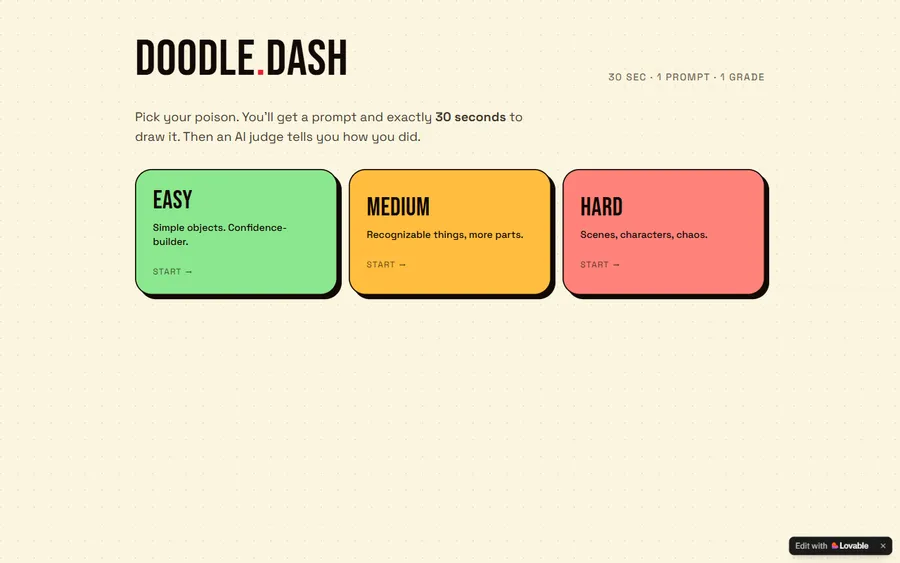 GameDoodle Dash: 30-Second Drawing ChallengePick a difficulty, get a prompt, and you have exactly 30 seconds to draw it, then an AI judge scores how close you got. Three modes from easy objects to chaotic scenes. Shubh vibe-coded it idea-first, wiring real AI image grading into a fast, addictive drawing game.by ShubhOpen the live project ↗
 AI & MLBookDesk: AI Book Summaries & QuizzesType in any book name and author, and BookDesk pulls together the book's details, a clear summary and a custom quiz to test what you've learned, a genuinely useful study companion. Anika built it as a full-stack AI application, powered by Google Gemini with a live database behind it.by AnikaOpen the live project ↗