Skip to content
Home/United Kingdom/North Yorkshire
North Yorkshire

Coding classes in North Yorkshire

What are the best coding classes in North Yorkshire?

This page covers North Yorkshire as a county: the North Yorkshire Council area, counted at the 2021 Census as seven districts, together with York, Middlesbrough and Redcar and Cleveland. Adding up the ten published counts gives our total of 1,098,768 residents. The biggest places are Middlesbrough, York, Harrogate and Scarborough. We teach live over video from India, and place each learner in a class matched to their ability, whatever their age. That runs from 6 to 67, with groups of five to ten or one-to-one lessons in coding, Python, data science and maths. The North Yorkshire project uses real census data on who commutes where. A first lesson is on us; carrying on costs USD 100 a month for a group or USD 150 a month for one-to-one.

Why do more people commute from Selby to York than from Scarborough to Richmondshire? Big places attract more journeys, and near places attract more than far ones. Geographers turned that common sense into a formula borrowed from physics, the gravity model: the flow between two places grows with their size and shrinks with the distance between them. The census recorded where people lived and where they worked, so the formula can be tested properly. This page's project fits it in Python to the real 2011 Census flows between ten North Yorkshire areas, measures how much it explains, and then studies the places where it gets the answer badly wrong, because that is where the interesting geography is.

Facts last verified 26 September 2026. Teaching is online; no North Yorkshire branch is claimed.

Courses for North Yorkshire

Where North Yorkshire learners start

A seven-year-old in Northallerton building a first game, a Year 8 in Knaresborough who loves maps, a Year 12 in Guisborough keen on data science, and an adult in Scarborough who works with spreadsheets every day. Each of them begins with a free lesson.

Browse the course atlas for more than one hundred options and use the coding roadmap to check prerequisites.

The four we are known for

Python, AI, vibe coding and agentic coding

These run underneath everything above. Every one is live and online, placed by ability rather than by age, and the first class is free.

North Yorkshire in figures

1,098,768 people from the Dales to the Tees

Area counts are 2021 Census figures on Nomis; the county total is our own sum. Town figures are ONS built-up areas, which we checked by totalling census output areas.

The twelve largest built-up areas in North Yorkshire, 2021 Census
TownResidentsTownResidents
Middlesbrough148,215Selby19,475
York141,685Guisborough18,095
Harrogate75,515Ripon16,590
Scarborough59,505Knaresborough15,785
Redcar37,660Skipton15,050
Eston29,635Catterick Garrison14,210

The ONS Middlesbrough area crosses into Redcar and Cleveland, so it is larger than the borough, which had 143,926. York is the largest single council at 202,821, and Richmondshire the smallest of the old districts at 49,776. Beyond the table are Northallerton, Whitby, Huntington and Haxby. The seven districts the census used have since become one North Yorkshire Council, which appears in the ONS list of councils from April 2023. The southern part of Stockton-on-Tees also lies in the ceremonial county, and our County Durham page covers that borough whole. North Yorkshire Council, York, the two Teesside councils and academy trusts set school holidays, which we did not read; lesson breaks are arranged with each family.

Two city pages already

Our York page is about street names, and Ripon is about river floods. This page is for the rest of the county, from Skipton to Saltburn.

The North Yorkshire project

Does commuting obey a law of gravity?

Real census flows between ten areas, a formula from physics, and the places where it fails.

The learner downloads the 2011 Census table WU01UK from Nomis, which counts people by where they lived and where they worked. For our ten areas that gives 90 journeys between different areas: 62,358 people commuted across a boundary between two of them, while 262,282 lived and worked in the same one. For each area the learner totals the commuters leaving and the jobs filled, finds a centre point from ONS population-weighted centroids, and measures the distance between every pair of centres.

Newton's gravity falls with the square of distance. The commuting version is flow = k × (size of origin)ᵃ × (size of destination)ᵇ ÷ distanceᶜ, and taking logarithms turns it into a straight line that ordinary least squares can fit. Fitted to the 89 pairs with at least one commuter, it gives a distance power of 3.3 and explains 77.6 per cent of the variation in the logged flows, an R² of 0.776. Forcing Newton's square law instead drops the fit to 0.677: commuting falls away with distance much faster than gravity does.

Where our fitted model misses by most, 2011 Census commuters
FromToActualModelWhat it tells you
YorkHambleton2,915552Centres 40 km apart; journeys near the edges are much shorter.
SelbyYork5,0935,403A near hit, for comparison.
Redcar and ClevelandMiddlesbrough10,56932,225Centres only 11 km apart, and a steep power law overshoots.
MiddlesbroughRedcar and Cleveland5,11126,499Half the flow of the reverse trip, yet predicted almost as high.
HarrogateLeeds8,481not in modelLeeds lies outside the ten areas, so the model never sees it.

Each big miss is a lesson in its own right. York to Hambleton flows more than five times what the model expects, and the likely reason is the crude distance: we measured from centre to centre of two large districts, while real journeys start and end all over them. Between Middlesbrough and Redcar and Cleveland the model overshoots in both directions, predicting 32,225 and 26,499 where the census found 10,569 and 5,111: a distance raised to the power 3.3 becomes tiny for centres only 11 km apart, so the formula explodes. It also barely separates the two directions, although one flow is double the other. And the largest flow from Harrogate in the whole table goes somewhere our model does not include: 8,481 people commuted to Leeds, more than four times Harrogate's biggest flow inside the ten areas, 1,920 to Hambleton.

Ages 10 to 13

Put pins in a paper map for five towns, guess the busiest commute between them, then check the real census number.

Ages 13 to 16

Load the flow table into Python, compute distances, and plot logged flow against logged distance to see the straight line appear.

Ages 16 and up

Fit the full model with least squares, compare it with Newton's square law, and write up the five largest residuals with an explanation for each.

Whose numbers these are

The commuting counts are from the 2011 Census, published by the ONS on Nomis, and the centre points from ONS centroids. The fitted formula, its powers, R² values and every model prediction are ours, computed for teaching. Commuting in 2011 may differ from commuting now.
Why North Yorkshire

A big, varied county is a fair test

Why this county suits a gravity model, and where its limits show.

Some 2011 Census commuting flows, from Nomis table WU01UK
FromToCommuters
SelbyYork5,093
HarrogateLeeds8,481
SelbyLeeds6,193
YorkLeeds5,023
HarrogateYork1,837
ScarboroughRyedale2,036

A county that runs from Pennine towns through market towns to a coast and an industrial river gives a model plenty to explain: short busy links like Selby to York, long thin ones across the moors, and strong pulls from cities just outside, like Leeds. A learner who fits the model and then argues with its mistakes is doing what transport planners and data scientists do every day, and learning that a good fit and a complete explanation are not the same thing.

We have no link with the Office for National Statistics, Nomis, North Yorkshire Council or any council named here. The census counts are theirs; the model and any error in it are ours.

Nearby pages

York and Ripon have their own pages; the East Riding is to the south-east, County Durham to the north and Leeds to the south.

The path

From maps and games to models of real data

The free lesson settles where each learner starts. Age is a first guess only.

Ages 6 to 10

Games and maps

Block coding with games that move around a map, measuring how far a sprite has travelled.

Coding for KidsScratch Coding for Kids
Ages 8 to 13

Numbers in Python

Typed Python with tables, totals and simple graphs built from real numbers.

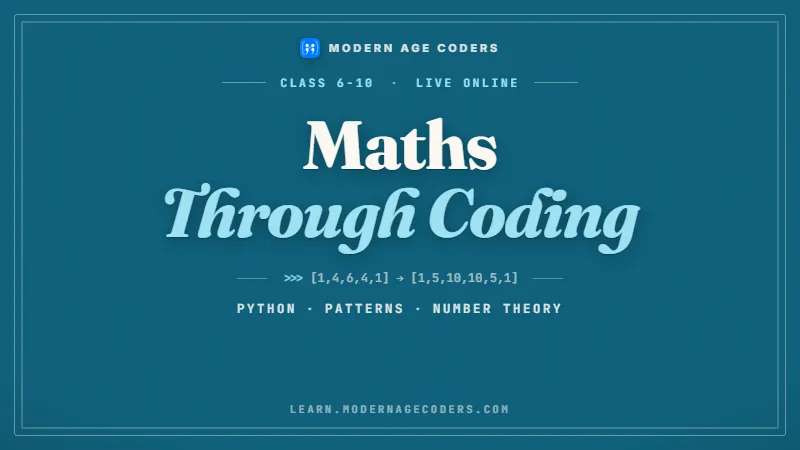
Python and AI for KidsMaths Through Coding
Ages 13 to 18

Models and data

Data science in Python, fitting lines and curves to real tables and questioning the leftovers.

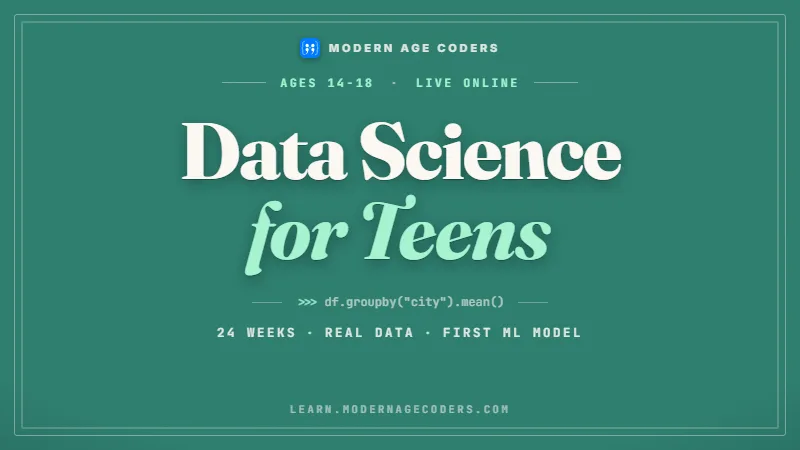
Data Science for TeensPython for Teens
Ages 18 to 67

Data for work

Spreadsheets, SQL and Python for adults who need to explain what the numbers really show.

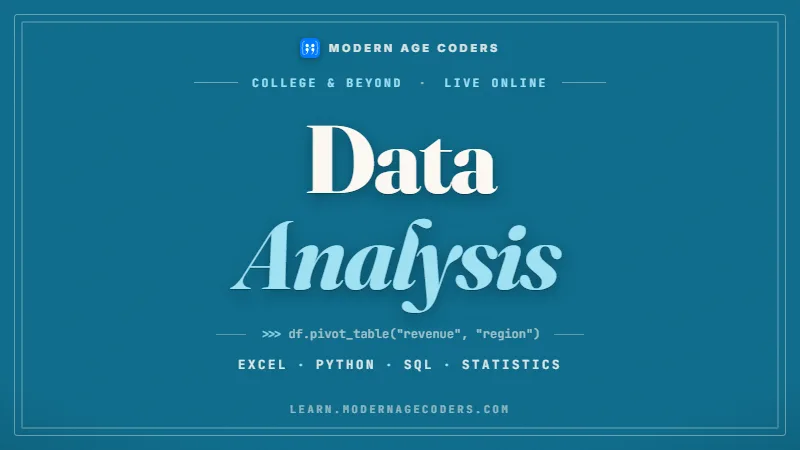
Data Analysis CourseData and AI Analytics for Non-Programmers (Excel, Sheets, Power BI)
AI and models

An AI can fit a model in seconds. Can it tell you what the model left out?

A good score hides the questions that matter most.

Hand an assistant the flow table and ask for a gravity model, and it will return a formula and an R² close to ours without fuss. It is far less likely to notice that the biggest flow from Harrogate goes to a city outside the data, or that the model treats Middlesbrough to Redcar and the reverse journey as nearly the same. Those gaps sit outside the numbers it was given.

Every AI system is a fitted model of some data, and its failures often come from what was left out of that data. A North Yorkshire student who has chased down the Leeds commuters knows to ask what a model was never shown, which is one of the most useful questions anyone can put to an AI tool.

So a young person in North Yorkshire should learn to code in 2026 to see what a model is missing, not just how well it scores. The longer argument is in why teenagers should still learn to code in 2026.

How lessons happen

Dales, moors and coast, one screen away

In a county this size, a weekly class in York or Middlesbrough can mean a long drive each way. Online lessons remove it.

Lessons at home

A farmhouse in Wensleydale, a terrace in Redcar, a flat in Harrogate. The teacher shares a screen and the learner does the coding.

Words from your school

Year groups, key stages, GCSEs and A levels are named as North Yorkshire schools name them, and lessons are in English.

A free lesson first

A proper lesson with real work, then clear advice on level and course, with no card details asked for.

Classmates at your level

Five to ten learners at the same stage, from across the county, the UK and further afield.

Breaks when school breaks

Two lessons a week is typical, and we pause for your own school's holidays.

UK times, always

Your lesson time is set in UK time and does not shift with the clocks; the teacher, who keeps India time several hours ahead, adjusts instead.

Why groups go by level

Even York or Middlesbrough rarely has five learners at the same stage free on the same evening. Grouping by level means a learner in Whitby or Settle joins a class that fits.

Fees

Fees in North Yorkshire

Skipton or Saltburn, the fee is identical, and it is the fee in every country we teach apart from India.

First classUSD 0

A full lesson of real work, ending with a suggested level and course.

Group tuitionUSD 100

Around eight lessons a month with five to ten learners at one level.

Private tuitionUSD 150

Around eight lessons a month with a teacher to themselves.

We bill in US dollars and quote no sterling prices. Nothing is charged until the free lesson has settled a course and a weekly time, and our pricing page explains pauses, missed lessons and switching between group and private.

Reviews

Families rate us on Google

Rated 4.9 across 547 Google reviews. These are real reviews, reproduced as written.

★★★★★

"The one step solution for my son. Modern Age Coders make learning coding so simple that kids love it. The teachers explain complex concepts clearly with practical exercises and interactive content."

Ria Mukherjee

Parent

★★★★★

"Modern Age Coders has been a game-changer for me. I struggled to grasp IT concepts and coding before joining, but their classes transformed everything. I can now confidently write complex programs with ease."

Samriddha Mondal

Student

★★★★★

"One of the most wonderful education centres out there. Education is not limited to school syllabus but focuses on skill development."

Vansh Agarwal

Student

★★★★★

"My child Dhairya is really enjoying the Modern Age Coders classes. This is his first online class and he eagerly looks forward to it. I can already see his improvement, and the teachers are very cooperative."

Sonam Oswal

Parent of Dhairya

★★★★★

"Modern Age Coders have wonderful teachers who teach in a clear, easy and practical way. The teacher boosts students' confidence and inspires them to learn without hesitation."

Sonu Goyal

Parent

★★★★★

"I highly recommend this computer coding class! The teachers are incredibly knowledgeable and passionate about coding."

Ritu Kedia

Parent

Free placement class

Book a free lesson in North Yorkshire

Tell us an age or school year and what the learner enjoys. A first lesson could be a map game in Scratch, a Python table, or the commuting data on this page.

+44

FAQ

North Yorkshire questions

The county, the commuting project and how lessons run.

How many people live in North Yorkshire?

Counting the North Yorkshire Council area with York, Middlesbrough and Redcar and Cleveland, there were 1,098,768 usual residents at the 2021 Census, by our sum of the ten ONS area figures on Nomis.

What are the largest towns in North Yorkshire?

By ONS built-up area: Middlesbrough 148,215, York 141,685, Harrogate 75,515, Scarborough 59,505 and Redcar 37,660.

What is the commuting project?

Learners fit a gravity model to 2011 Census commuting flows between ten North Yorkshire areas, find it explains 77.6 per cent of the variation in logged flows, and investigate the largest misses, such as York to Hambleton and Harrogate to Leeds.

What is a gravity model?

A formula saying the flow between two places rises with their sizes and falls with the distance between them. It is borrowed from Newton's law of gravity and is used for commuting, trade and migration.

Why use 2011 commuting data?

It is the Nomis table we read at local authority level for this page. The model is a teaching exercise, and commuting today may be different.

Are lessons held anywhere in the county?

No. Every lesson is live online, so nobody drives to a class.

Which ages can join?

Ages 6 to 67. Children start with block coding or early Python, teenagers move on to data science and advanced Python, and adults take Python, data or SQL. The free lesson sets the level.

Can a teenager learn data science?

Yes. The teen data science course uses Python on real tables, including fitting models and reading the parts they get wrong.

How much are lessons?

The first lesson is free. Groups are then USD 100 per month and one-to-one USD 150 per month, with no joining fee and no fixed contract.

Do lessons pause for North Yorkshire school holidays?

Yes, if you like. North Yorkshire Council, York, Middlesbrough, Redcar and Cleveland and academy trusts publish their own dates, and we fit breaks to yours.

Close by

Neighbouring pages

Start with York or Ripon, then County Durham, the East Riding and Leeds. The UK hub lists the rest.

Free North Yorkshire classCall +91 91233 66161

Keep exploring Modern Age Coders

Coding classes in nearby places

Free resources

From the blog

Start here