Skip to content
County of Cumbria

Coding classes in Cumbria

What are the best coding classes in Cumbria?

Cumbria had 499,849 residents at the 2021 Census, counted then in six districts and now served by two councils, Cumberland and Westmorland and Furness. Carlisle is by far the largest town, then Barrow-in-Furness, Kendal, Whitehaven and Workington, and after them small towns scattered across fells, coast and valleys. Distance is the county's defining fact, and online teaching is how we answer it: a teacher in India, live on video, working with learners placed by ability rather than age, anyone from 6 up to 67, in small groups of five to ten or on their own. We teach programming, Python, AI, machine learning and maths. The Cumbria project is about the Lake poets and a machine that learns. The first lesson costs nothing; then a group place is USD 100 a month and private teaching USD 150.

Wordsworth grew up and wrote in the Lakes, and Coleridge wrote part of Christabel "in the year 1800, at Keswick, Cumberland", as his own preface puts it. Their styles are different enough that a simple machine learning model can tell their poetry apart with startling accuracy. This page's project builds that model from scratch, a naive Bayes classifier, and trains it on free editions of each poet. It scores nearly 97 per cent. Then comes the twist every learner should see once: when you ask the model which words convinced it, many of them turn out not to be poetry at all, but the editors' footnotes. The project is about building a classifier, and even more about asking what it has really learned.

Facts last verified 26 September 2026. Teaching is online; no Cumbria branch is claimed.

Courses for Cumbria

Where Cumbrian learners usually begin

A nine-year-old in Cockermouth curious about how chatbots work, an eleven-year-old in Penrith ready for real Python, a Year 12 in Kendal interested in machine learning, and a teaching assistant in Workington who wants to understand the AI tools arriving at work. One free lesson each.
Browse the course atlas for more than one hundred options and use the coding roadmap to check prerequisites.

The four we are known for

Python, AI, vibe coding and agentic coding

These run underneath everything above. Every one is live and online, placed by ability rather than by age, and the first class is free.

The county in figures

499,849 people across six former districts and two new councils

The 2021 Census was taken in the old six-district geography, and those are the figures Nomis publishes. The town list is the ONS built-up areas, which we confirmed against our own small-area totals.

Cumbria's six former districts at the 2021 Census, usual residents, largest first
Former districtUsual residentsMain townsCouncil today
Carlisle110,024CarlisleCumberland
South Lakeland104,450Kendal, UlverstonWestmorland and Furness
Allerdale96,157Workington, Cockermouth, Maryport, WigtonCumberland
Barrow-in-Furness67,407Barrow-in-Furness, Dalton-in-FurnessWestmorland and Furness
Copeland67,076Whitehaven, Cleator Moor, Egremont, MillomCumberland
Eden54,735PenrithWestmorland and Furness

Cumberland Council's own website describes it as moving across content from the former Allerdale, Carlisle and Copeland councils, which leaves Barrow-in-Furness, Eden and South Lakeland in the Westmorland and Furness area. Either way, the numbers tell the same story: under half a million people spread over one of England's largest counties, with only Carlisle above 60,000. For a teenager who wants to go further with programming, the nearest group at the right level may be two valleys and an hour away.

All fifteen Cumbrian built-up areas above 5,000 residents, 2021 Census
TownResidentsTownResidents
Carlisle77,730Cockermouth8,860
Barrow-in-Furness55,255Maryport8,525
Kendal28,940Dalton-in-Furness7,555
Whitehaven22,945Cleator Moor6,670
Workington21,275Egremont5,795
Penrith16,700Millom5,690
Ulverston11,220Wigton5,395
Seaton5,050

Each of the fifteen agrees with our own output-area count within rounding, and all lie inside the county. We print no school calendar: the two councils and the academies set their own dates, and lesson breaks are agreed with each family around the dates their school sends home.

The Cumbria project

Teaching a program to tell Wordsworth from Coleridge

Two free Gutenberg editions, a classifier a sixteen-year-old can write from first principles, and a result that is right for partly the wrong reasons.

The learner takes the first volume of each poet's collected works from Project Gutenberg, splits the text into chunks of 300 words, and labels each chunk with its author: 342 Wordsworth, 572 Coleridge. Four-fifths train the model, the rest test it. Naive Bayes is simple: for each author, count how often every word appears, then score a new chunk by how likely its words would be under each author's counts, with one added to every count so an unseen word does not wreck the sum. The chunk goes to whichever author scores higher.

Our run of 26 September 2026 (seed 20260926)
TestResult
Always guess the bigger author, Coleridge60.7 per cent correct, the baseline to beat
Naive Bayes on 300-word chunks96.7 per cent correct on 183 unseen chunks
Same, after removing 223 one-sided and editorial words94.5 per cent
A separate plain edition of the Ancient Mariner13 out of 13 chunks called Coleridge
Smaller chunks: 100, 30 and 10 words93.1, 86.9 and 79.1 per cent

The first row is the lesson people forget. A model that always says "Coleridge" would already be right 60.7 per cent of the time, because there are more Coleridge chunks. Any accuracy figure is meaningless until you compare it with that lazy baseline. Ours beats it comfortably. The last row shows the other honest limit: with only ten words to go on, the model is right 79.1 per cent of the time, because short passages simply carry less evidence.

Then the twist. Asked which words most strongly pointed to Coleridge, the model listed "linenotes", "MSS" and "sibylline", editorial markers from his edition. Its strongest Wordsworth clues included "Marmaduke" and "Oswald", characters in his play The Borderers, and the words "variant" and "footnote". The model had partly learned to recognise the editors, not the poets. Removing the giveaway words cost only two points, and a separately published Ancient Mariner was still classified correctly every time, so some genuine style signal is there. But a learner who never asks "what did it learn?" would never know how much.

Ages 10 to 13

Count the ten commonest words in two short poems by hand, then in Python, and guess which poet wrote a mystery verse.

Ages 13 to 16

Build the naive Bayes classifier with add-one smoothing, measure the baseline first, and report accuracy against it.

Ages 16 and up

List the most telling words, spot the editorial leakage, clean it out and measure how much accuracy was real.

What this does not prove

Our result says a word-count model can separate two collected editions. It does not settle any question of who wrote what, and the 1798 Lyrical Ballads were published anonymously, so we make no claims about individual poems. The texts are Project Gutenberg's public domain editions; the chunks, the model and the numbers are ours.

Why the Lakes

Two poets, Keswick and Grasmere, in their own editions

The Cumbria link, quoted from the Gutenberg editions the project uses.

Cumbrian places in the two collected editions
EditionWhat it says
Coleridge, preface to Christabel"The second part, after my return from Germany, in the year 1800, at Keswick, Cumberland."
Wordsworth, ed. William KnightDorothy Wordsworth's journal covers the years "when the brother and sister lived together at Grasmere".
Wordsworth, ed. William KnightThe "School Exercise written at Hawkshead" dates from "the poet's fourteenth year".
Wordsworth, ed. William KnightIts list of illustrations includes Cockermouth, Hawkshead, Dove Cottage and Allan Bank, Grasmere.

The same Gutenberg files that train the model also record where these poems were written, which is a neat reminder that data carries its context with it, sometimes more than we want. The footnotes that tell a historian where Christabel was finished are exactly the footnotes that fooled our classifier. Good data science reads both.

Modern Age Coders has no connection with Project Gutenberg, the National Trust, the Wordsworth Trust, Cumberland Council or Westmorland and Furness Council, and nothing on this page implies one. The texts are public domain; the analysis and any errors in it are ours.

Nearby pages

Carlisle has a page of its own, Cheshire and Greater Manchester are to the south, and the UK hub links the rest.

Stage by stage

From counting words to questioning a model

The free lesson finds where to start. School year hints at it; ability decides.

Ages 6 to 10

Patterns in words

Scratch and word games where children sort, count and match, the first steps toward seeing data in text.

Scratch Coding for KidsCoding for Kids
Ages 10 to 13

How AI learns

Python word counts and simple predictions, alongside honest lessons on where AI tools go wrong.

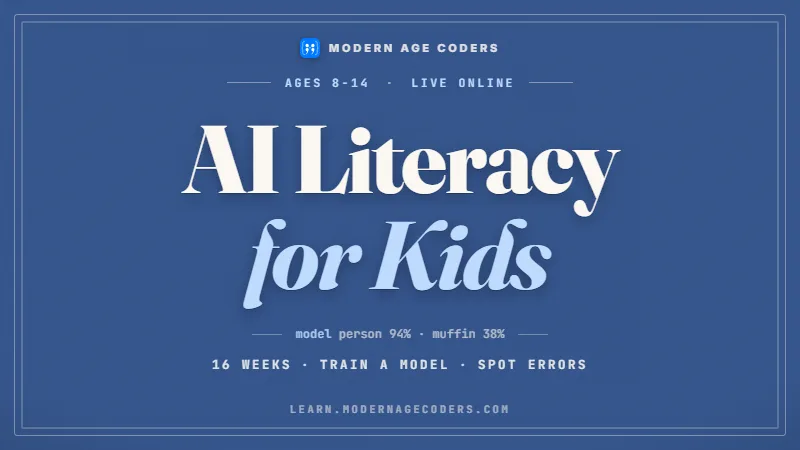
Python and AI for KidsAI Literacy for Kids (Ages 8 to 14)
Ages 13 to 18

Models you can explain

Classifiers, baselines, evaluation and leakage, so a teenager can build a model and defend its numbers.

AI and Machine Learning for TeensData Science for Teens
Ages 18 to 67

AI at work, understood

Adults learn how language models are built and tested, and how to check what a tool has really learned.

Generative AI CourseData Science Course
AI, honestly

A model scored 96.7 per cent. Why should a Cumbrian teenager doubt it?

Because the number alone never says what the model was looking at.

High accuracy is the most convincing and the most misleading number in machine learning. Our classifier was genuinely good at telling two collected editions apart, and partly for reasons that had nothing to do with poetry. The same trap catches real systems: medical models that learn which hospital took the scan, hiring models that learn a postcode, AI detectors that learn a font. The failure is invisible until someone asks the model to show its reasons.

A learner who has found "linenotes" at the top of their own model's list will never again accept an accuracy figure without asking for a baseline, a clean test set and the model's most influential features. That habit is the difference between using AI and being fooled by it, and it is exactly what schools, employers and anyone evaluating an AI claim now need.

So a Cumbrian teenager should learn to code in 2026 to be able to open up a model and see what it has really learned, a skill worth more than any single score. The longer argument is in why teenagers should still learn to code in 2026.

The practical side

Millom to Carlisle with the fells in between

Cumbria's distances are long and its roads slow in winter. Online lessons ignore both.

Taught where you live

A farmhouse table near Wigton, a bedroom in Egremont, a desk in Ulverston. Teacher and learner share one screen.

School words, in English

Year 9 options, GCSEs and A levels are named the way Cumbrian schools name them, and teaching is in English.

The first lesson is free

A proper lesson with real work and a clear recommendation afterwards. There is nothing to pay and no card to give.

A class at your stage

Five to ten learners who have reached the same point, from towns and countries far apart, meeting at a sensible hour.

Your school's holidays

Two lessons a week is typical, paused whenever your own school breaks up.

Always in UK time

Teachers are in India, four and a half hours ahead of UK summer time and five and a half ahead in winter; you only ever see UK time.

Why groups are formed by level

Fifteen towns spread over mountains and coast mean no single place has enough learners at every stage. Level-based groups let a Maryport learner and a Kendal learner share one class.

Fees

Fees in Cumbria

One price for every Cumbrian town, and for every country outside India.

First classUSD 0

A full lesson of real work, finishing with a recommended level and course.

Group tuitionUSD 100

About eight lessons a month in a group of five to ten at the same level.

Private tuitionUSD 150

About eight lessons a month with a teacher and one learner.

We charge in US dollars for all families outside India and have no pound price list. The first payment is taken only after the free lesson has settled a course and weekly slot; pauses, missed lessons and changes between group and private teaching are covered on the pricing page.

Reviews

Families' words, from Google

Rated 4.9 across 547 Google reviews. These are real reviews, reproduced as written.

★★★★★

"The one step solution for my son. Modern Age Coders make learning coding so simple that kids love it. The teachers explain complex concepts clearly with practical exercises and interactive content."

Ria Mukherjee

Parent

★★★★★

"Modern Age Coders has been a game-changer for me. I struggled to grasp IT concepts and coding before joining, but their classes transformed everything. I can now confidently write complex programs with ease."

Samriddha Mondal

Student

★★★★★

"One of the most wonderful education centres out there. Education is not limited to school syllabus but focuses on skill development."

Vansh Agarwal

Student

★★★★★

"My child Dhairya is really enjoying the Modern Age Coders classes. This is his first online class and he eagerly looks forward to it. I can already see his improvement, and the teachers are very cooperative."

Sonam Oswal

Parent of Dhairya

★★★★★

"Modern Age Coders have wonderful teachers who teach in a clear, easy and practical way. The teacher boosts students' confidence and inspires them to learn without hesitation."

Sonu Goyal

Parent

★★★★★

"I highly recommend this computer coding class! The teachers are incredibly knowledgeable and passionate about coding."

Ritu Kedia

Parent

Free placement class

Start with a free lesson

Give us an age or school year and one interest. The first lesson could be an AI literacy session, a first Python word counter, or the Lake poets classifier on this page.

+44

FAQ

Cumbria questions

On the county, the poets project and the lessons.

How many people live in Cumbria?

The 2021 Census counted 499,849 usual residents across Cumbria's six former districts, from ONS figures on Nomis. Carlisle was the largest at 110,024 and Eden the smallest at 54,735.

Which councils cover Cumbria now?

Two unitary councils: Cumberland, which took over from the former Allerdale, Carlisle and Copeland councils, and Westmorland and Furness, covering Barrow-in-Furness, Eden and South Lakeland.

What are the largest towns in Cumbria?

By ONS built-up area: Carlisle 77,730, Barrow-in-Furness 55,255, Kendal 28,940, Whitehaven 22,945 and Workington 21,275. All fifteen above five thousand are listed on this page.

What is the Lake poets project?

Learners build a naive Bayes classifier from free Gutenberg editions of Wordsworth and Coleridge. It reaches 96.7 per cent against a 60.7 per cent baseline, and its most telling words reveal it partly learned the editors' footnotes.

Why does a baseline matter?

Because always guessing the more common author would already score 60.7 per cent here. An accuracy figure only means something compared with that.

Is there a classroom in Carlisle or Kendal?

No. Every lesson is live online, so a learner in Millom and one in Penrith can be in the same class with no journey.

What ages do you teach?

Six to sixty-seven. Scratch and word games for young children, typed Python from about ten, AI and machine learning for teenagers, and data or AI routes for adults. The free lesson decides the starting level.

Do you teach AI to children?

Yes. Our AI literacy course for ages 8 to 14 explains how AI learns from data and where it goes wrong, using age-appropriate supervised tools.

What does it cost?

The first lesson is free. Then a group place is USD 100 a month and private lessons USD 150 a month, with no joining fee and no fixed term.

When are Cumbrian school holidays?

Cumberland, Westmorland and Furness and the academies set their own dates. We arrange lesson breaks around your school's calendar.

Around the UK

Other pages from here

Carlisle has its own page. For other counties see Cheshire, Greater Manchester or Cornwall, and the UK hub for everything else.

Free Cumbria classCall +91 91233 66161

Keep exploring Modern Age Coders

Coding classes in nearby places

Free resources

From the blog

Start here