Skip to content
Calgary, Alberta

Coding and AI classes in Calgary

Can a Calgary student learn coding and AI live with a real teacher, online?

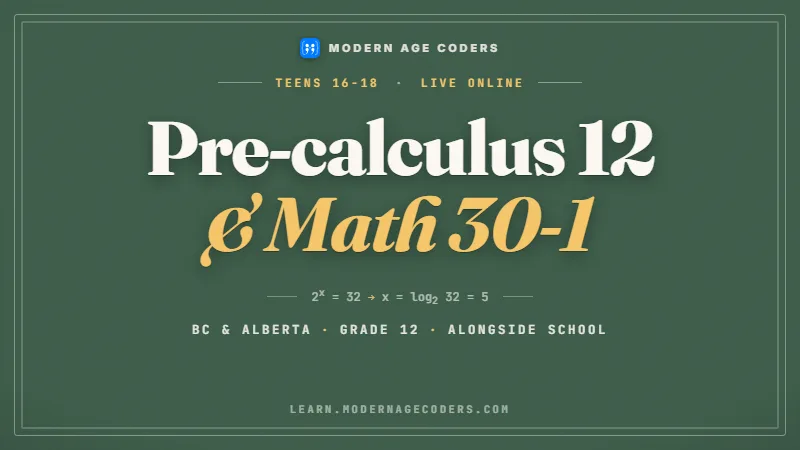
Yes. Modern Age Coders runs live online coding, Python and AI classes for Calgary learners from age 6 to adult, taught one to one or in a class of fifteen to twenty. Young children usually begin with block coding, teenagers with Python for Teens, and Grade 12 students add our Pre-calculus 12 and Math 30-1 course. The first class is free.

For a Calgary student in a Grade 12 diploma course, the course ends at a desk with an Alberta diploma exam, and in Mathematics 30-1 that one sitting is worth 30% of the final mark. Long before then, Alberta's newer elementary math curriculum, brought in for kindergarten to Grade 3 in September 2022 and for Grades 4 to 6 in the 2023 to 2024 school year, has been asking children to reason step by step. Coding is one of the clearest ways to practise that, because a program does exactly what it is told, and a student learns to count, check and explain before trusting an answer. This page sets out the Alberta dates a Calgary family will meet in 2026 to 2027, the CEMC contests open to Calgary students, a project our students run on the City of Calgary playground equipment file, and why Calgary's single all-year clock makes live classes easy to schedule.

Facts last verified 22 October 2026. Teaching is online; no Calgary branch is claimed.

Course picks for Calgary

Four courses Calgary families start with

Matched to Alberta's school stages, then confirmed in a free first lesson where the teacher sees what the student can already do.

Browse the course atlas for more than one hundred options and use the coding roadmap to check prerequisites.

The four we are known for

Python, AI, vibe coding and agentic coding

These run underneath everything above. Every one is live and online, placed by ability rather than by age, and the first class is free.

Alberta school stages

The Alberta dates and rules a Calgary student meets on the way to Grade 12

Calgary schools follow Alberta's curriculum and its provincial exams. We read the government pages and bulletins below on 22 October 2026; short quotations are Alberta's, the rest is our summary.

Mathematics 30-1 diploma exam sittings for 2026 to 2027, from Alberta's 2026-2027 General Information Bulletin (each sitting 9 am to noon; read 22 October 2026)
SittingDateWritten with
NovemberTuesday 3 November 2026Mathematics 30-2, same morning
JanuaryWednesday 20 January 2027Mathematics 30-2, same morning
AprilThursday 8 April 2027Mathematics 30-2, same morning
JuneThursday 17 June 2027Mathematics 30-2, same morning

Seventy and thirty

Alberta says diploma exam weighting returned to 30% from 1 September 2023: 70% of the final mark comes from course work and 30% from the exam. To pass the course, the combined mark has to reach at least 50%.

January 2026 was cancelled

Alberta cancelled its January 2026 diploma exams and Grade 9 Provincial Achievement Tests. A Calgary student planning around a January sitting should check the current bulletin rather than last year's habits.

On a screen, not on paper

Alberta now has students write diploma exams and achievement tests digitally rather than with pencil and paper. Typing, reading carefully on a screen and checking work there are skills a coding class practises every week.

Below Grade 12, the math curriculum itself has changed. Alberta's renewal timeline shows the new elementary math arriving in two steps: kindergarten to Grade 3 in September 2022, then Grades 4 to 6 in the 2023 to 2024 school year. A Calgary child in elementary school today is learning from that newer program. Our guide to Alberta's new math curriculum sets out what changed, and families with a Grade 12 student can read about Math 30-1 diploma preparation and choosing between Math 30-1 and 30-2.

What we do, and do not, provide

We teach alongside a student's Alberta courses and we do not grant Alberta credits or diploma exam marks; those come only from school and from Alberta Education. We are not connected with Alberta Education, any Calgary school board or the City of Calgary.

Calgary data project

Rows are not swings: counting Calgary's playground equipment properly

The City of Calgary publishes a list of playground equipment that Calgary Parks maintains or that sits on land in its care, updated weekly. Our students use it to learn the difference between counting rows and counting things. All figures below are ours, worked out from the copy we downloaded on 22 October 2026.

Rows by equipment type, as we counted them in the City of Calgary Playground Equipment file (5,905 rows; top eight types; downloaded 22 October 2026). One row is one piece of equipment as the city records it
TYPE_DESCRIPTION in the fileRows
SWING1,225
MULTI PLAY COMPLEX1,116
SPRING TOY684
CLIMBER592
STATIONARY TOY543
SPINNING TOY494
TEETER TOTTER SEESAW382
FITNESS EQUIPMENT291

A child asked how many swings Calgary has will read 1,225 off that table. That is the number of swing rows, and a swing frame can hold several seats. The file has columns for that, COUNT_SR_SWING for standard seats and COUNT_BABY_SWING for baby seats, and adding them up gives a different and more interesting answer. This short program counts the types, sums the seats and runs one more check. Nothing beyond the standard library is needed, and it looks for the CSV in its own folder:import csv from collections import Counter by_label = Counter() seats = Counter() blank_baby = 0 labels_for_code = {} with open("playground-equipment.csv", encoding="utf-8-sig") as equipment: for row in csv.DictReader(equipment): label = row["TYPE_DESCRIPTION"] by_label[label] += 1 labels_for_code.setdefault(row["ASSET_TYPE"], set()).add(label) if label == "SWING": for column in ("COUNT_SR_SWING", "COUNT_BABY_SWING"): if row[column].strip(): seats[column] += int(row[column]) if not row["COUNT_BABY_SWING"].strip(): blank_baby += 1 for label, n in by_label.most_common(8): print(label, n) print(dict(seats), "| SWING rows with no baby-seat count:", blank_baby) for code in sorted(labels_for_code, key=int): if len(labels_for_code[code]) != 1: print("code", code, "has labels", sorted(labels_for_code[code]))

1. Count rows

A Counter tallies TYPE_DESCRIPTION once per row. It answers how many pieces of each type the city lists, which is a fair question with a clear answer: 1,225 swings, 1,116 multi play complexes, 684 spring toys.

2. Sum quantities

On the swing rows, the seat columns add up to 1,356 standard seats and 1,162 baby seats. But 176 swing rows leave the baby-seat count blank, so 1,162 is a floor, not a total: the true number can only be higher.

3. Check codes against labels

Each type also has a numeric code in ASSET_TYPE. Code 1 should always mean SWING, yet one code-1 row says CLIMBER; code 5 carries SPINNING TOY, KIDS_TABLE and one SPRING TOY. Those few rows are worth a polite email to the city, not a guess.

More of our checks on the same City of Calgary file (our counts; the city publishes none of these totals)
QuestionWhat we found
Rows marked ACTIVE and INSTALLED in LIFE_CYCLE_STATUS5,684 and 221
INSTALLED rows maintained by DEVELOPER CONSTRUCTIONAll 221 of them
Rows that are not swings but still hold a swing-seat count144
EQUIPMENT_AGE_CLASS: SENIOR, JUNIOR, COMBINED, blank1,811, 1,370, 992 and 1,732

Where the file stops

The file lists equipment, not playgrounds, and it does not tell us how many separate playgrounds there are, how old each piece is or what state it is in. SENIOR and JUNIOR are the city's own age classes for equipment; we do not guess the ages behind them. Saying exactly what a count means is the part of the lesson that lasts.

The licence is the Open Government Licence - City of Calgary, version 2.1, which permits commercial use as long as the source is credited. Contains information licensed under the Open Government Licence - City of Calgary (licence, dataset page). The counts are ours; the City of Calgary has no part in this page or in our teaching.

Contests from Calgary

CEMC contests Calgary students can enter in 2026 to 2027, starting young

Schools across Alberta order contests from CEMC, the math and computing centre at the University of Waterloo. Three of them suit a Calgary student meeting code for the first time. Dates are CEMC's for the Americas, checked 22 October 2026.

Three CEMC contests that work as first contests for Calgary students, 2026 to 2027 (CEMC wording and dates)
ContestWho it suitsCEMC dateWhy it fits a beginner
Beaver Computing ChallengeAny student in Grade 10 or younger, in three levels9 to 20 November 2026CEMC says it needs only concepts from the math curriculum, no coding
GaussGrades 7 and 8, and keen younger students10 to 21 May 2027Twenty-five multiple-choice math questions in an hour
CCC JuniorAny grade, beginner to intermediate programmersWednesday 17 February 2027Its first questions test basic loops and conditions

Ask the school

CEMC does not take individual registrations: in its words, all students must participate through their school. A Calgary student whose school does not order a contest can ask another local school to let them write there.

Younger writers welcome

The Gauss contest is set for Grades 7 and 8, but CEMC adds that motivated students in lower grades are welcome. A strong Grade 6 coder often enjoys it as a first taste.

Free practice

CEMC posts ten years of past papers free, with no account needed. We send students to CEMC's archive to practise and teach with problems of our own, never CEMC's.

The CCC Junior ladder starts where the playground project starts: a loop over input, a condition, a count. By the later Junior questions CEMC expects counting combined with loops and conditions, then recursion and two-dimensional arrays. Our CCC preparation page describes how we build up to it, and the Waterloo math contest page covers Gauss and the high school contests. CEMC and the University of Waterloo have no link with us.

Class times

One clock all year: Calgary time and India time

Alberta's Official Time Act fixes official time at 6 hours behind Coordinated Universal Time, with no spring or autumn change. That makes Calgary one of the easiest cities to schedule from India, where our teachers are.

Calgary example hours shown in India time (Calgary UTC-6 all year under Alberta's Official Time Act; India UTC+5:30; arithmetic ours)
Calgary hourSame moment in IndiaSame moment in Toronto
Wednesday 4 to 5 pmThursday 3:30 to 4:30 am5 to 6 pm in winter, 6 to 7 pm from 14 March 2027
Saturday 10 to 11 amSaturday 9:30 to 10:30 pm11 am to noon in winter, noon to 1 pm from 14 March 2027

No change in November

Eastern Canada changes its clocks on 1 November 2026 and again in mid-March 2027; Calgary does not. A Calgary class keeps the same Calgary hour all year, and only its Eastern equivalent shifts.

Neighbours on the map

Saskatchewan also keeps UTC-6 all year, so Regina and Calgary read the same time. British Columbia now sits on UTC-7 all year, one hour behind Calgary in every month.

Calgary numbers

Calgary numbers use 403, with 587, 825 and 368 shared across Alberta. Any of them works in the form as ten digits; the +1 is filled in for you.

Learning ladder

From block coding in Grade 1 to Math 30-1 and machine learning

Grades are a guide. A free first class decides where each learner really starts.

Grades 1 to 3

Blocks and order

Short block programs, animations and puzzles, with the order of steps as the first big idea.

Coding for KidsScratch Coding for Kids
Grades 4 to 6

Into Python

Typed code with loops and conditions, built on the step-by-step reasoning Alberta's newer math program asks for.

Python and AI for KidsMaths Through Coding
Grades 7 to 10

Python and contests

Python properly, real data files and a first CCC Junior for students who want a contest.

Python for TeensCCC Junior and Senior Preparation (Canadian Computing Competition)
Grades 11 and 12

Math 30-1 and AI

Diploma-year math alongside school, and machine learning for students heading to engineering or science.

Western Canada Grade 12 MathAI and Machine Learning for Teens
Coding and AI

An AI tool will count the swings. Will it say the count is a floor?

Not unless someone asks the right question.

Hand an AI assistant the Calgary playground file and ask how many swings there are, and it may report 1,225, the number of rows. Ask for seats and it may add the columns and report 1,162 baby seats as a total, without noticing the 176 blanks that make it a minimum. Both answers look confident. Only a student who has written the sum themselves knows which one to believe.

So we teach students to think through a problem before typing: what is being counted, what could be missing, and how to check. Older students use AI tools too, inside the age limits we keep to, as a way to test and extend their own reasoning, never as a replacement for it.

Alberta's diploma exams reward the same habit: read the question exactly, show the working, and check the answer against what was asked. The longer argument is in why we still think every student should learn to write code.

Delivery

Live online classes for Calgary and nearby towns

Every class is online, so a student in the northwest and one in the deep south of the city share a teacher with no drive across town.

When classes run

Weekdays or weekends, flexible: choose your batch, or for a very personalised plan choose 1-on-1 at your convenience, weekend mornings or weekdays.

Two ways to learn

Learn in a class of fifteen to twenty at the same stage, or book a teacher to yourself for a faster pace, contest work or Math 30-1.

Alberta grades

Teachers plan in Alberta grades and course names, so Math 30-1 means the right thing and diploma dates are on the calendar.

Around Calgary

Families in Airdrie, Cochrane, Chestermere and Okotoks join the same classes on the same Alberta clock.

What to have ready

A computer with a keyboard, a microphone and internet that can hold a video call. Typing real code is slow on a tablet, so we ask for a keyboard.

The free first class

It is a real lesson, free, and at the end the teacher suggests a level, a course and a time. We ask for no payment details.

No Calgary centre

Modern Age Coders has no office or classroom in Calgary or anywhere in Alberta, and claims none. Lessons are live and online, taught from India.

Fees

Fees for Calgary families

The fees appear with their currency code beside each figure.

First classFree

One complete live lesson at no charge, finished with a recommended level, course and time.

Group tuition$140 CAD

The monthly fee for a place in a group of fifteen to twenty students at the same stage.

Private tuition$210 CAD

The monthly fee for private lessons with one teacher, at hours you choose.

A Calgary family pays the same monthly fee as a family anywhere else in Canada. Billing starts only once you have taken the free lesson and settled on a course and a time. Holidays and missed sessions are covered on the pricing page.

Reviews

What our families and students write on Google

Rated 4.9 across 547 Google reviews. These are real reviews, reproduced as written.

★★★★★

"The one step solution for my son. Modern Age Coders make learning coding so simple that kids love it. The teachers explain complex concepts clearly with practical exercises and interactive content."

Ria Mukherjee

Parent

★★★★★

"Modern Age Coders has been a game-changer for me. I struggled to grasp IT concepts and coding before joining, but their classes transformed everything. I can now confidently write complex programs with ease."

Samriddha Mondal

Student

★★★★★

"One of the most wonderful education centres out there. Education is not limited to school syllabus but focuses on skill development."

Vansh Agarwal

Student

★★★★★

"My child Dhairya is really enjoying the Modern Age Coders classes. This is his first online class and he eagerly looks forward to it. I can already see his improvement, and the teachers are very cooperative."

Sonam Oswal

Parent of Dhairya

★★★★★

"Modern Age Coders have wonderful teachers who teach in a clear, easy and practical way. The teacher boosts students' confidence and inspires them to learn without hesitation."

Sonu Goyal

Parent

★★★★★

"I highly recommend this computer coding class! The teachers are incredibly knowledgeable and passionate about coding."

Ritu Kedia

Parent

Free placement class

Tell us about your Calgary student

The first task depends on the student: a block-coded animation for a Grade 1 child, a Python quiz for a Grade 6 student, or the playground file for a teenager ready for messy data.

+1

FAQ

Calgary coding and AI questions

Questions Calgary parents and students ask us most.

Are there coding classes for kids in Calgary with a live teacher?

Yes, online. From age 6, children learn with a live teacher over video, either in a class of fifteen to twenty or privately. There is no Calgary building to visit.

What does Alberta school expect in math before Grade 12?

Alberta brought in new elementary math in two steps, kindergarten to Grade 3 in September 2022 and Grades 4 to 6 in 2023 to 2024. In Grade 12, Mathematics 30-1 ends with a diploma exam worth 30% of the final mark, with course work making up the other 70%.

When are the 2026 to 2027 Math 30-1 diploma exams?

Alberta lists Tuesday 3 November 2026, Wednesday 20 January 2027, Thursday 8 April 2027 and Thursday 17 June 2027, each from 9 am to noon. Check the current bulletin before planning.

Do your classes count toward Alberta credits?

No. We do not grant Alberta credits or diploma marks. Our Math 30-1 and coding courses run alongside school, and all credits are earned there.

Do you have robotics classes in Calgary?

We teach the coding behind robotics, not the hardware: Python, logic and working with sensor data. A student who wants to build robots should join a school or community team as well.

Are there Python classes for Calgary teens?

Yes. Python for Teens starts at a student's first line of code and works up to reading files, writing functions and handling data; our AI and machine learning course follows on from it.

Which AI tools will my Calgary teen use in class?

Only tools suitable for their age. Tools with an adult-only rating, Claude among them, are never used with under-18 students. If a lesson involves ChatGPT, a teenager needs a parent's permission, and we get it before that lesson.

Does Calgary change its clocks for class times?

No. Alberta keeps UTC-6 all year under its Official Time Act, so a Calgary class stays at the same Calgary hour in every month.

When do classes run for Calgary students?

Weekdays or weekends, flexible: choose your batch, or for a very personalised plan choose 1-on-1 at your convenience, weekend mornings or weekdays. We write every confirmed time in Calgary time.

Will a 403 or 587 number work in your form?

Yes. Calgary numbers with 403 and Alberta numbers with 587, 825 or 368 are all accepted; type the ten digits that follow the +1.

Where are the fees shown?

In the fees section further down: first the free lesson, then what a group place and private lessons cost per month, with the currency code printed beside each. Billing starts only after the free lesson.

More for Canada

Other pages for Calgary and Alberta students

The province-wide picture is on coding classes in Alberta, and the national one on coding classes in Canada. Math families can use Math 30-1 tutoring and Grade 9 PAT practice, and contest students CCC preparation.

Free classPriority demoCall us

Keep exploring Modern Age Coders

Coding classes in nearby places

Learn more

Free resources

From the blog

Start here