COA / G / 01
Scratch coding
Games from scratch.
Open the syllabusUnited States · Ages 6 to 18 · codakid.com, 17 October 2026
CodaKid, based in Scottsdale, Arizona, built its name on self-paced video courses where children code real games in tools like Roblox Studio, Minecraft and Unity, and it now also offers live private lessons and week-long camps. The real choice behind most searches for a CodaKid alternative is not one company against another but self-paced learning against a live class. Below are CodaKid’s own published facts as of 17 October 2026, an honest look at what each way of learning asks of a child, and a one-week test you can run at home.
Checked against codakid.com · 17 October 2026 · no winner declared
In short
CodaKid offers three ways to learn for ages 6 to 18: more than 115 self-paced video courses with 24/7 AI-powered support and scheduled teacher sessions, live 50-minute 1-on-1 lessons on Zoom, and live small-group camps of two hours a day for a week. Modern Age Coders teaches only live: weekly classes with a teacher, in a batch, a mini batch of up to six, or privately, from age 6 into adulthood.
Live versions of familiar topics
Minecraft, Roblox and Python are central to CodaKid’s library. Here they are as live weekly courses.
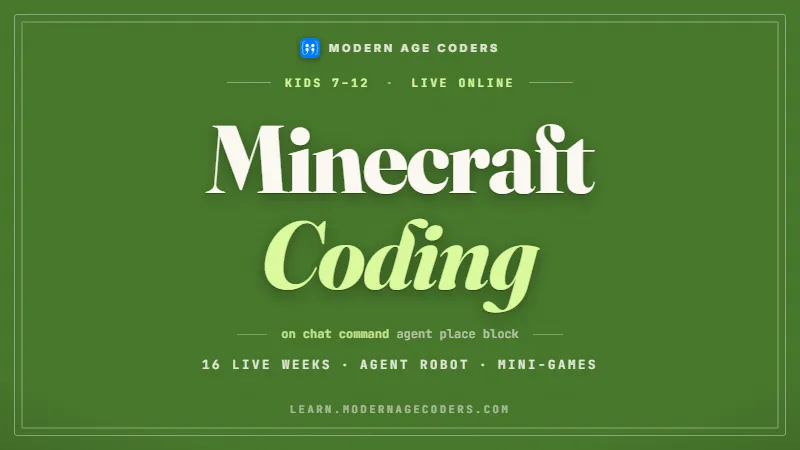
COA / 01
Younger children. From blocks to real code, with a teacher.
Open the syllabus →
COA / 02
Middle grades. Luau games built live.
Open the syllabus →
COA / 03
Upper elementary and middle school. Python with a teacher on hand.
Open the syllabus →Three ways
CodaKid presents its programs as three distinct options. Here they are in its terms, from codakid.com on 17 October 2026; prices are on its site.
| Program | How it works | Trial |
|---|---|---|
| Self-paced | More than 115 video courses; 24/7 AI-powered learning support; scheduled sessions with an instructor | First 14 days free |
| Private 1:1 | The same certified instructor each week; live 50-minute lessons over Zoom; homework; a progress report after each session | First session free |
| Virtual camps | One week, Monday to Friday, two hours a day, live in a small group; every session recorded | Not stated |
Its FAQ lists Python, JavaScript, Java, Lua, Scratch, C#, HTML, CSS and Unreal Blueprints, using tools such as Roblox Studio, Unity and Unreal Engine. Children build games, mods and websites rather than isolated exercises.
Its private tutors use what CodaKid calls the Mastery Method, a Socratic approach of asking guiding questions instead of handing over answers.
CodaKid says most of its courses can be finished in a couple of hours, while intermediate and advanced ones can take upwards of 20 hours. That short course length suits bite-sized progress.
A Family Plan covers up to three students on the self-study program, each with an account under one parent login.
Sources: codakid.com, its FAQ, private lessons and camps pages, read 17 October 2026. CodaKid has no link to Modern Age Coders, and its programs may have changed since.
Starting ages
CodaKid publishes a starting age for every course family, which is useful for any parent planning a sequence.
| Topic | CodaKid starting age |
|---|---|
| Scratch and JavaScript courses | 6+ |
| Minecraft and Roblox | 8+ |
| Minecraft and Roblox with professional languages | 9+ |
| AI courses | 9+ |
| Python | 10+ |
| Unity, Unreal Engine and web development | 12+ |
Read across, the ages describe a common sequence: blocks first, then a game world with a real language, then Python, then full engines. Our own courses follow a similar order, which makes it easy to move between the two schools at a natural break.
Self-paced vs live
The heart of the comparison. Neither model is better in general; each fits a different child and a different week.
| Question | Self-paced video | Live class |
|---|---|---|
| When does learning happen? | Any time, any length | At a set time each week |
| Who notices when a child is stuck? | The child must ask; AI support and scheduled teacher sessions help | The teacher, during class |
| What keeps the habit going? | The child’s own drive, or a parent | The timetable and the group |
| How fast can a child go? | As fast as they like | At the class pace, or faster 1-on-1 |
| Which child it suits | Independent, self-starting children | Children who need prompts and conversation |
A child who already loves building, works happily alone and hates waiting for classmates can fly through a library of short courses. CodaKid’s round-the-clock AI support is designed for exactly the moment when that child gets stuck at nine at night.
It is also a sensible fit for a family whose schedule changes every week.
A child who stalls quietly, skips the hard parts or needs to talk ideas through usually learns more with a person present at a fixed time. The appointment itself does part of the work.
CodaKid recognises this with its live private lessons and camps; our school is built only on live classes.
A one-week test
Our suggestion for deciding with evidence: keep a simple log for a week, then let a few lines of Python summarise it. The numbers below are a made-up sample.
# minutes coded and minutes spent stuck, one week of self-paced study (our sample log)
week = {
    "Mon": (30, 5), "Tue": (0, 0), "Wed": (45, 20), "Thu": (20, 0),
    "Fri": (0, 0), "Sat": (60, 25), "Sun": (15, 0),
}

coded = sum(m for m, s in week.values())
stuck = sum(s for m, s in week.values())
active_days = [d for d, (m, s) in week.items() if m > 0]

print("minutes coded:", coded)
print("share stuck:", f"{stuck / coded:.1%}")
print("days with any coding:", len(active_days))
Output: minutes coded 170, share stuck 29.4%, days with any coding 5. The share is 50 / 170 = 0.294.
| What the week shows | What it may suggest |
|---|---|
| Coding most days and rarely stuck | Self-paced is working; keep going |
| Coding most days but stuck a lot | Add live help: a teacher session or private lessons |
| Coding on few days | A fixed weekly class may build the habit |
| Stuck time spent on one topic | A teacher can unblock that topic quickly |
In the sample, almost a third of the coding time went on being stuck, mostly on two days. That is not failure; it is a sign the child is attempting hard things. The question is whether those stuck minutes end in a breakthrough or in closing the laptop, and only the child can tell you that.
Our setup
Differences stated as facts, so you can weigh them against your child.
| Point | CodaKid | Modern Age Coders |
|---|---|---|
| Main model | Self-paced video library | Live weekly classes |
| Live options | 1-on-1 lessons; week-long camps | Batches, mini batches of up to six, 1-on-1 |
| Ages | 6 to 18; adults use self-study too | From 6, including adults |
| Private lesson | 50 minutes, same instructor weekly | Same teacher weekly, times agreed with you |
| Trial | 14 free days (self-paced); free first private session | A free first lesson |
| Subjects | Coding and AI | Coding, AI and maths |
An independent child who wants a big library to explore at their own speed, or a family wanting a private tutor in a specific game tool.
A child who learns best with a teacher and classmates at a fixed time, or a family wanting maths as well.
Self-paced projects between weekly live classes, so practice and teaching support each other.
Two practical differences are easy to miss. CodaKid’s private lessons are 50 minutes with the same certified instructor, and its self-study program bills every 30 days after the trial; ours bill monthly for whichever live format you choose. And CodaKid publishes a starting age for every topic, which we find genuinely helpful; we place by a short check in the first lesson, so a younger child with real experience is not held back by a number.
Where your child is
Stages we see in children who arrive after a self-paced program.
| Stage | What it looks like |
|---|---|
| 1. Explorer | Finishes short courses happily; follows the videos closely |
| 2. Copier | Can repeat what the video did but not change it |
| 3. Tinkerer | Changes projects, sometimes gets stuck for days |
| 4. Designer | Wants to build their own idea from scratch |
Stage 2 is where a teacher’s questions help most: "what would happen if you changed this line?"
At stage 4, a child needs feedback on design, not just code, which is easier live.
Try changing one thing in a finished course project without the video. That shows you what you really learned.
Keep a list of ideas; a teacher can help you pick one to build.
Our catalogue
Each taught weekly by one teacher, live, in a group, a mini batch or privately.
COA / G / 01
Games from scratch.
Open the syllabusCOA / G / 02
Mods and logic.
Open the syllabusCOA / G / 03
Three platforms.
Open the syllabusCOA / L / 01
Scripting games.
Open the syllabusCOA / L / 02
Typed code first.
Open the syllabusCOA / L / 03
Puzzles and games.
Open the syllabusCOA / E / 01
C# and shipped games.
Open the syllabusCOA / E / 02
CSS to React.
Open the syllabusCOA / E / 03
The full language.
Open the syllabusHow our lessons run
Weekdays or weekends, flexible: choose your batch, or for a very personalised plan choose 1-on-1 at your convenience, weekend mornings or weekdays.
Weekdays
A fixed after-school slot builds the habit.
Weekends
Morning classes in your time zone.
1-on-1
For a child who wants to go faster.
No waiting for a support session.
Students alter code, not replay videos.
Ideas from other children.
Feedback on design as well as code.
Timed for US families.
Change format after a month.
Student work
Projects our students designed with a teacher alongside. See more at student labs.

AI and ML
An AI nutrition coach that reads what you eat and works you toward a target.

AI and ML
A chatbot that answers mathematics and programming questions, built and deployed by a student.

AI and ML
An assistant that helps a young person recognise unsafe situations online.

Web app
A weather forecasting site with live conditions for any location.
Fees
We charge monthly in US dollars for live classes. CodaKid publishes its own subscription and lesson prices on its site, so we leave them there.
Free first class
USD 0
no card required
Group batch
USD 100
a month, billed in US dollars
One to one
USD 150
a month, billed in US dollars
What families say
Reviews our families posted on Google, unaltered.
★★★★★
"The one step solution for my son. Modern Age Coders make learning coding so simple that kids love it. The teachers explain complex concepts clearly with practical exercises and interactive content."
Ria Mukherjee
Parent
★★★★★
"Modern Age Coders has been a game-changer for me. I struggled to grasp IT concepts and coding before joining, but their classes transformed everything. I can now confidently write complex programs with ease."
Samriddha Mondal
Student
★★★★★
"One of the most wonderful education centres out there. Education is not limited to school syllabus but focuses on skill development."
Vansh Agarwal
Student
★★★★★
"My child Dhairya is really enjoying the Modern Age Coders classes. This is his first online class and he eagerly looks forward to it. I can already see his improvement, and the teachers are very cooperative."
Sonam Oswal
Parent of Dhairya
★★★★★
"Modern Age Coders have wonderful teachers who teach in a clear, easy and practical way. The teacher boosts students' confidence and inspires them to learn without hesitation."
Sonu Goyal
Parent
★★★★★
"I highly recommend this computer coding class! The teachers are incredibly knowledgeable and passionate about coding."
Ritu Kedia
Parent
Questions from families
Both. Its main program is self-paced video courses, more than 115 of them, and it also offers live 50-minute private lessons on Zoom and live week-long camps, according to its own site on 17 October 2026.
Ages 6 to 18, with each course listing a starting age, from 6+ for Scratch to 12+ for Unity, Unreal and web development. Its FAQ says adults also use the self-study courses.
Its FAQ describes a 14-day free trial of the self-study program and a free first session for private tutoring, with billing starting afterwards.
Its camps page says every session is recorded, so a missed day can be caught up.
We teach only live classes, in batches, mini batches of up to six or privately, for ages 6 and up, with maths as well as coding and teachers based in India. CodaKid is mainly self-paced, with live private lessons and camps.
An independent child who enjoys working alone may do well self-paced; a child who needs prompts and conversation often does better live. Logging one week of self-paced study, as shown on this page, helps you see which.
Yes. Self-paced projects between weekly classes give practice, and the teacher can help with whatever got stuck.
Its FAQ lists Python, JavaScript, Java, Lua, Scratch, C#, HTML, CSS and the Unreal Blueprints scripting language, used in tools such as Roblox Studio, Unity and Unreal Engine.
Weekdays or weekends, flexible: choose your batch, or for a very personalised plan choose 1-on-1 at your convenience, weekend mornings or weekdays.
No. Modern Age Coders is a separate school. We summarise CodaKid's public pages and link to them.
Elsewhere on this site
Choosing between self-paced and live learning.
The question at the heart of this page.
Another self-paced platform compared.
App or teacher.
Live Minecraft coding.
A guide for young builders.
Our US hub page.
Coding with Kids and Modern Age Coders, compared on published facts.
Khan Academy CS or live classes? A fair comparison, built from Khan Academy descriptions of its course.
Six US online coding class providers for kids, compared on their own published facts.
Start here
Bring a project your child made on any platform. The teacher will ask them to change something in it, which is the quickest way to see what they understand.
For background, read how we run a class or open a syllabus from our courses.
WhatsApp us · +91 91233 66161 · connect@modernagecoders.com
Every class is taught live by video from India, at US-friendly times, never replaced by a recording. Ask us anything on WhatsApp.
A priority demo is a full class of about 45 to 60 minutes. After the class the mentor sends a written skill report and a personal learning roadmap on WhatsApp. If you enrol, the demo fee is adjusted against your first month's fee. Share your demo Order ID with us on WhatsApp and we take it off.
Book a priority demo