Skip to content
Home/United Kingdom/Wales/Monmouthshire
Monmouthshire

Coding classes in Monmouthshire

What are the best coding classes in Monmouthshire?

Monmouthshire had 92,957 usual residents at the 2021 census. Abergavenny, Chepstow and Monmouth are its three main towns, each above 10,000 people, with Caldicot close behind and Undy and Magor, Usk, Gilwern and Llanfoist among the smaller places. Teachers in India run each lesson live by video, and a trial session at no cost shows where a Year 4 child, a sixth former or an adult ought to start. Coding, Python and maths are open to anyone from 6 to 67, taught solo or in a class of five to ten at one level. The Monmouthshire project starts at a hilltop roundhouse above Monmouth. Families who continue pay USD 100 monthly for group classes or USD 150 monthly for solo tuition.

In 1794 a dining club in Monmouth built a small round tower on the highest point of The Kymin, purely to enjoy the view. Cadw lists the Kymin Roundhouse at Grade II* and records that Nelson breakfasted there in 1802, that its windows were supposedly aligned on objects in the view, and that its flat roof once carried a telescope for the members. A telescope does more than make things bigger. The size of its lens sets the finest detail it can ever show, because light spreads slightly as it passes through any opening. And the air itself adds a shimmer that no lens can beat. How much detail could the club have seen, and what really limited it? Python gives the answer below.

Facts last verified 26 September 2026. Teaching is online; no Monmouthshire branch is claimed.

Courses for Monmouthshire

Starting points around Monmouthshire

A Year 1 pupil in Usk who loves binoculars, a Year 6 in Caldicot ready to type code, a Year 11 in Abergavenny preparing for WJEC GCSE maths, and an adult in Chepstow teaching themselves Python. Each begins with a free lesson.
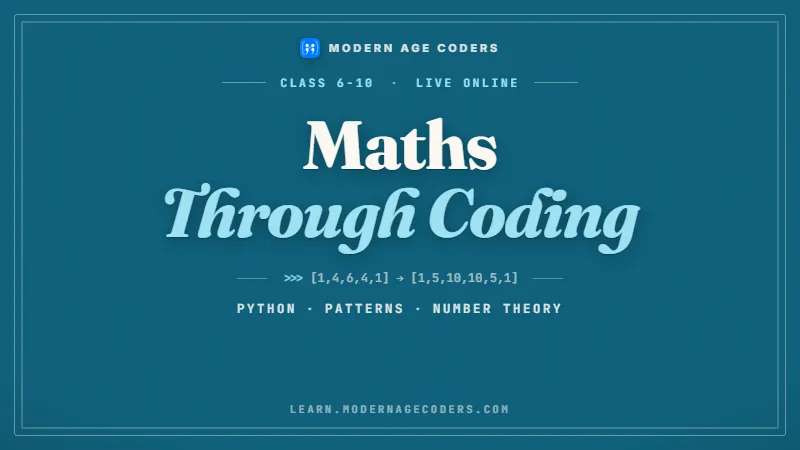
Browse the course atlas for more than one hundred options and use the coding roadmap to check prerequisites.

The four we are known for

Python, AI, vibe coding and agentic coding

These run underneath everything above. Every one is live and online, placed by ability rather than by age, and the first class is free.

Monmouthshire in figures

92,957 people in Monmouthshire

ONS counted 92,957 usual residents in Monmouthshire on census day 2021, read here through Nomis. Town figures below are ONS built-up areas, counted on that same day.

Monmouthshire built-up areas of 2,000 or more people, ONS 2021
TownPeopleTownPeople
Abergavenny13,695Undy and Magor5,740
Chepstow11,935Usk2,310
Monmouth10,325Gilwern2,185
Caldicot9,815Llanfoist2,005

Each figure matches our own output-area total to within six people. Monmouthshire's schools teach the Curriculum for Wales, and exam classes follow WJEC GCSE and A level courses. Monmouthshire County Council sets the holidays; we have not read its calendar, so each family tells us its own dates.

Newport and WJEC exams

The city of Newport has its own page. For exam support, see GCSE Maths and Numeracy in Wales and WJEC GCSE Computer Science.

The Monmouthshire project

How fine can a lens see?

One formula for light spreading through an opening, and one number for shimmering air.

Light passing through any circular opening spreads a little, which blurs every point into a tiny disc. The smallest angle a lens can separate, its angular resolution at the diffraction limit, is about 1.22 times the wavelength divided by the opening's width. Green light has a wavelength of about 550 billionths of a metre. The learner codes the formula, converts the angle from radians into arcseconds, the astronomer's unit where 3,600 make a degree, and multiplies by distance to find the smallest detail that could be seen. The distances and telescope sizes are our own choices; the record does not say what the club's telescope was.

Our resolution sums, green light, 26 September 2026
OpeningFinest angleSmallest detail at 5 kmAt 10 km
Eye pupil, 5 mm27.7 arcsec0.67 m1.34 m
Telescope, 3 cm4.6 arcsec11 cm22 cm
Telescope, 5 cm2.8 arcsec7 cm13 cm
Telescope, 10 cm1.4 arcsec3 cm7 cm

Doubling the width of the lens halves the finest angle, so a 10 centimetre telescope could in principle pick out detail about twenty times finer than the pupil of an eye. Real eyes do worse than their pupil suggests, typically about a minute of arc, because of the retina behind them. But the telescope has a limit too: the air. Warm and cool pockets bend light slightly and set a shimmer that astronomers call seeing. On a good night that is about one arcsecond, and along the ground on a sunny day it is usually worse. One arcsecond at 10 kilometres is about 5 centimetres.

So which limit wins? The learner finds the crossover by setting the diffraction limit equal to one arcsecond: an opening of about 14 centimetres. For any telescope smaller than that, the lens is the bottleneck; for anything bigger, the air is. A classic slip also appears: forgetting to convert arcseconds to radians. Treat one arcsecond as one radian and the program claims the smallest visible detail at 10 kilometres is 10 kilometres wide, an answer so wrong it is easy to catch, if someone checks.

Ages 8 to 11

Test how far away two dots can be told apart by eye, then draw the experiment in Scratch.

Ages 11 to 15

Code the diffraction formula in Python and print the smallest detail for different lenses and distances.

Ages 15 and up

Add atmospheric seeing, find the crossover aperture, and write a test that catches the arcsecond-radian slip.

A real tower, a model telescope

The Roundhouse history comes from Cadw's record. The telescope sizes, distances and seeing figure are our assumptions, so the table shows the physics of any hilltop view rather than what the Kymin Club actually saw.

Why the Kymin

A roundhouse built for a view

What Cadw's record says.

The Kymin Roundhouse, Monmouth, Cadw listed building record 2222, Grade II*
Record detailWhat it says
Built1794, by the Kymin Club as a picnic house
SiteThe highest point of The Kymin, chosen for its views
VisitorsNelson and the Hamiltons breakfasted there in 1802
WindowsSupposedly aligned on objects in the view
RoofFlat, once carrying a telescope for the members
OwnershipGiven to the National Trust in 1902

Resolution limits decide what phone cameras, microscopes, satellites and self-driving cars can see, and engineers balance lens size, sensor size and atmospheric effects in software every day. The same one-line formula explains why telescopes keep getting larger and why the largest ones need systems to correct for the air. A Monmouthshire student who has found the crossover between lens and air understands a real design trade-off.

We have no connection with Cadw, the National Trust or Monmouthshire County Council. The record belongs to Cadw; the resolution sums and any errors belong to us.

Learning path

From spotting games to optics

The year bands are rough guides; the trial lesson places each learner.

Years 1 to 4

Looking closely

Block coding with zooming, spotting and simple light games.

Coding for KidsScratch Coding for Kids
Years 5 to 8

Angles and units

Typed Python converting angles and working with tiny numbers.

Maths Through CodingPython and AI for Kids
Years 9 to 13

Physics formulas

Waves, optics and standard form alongside WJEC GCSE and A level courses.

High School MathematicsPython for Teens
Adults

Science in Python

Python for adults, from quick calculations to reusable tools.

Python MasterclassData Analysis Course
AI and limits

An AI can quote a resolution formula in seconds. Will it tell you the air wins?

The formula is only half the answer; knowing which limit applies is the other half.

Ask a chatbot how much detail a big telescope can see and it may apply the diffraction formula alone, promising impossibly fine detail along the ground. The shimmer of the air, which dominates beyond a modest lens size, is easily left out.

A Monmouthshire learner who has compared the two limits knows to ask which one actually applies. That is the kind of question that keeps AI answers honest.

Spotting the missing limit in a confident answer is a skill a Monmouthshire teenager builds by coding the sums. The longer argument is in why teenagers should still learn to code in 2026.

How lessons run

From Usk to Caldicot, lessons at home

Every town and village in the county joins by video.

Pupils write the code

Every line on screen is typed by the learner; the teacher watches the shared window and steps in only when stuck.

Welsh years and WJEC

We place a Magor Year 5 or a Monmouth Year 12 using Welsh school years and Curriculum for Wales progression steps, and name exams as WJEC does. Lessons are in English.

A free trial

One whole lesson at no cost, then straight advice.

Level-matched groups

Five to ten learners at one level, from many places.

Term-time lessons

Two lessons a week during term; holidays off.

Steady UK time

When British clocks go forward or back, your slot stays put on the local clock and our teachers shift instead.

Why groups span towns

Five learners at one level, free at the same time, rarely live in one Monmouthshire town. Grouping by level gives a pupil in Gilwern or Llanfoist a class that fits.

Fees

Fees in Monmouthshire

Chepstow or Abergavenny, the fee is the same, as in every country we teach outside India.

First classUSD 0

A complete free lesson, followed by a recommendation.

Group tuitionUSD 100

About eight lessons a month in a group of five to ten.

Private tuitionUSD 150

About eight lessons a month with your own teacher.

We charge in US dollars only; no sterling prices. Nothing is billed until the trial has settled a course and a weekly slot; holidays, missed sessions and changes of format are explained on the pricing page.

Reviews

Ratings from families on Google

Rated 4.9 across 547 Google reviews. These are real reviews, reproduced as written.

★★★★★

"The one step solution for my son. Modern Age Coders make learning coding so simple that kids love it. The teachers explain complex concepts clearly with practical exercises and interactive content."

Ria Mukherjee

Parent

★★★★★

"Modern Age Coders has been a game-changer for me. I struggled to grasp IT concepts and coding before joining, but their classes transformed everything. I can now confidently write complex programs with ease."

Samriddha Mondal

Student

★★★★★

"One of the most wonderful education centres out there. Education is not limited to school syllabus but focuses on skill development."

Vansh Agarwal

Student

★★★★★

"My child Dhairya is really enjoying the Modern Age Coders classes. This is his first online class and he eagerly looks forward to it. I can already see his improvement, and the teachers are very cooperative."

Sonam Oswal

Parent of Dhairya

★★★★★

"Modern Age Coders have wonderful teachers who teach in a clear, easy and practical way. The teacher boosts students' confidence and inspires them to learn without hesitation."

Sonu Goyal

Parent

★★★★★

"I highly recommend this computer coding class! The teachers are incredibly knowledgeable and passionate about coding."

Ritu Kedia

Parent

Free placement class

Book a free Monmouthshire lesson

Send the learner's age or school year and a favourite interest. The trial could be a Scratch spotting game, a Python calculator, or the Kymin telescope sums.

+44

FAQ

Monmouthshire questions

The county, the Kymin project and practical details.

How many people live in Monmouthshire?

The 2021 census counted 92,957 usual residents in Monmouthshire.

What are the largest towns in Monmouthshire?

ONS 2021 built-up areas: Abergavenny 13,695, Chepstow 11,935, Monmouth 10,325 and Caldicot 9,815.

What is the Kymin project?

Learners compute the diffraction limit of an eye and of small telescopes in Python, compare it with the shimmer of the air, and find that above about a 14 cm lens the air sets the limit.

What is the diffraction limit?

The finest angle a lens or opening can separate, about 1.22 times the wavelength of light divided by the opening's width.

When was the Kymin Roundhouse built?

In 1794, by the Kymin Club, according to Cadw, which lists it at Grade II*.

Are lessons held in Monmouthshire?

No classroom to travel to: every session happens by video, from a kitchen table in Usk or a bedroom in Chepstow.

Do you teach GCSE maths in Wales?

Yes, and WJEC GCSE Computer Science too. Our aim is secure understanding; no tutor can honestly guarantee a grade, and we do not.

What ages can learn?

Any learner between 6 and 67: picture blocks for young children, typed Python for grown-ups.

How much are lessons?

Nothing for the opening lesson; after it, a group place costs USD 100 each month and a private teacher USD 150.

Do lessons stop in the school holidays?

Yes. Send us the holiday weeks for your school and those weeks stay empty.

Nearby pages

More South East Wales pages

Newport and Cardiff have city pages, and Blaenau Gwent explains why cameras flatten a round street. Our Wales index gathers every Welsh county page so far, and the UK hub reaches England, Scotland and Northern Ireland.

Free Monmouthshire classCall +91 91233 66161

Keep exploring Modern Age Coders

Coding classes in nearby places

Free resources

From the blog

Start here