★★★★★
"The one step solution for my son. Modern Age Coders make learning coding so simple that kids love it. The teachers explain complex concepts clearly with practical exercises and interactive content."
Ria Mukherjee
Parent
CBSE Class 11 · Artificial Intelligence, code 843 · 2026-27
These Class 11 AI 843 notes keep to the topics in the CBSE document for 2026-27, unit by unit, with the marks beside each. Where a unit has numbers, they are worked by hand first. Where it has Python, the program was run and its output pasted. And where the document only names a topic without defining it, we say so.
Live online · 8 units, 40 marks, with 10 more for Part A · programs run, numericals recomputed · one to one
Start here
Classes for 843 follow the 2026-27 units on this page. The courses below are where a student goes for the longer story: the AI subject across classes, machine learning in depth, and Python on its own.
Codes 417 and 843
A long course on the AI skill subject for Classes 9 to 12. A Class 11 student joins at the Class 11 stage, and lessons keep to the current CBSE units.
Open the course →
Beyond Unit 6
Real models trained and evaluated by the student, beginner friendly, for ages 13 to 18. Good for the parts 843 leaves to advanced learners.
Open the course →
Under Unit 3
If the Level 1 programs feel hard, the trouble is Python and not AI. This starts from the first line.
Open the course →Ans. The short version
Class 11 AI 843 notes for 2026-27 cover eight subject units worth 40 marks: AI for Everyone (4), Unlocking your Future in AI (5), Python Programming (5), Introduction to Capstone Project (5), Data Literacy (6), Machine Learning Algorithms (6), Leveraging Linguistics and Computer Science (5) and AI Ethics and Values (4). Employability skills add 10 theory marks, and practical work is 50. Portions marked for Advanced Learners are not examined. Modern Age Coders teaches 843 live in personalised one to one classes at your own timing; a priority demo lets you try a full class first.
Unit 1, 4 marks. Unit 2, 5 marks
Artificial intelligence is the part of computer science that builds machines able to do tasks which need human intelligence, such as seeing, understanding language, deciding and learning from data.
| Year | What happened |
|---|---|
| 1950 | Alan Turing asks whether machines can think and proposes the imitation game |
| 1956 | The Dartmouth workshop gives the field its name |
| 1966 | ELIZA, an early chatbot, works by matching patterns in what is typed |
| 1997 | Deep Blue beats the world chess champion Garry Kasparov |
| 2011 | IBM Watson wins the quiz show Jeopardy! |
| 2016 | AlphaGo beats Lee Sedol at the game of Go |
CBSE lists the topic without dates. Learn what each step changed: from rules written by people, to machines that search, to machines that learn from examples.
Types. Narrow AI does one kind of task, such as filtering spam. General AI would handle any intellectual task a person can, and super AI would exceed us; neither of those exists. Some books add broad AI between narrow and general. Use the grouping in your handbook.
Domains. Data (numbers and tables, as in price prediction), computer vision (images and video) and natural language processing (text and speech). The practical task asks you to sort applications into the three.
| Term | In one line |
|---|---|
| Machine learning | A part of AI in which a program learns patterns from data and not from rules typed in |
| Deep learning | A part of machine learning that uses neural networks with many layers |
| Training data | The examples a model learns from |
| Feature and label | An input column, and the answer column to be predicted |
| Model | What is left after training: something that takes inputs and gives a prediction |
| Reinforcement learning | Learning by trial, with rewards and penalties |
Benefits: speed, work without tiring, patterns found in very large data, help in health, farming and access for people with disabilities. Limits: needs good data, can be biased, can be costly, may not explain itself, has no common sense.
| Role | Mainly does |
|---|---|
| Data scientist | Asks questions of data and explains the answers |
| Data engineer | Collects, stores and moves data safely |
| Machine learning engineer | Builds and runs models in real systems |
| NLP or vision engineer | Works on language, or on images |
| AI ethicist | Checks fairness, privacy and harm |
Skills: Python, statistics, data handling, domain knowledge; and communication, teamwork, curiosity, clear thinking. For the file, list ten companies that are hiring today and copy the skills from two real advertisements. We quote no salaries or demand figures, because they date quickly.
Unit 3. 5 marks, and most of the lab
Unit 3 has two levels. Level 1 is basics: character set, tokens, modes, operators, data types and control statements. Level 2 is CSV files and the libraries NumPy, pandas and scikit-learn. CBSE asks for at least five programs at each level.
Keywords, identifiers, literals, operators and punctuators are tokens. Interactive mode answers one line at a time; script mode runs a saved .py file.
Arithmetic including //, % and **; relational; logical; assignment; in. 17 // 5 is 3, 17 % 5 is 2, 2 ** 5 is 32.
NumPy: fast arrays and matrices. pandas: tables called DataFrames. scikit-learn: ready-made learning algorithms with fit() to train and predict() to use.
# Level 1: operators, types, control
temps = [31, 28, 36, 40, 27]   # int list
alerts = 0
for t in temps:
    if t >= 35:
        print(t, "alert")
        alerts += 1
    elif t >= 30:
        print(t, "warm")
    else:
        print(t, "normal")
share = alerts / len(temps) * 100
print("Alert days:", alerts)
print("Share:", share, "%") # a float31 warm 28 normal 36 alert 40 alert 27 normal Alert days: 2 Share: 40.0 %
# Level 2: CSV and a missing value
import pandas as pd

data = pd.read_csv("clinic.csv")
print(data)
wait = data["wait"]
print("Missing:", wait.isnull().sum())

data["wait"] = wait.fillna(wait.mean())
print(data["wait"].tolist())patient wait 0 Anu 12.0 1 Bilal NaN 2 Chen 20.0 3 Dev 16.0 Missing: 1 [12.0, 16.0, 20.0, 16.0]
The file clinic.csv held a heading line and four rows, and Bilal's wait was left blank. A blank makes pandas store the whole column as float, which is why 12 is printed as 12.0. NaN means not a number: the value is missing, and it is not zero.
More beginner programs with output, good for the Level 1 half of the file, are in Python programs for Class 11.
Unit 4. 5 marks
A capstone project is one larger piece of work that uses what the course taught to solve a real problem. Unit 4 is about choosing and shaping that problem before any code is written.
| Stage | Question it answers | Example: water wasted in a school |
|---|---|---|
| Empathise | Who is affected, and how? | Talk to the cleaner, the gardener, two students |
| Define | What exactly is the problem? | Taps on floor 2 are left running after break |
| Ideate | What could be done? | Posters, a rota, a sensor, a leak alert |
| Prototype | What is the smallest version? | A sheet that flags unusual meter readings |
| Test | Does it help? | Use it for two weeks and compare |
Who wastes it, what is wasted, when, where, why, and how does it happen? Six short answers break a vague complaint into something that can be measured.
| Says | Thinks |
|---|---|
| "I tell them every day to close it." | Nobody listens because nobody sees the bill. |
| Does | Feels |
|---|---|
| Walks to floor 2 after each break. | Tired, and a little ignored. |
This one is the cleaner's map. Fill it from a conversation, not from imagination, and the Define stage nearly writes itself.
The SDGs are 17 goals adopted by the United Nations in 2015, to be reached by 2030. CBSE wants the capstone problem aligned to one. Water in school fits Goal 6, clean water and sanitation; food waste fits Goal 12, responsible consumption and production; a reading helper fits Goal 4, quality education.
Project abstract: problem, users, SDG, idea, data needed, expected result. Six sentences, in words a non-technical reader follows, is a good length.
Unit 5. 6 marks
Data literacy is the ability to read, work with, analyse and argue with data. For AI it matters because a model can be no better than the data it learned from.
Primary data is collected by you: survey, interview, observation, sensor. Secondary data already exists: a government portal, a published table, a website that permits its use.
| Level of measurement | Meaning | Example |
|---|---|---|
| Nominal | Names only, no order | Blood group, house colour |
| Ordinal | Order, but gaps not equal | Rank in a race, rating out of 5 |
| Interval | Equal gaps, no true zero | Temperature in Celsius, calendar year |
| Ratio | Equal gaps and a true zero | Height, marks, time taken |
Pre-processing: clean (missing values, duplicates, wrong entries), transform (change units or scale), reduce (drop columns that do not help), combine sources. Modelling and evaluation: keep some rows aside; train on the rest; test on the rows the model has not seen.
Rain in mm on five days: 12, 15, 11, 15, 17.
| Measure | Working | Value |
|---|---|---|
| Mean | 70 / 5 | 14 |
| Median | middle of 11, 12, 15, 15, 17 | 15 |
| Mode | comes most often | 15 |
| Variance | (4 + 1 + 9 + 1 + 9) / 5 | 4.8 |
| Standard deviation | square root of 4.8 | 2.19 |
This is the variance of the whole list, divided by 5. For a sample it is divided by 4 and comes to 6. In Python the first is pvariance and the second variance, so say which one you used.
# Five measures of one list
import statistics as st

rain = [12, 15, 11, 15, 17]
print("Mean    ", st.mean(rain))
print("Median  ", st.median(rain))
print("Mode    ", st.mode(rain))
print("Variance", st.pvariance(rain))
sd = st.pstdev(rain)
print("Std dev ", round(sd, 2))Mean 14 Median 15 Mode 15 Variance 4.8 Std dev 2.19
# Level 2: matrices with NumPy
import numpy as np

A = np.array([[2, 1], [0, 3]])
B = np.array([[1, 4], [2, 5]])
print(A + B)          # add place by place
print(A @ B)          # matrix product
print(A.T)            # transpose
print(A.shape)
[[3 5]
 [2 8]]
[[ 4 13]
 [ 6 15]]
[[2 0]
 [1 3]]
(2, 2)
In the product, 4 is 2 x 1 + 1 x 2: first row of A with first column of B. Matrices matter in AI because a table of data is one, and so is a grey image.
| Chart | Use it for | Matplotlib |
|---|---|---|
| Line | Change over time | plt.plot() |
| Bar | Comparing categories | plt.bar() |
| Histogram | How values spread over ranges | plt.hist() |
| Scatter | Relation between two quantities | plt.scatter() |
| Pie | Parts of one whole | plt.pie() |
Unit 6. 6 marks
Supervised learning uses data with known answers; unsupervised learning finds groups in data without answers. Unit 6 asks for the idea behind linear regression, k-nearest neighbour and k-means, and a spreadsheet demonstration of the first.
| Kind | Predicts | Example in this unit |
|---|---|---|
| Regression (supervised) | A number | Linear regression |
| Classification (supervised) | A label | k-nearest neighbour |
| Clustering (unsupervised) | Groups, with no labels given | k-means |
Hours x: 1, 2, 3, 4, 5. Scores y: 30, 38, 44, 52, 56. The means are 3 and 44.
| Sum | Value |
|---|---|
| (x - mean of x)(y - mean of y) | 66 |
| (x - mean of x) squared | 10 |
| (y - mean of y) squared | 440 |
Pearson r = 66 / square root of (10 x 440) = 66 / 66.33 = 0.995, a strong positive relation. Slope = 66 / 10 = 6.6. Intercept = 44 - 6.6 x 3 = 24.2. So y = 6.6x + 24.2, and six hours predicts 63.8.
In MS Excel the same values come from CORREL, SLOPE and INTERCEPT. r lies between -1 and 1, and a high r does not prove that one thing causes the other.
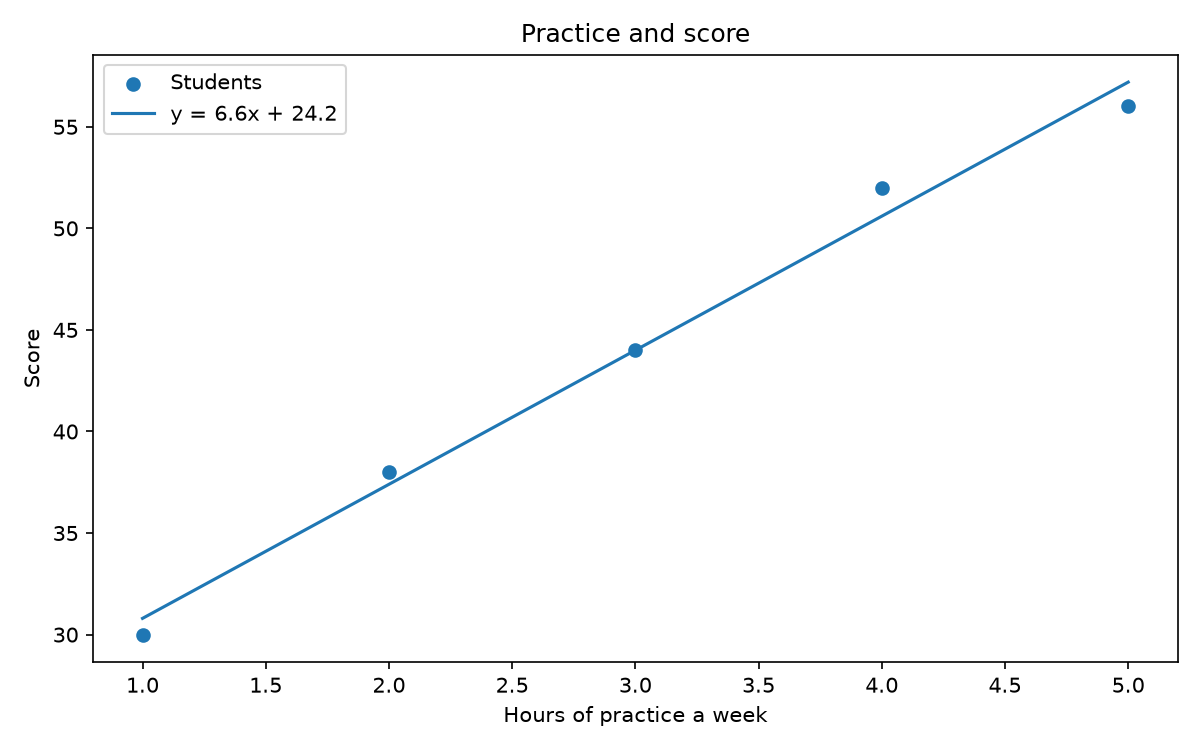
import matplotlib.pyplot as plt
plt.figure(figsize=(8, 5))

hours = [1, 2, 3, 4, 5]
score = [30, 38, 44, 52, 56]
line = [6.6 * h + 24.2 for h in hours]

plt.scatter(hours, score,
            label="Students")
plt.plot(hours, line,
         label="y = 6.6x + 24.2")
plt.title("Practice and score")
plt.xlabel("Hours of practice a week")
plt.ylabel("Score")
plt.legend()
plt.tight_layout()
plt.savefig("chart.png", dpi=150)Five fans are marked Keep or Service from two readings. A new fan reads (4, 4).
| Fan | Reading | Label | Distance |
|---|---|---|---|
| Q | (3, 3) | Keep | 1.41 |
| P | (2, 3) | Keep | 2.24 |
| T | (6, 6) | Service | 2.83 |
| R | (6, 7) | Service | 3.61 |
| S | (7, 6) | Service | 3.61 |
With k = 3 the vote is Keep 2, Service 1, so Keep. With k = 5 it is Service 3, Keep 2. The answer changed because k changed, which is why k is chosen with care and is usually odd.
Values 2, 3, 4, 10, 11, 15; k = 2; first centres 2 and 4.
| Round | Group 1 | Group 2 | New centres |
|---|---|---|---|
| 1 | 2, 3 | 4, 10, 11, 15 | 2.5 and 10 |
| 2 | 2, 3, 4 | 10, 11, 15 | 3 and 12 |
| 3 | 2, 3, 4 | 10, 11, 15 | 3 and 12 |
Each value joins the nearer centre; then each centre moves to the mean of its group. When nothing changes, stop. Value 4 moved from group 2 to group 1 in round 2: that is the point to show in an answer.
Not examined. Python demonstrations of linear regression, k-NN and k-means are marked for Advanced Learners, and the document says such portions are not to be evaluated in theory or practical. The ideas, and the Excel work on correlation and regression, are.
Unit 7. 5 marks. Unit 8, 4 marks
Natural language processing lets a computer work with human language; AI ethics asks whether what it does is fair, safe and explainable. Both units are mostly explanation, with examples doing the work.
One word, many meanings (a bank of a river, a bank with lockers). One sentence, two readings ("I saw the boy with the telescope"). Tone that flips meaning ("Great, another power cut"). Mixed languages, spelling and idioms.
| Phase of NLP | What it looks at |
|---|---|
| Lexical analysis | Splits text into words and finds their basic forms |
| Syntactic analysis | Grammar: how the words are arranged |
| Semantic analysis | Meaning: does the sentence make sense? |
| Discourse integration | Meaning that depends on earlier sentences, such as what "it" refers to |
| Pragmatic analysis | What the speaker intends in that situation |
Sentiment analysis says whether text is positive, negative or neutral. Emotion detection goes finer: joy, anger, fear. Classification puts text into classes, such as spam or not spam. Other applications: translation, search, voice assistants, summaries.
Chatbots. A rule-based bot follows paths written by a person; a bot that learns is trained on conversations. The practical task is an ice-cream ordering bot. Draw it first: greeting, flavour, size, quantity, total, confirm, and a reply for anything unexpected.
Before any sign-up: CBSE names Dialogflow, Botsify and Botpress, and allows another online platform. Read the age terms with a parent or teacher; Botpress, for one, asks for a parent's consent under 16. If a platform's account is for adults, use your teacher's in the lab.
The CBSE document names "the five pillars" without listing them. IBM, whose SkillsBuild ethics course the document links, gives these five:
| Pillar | In plain words |
|---|---|
| Explainability | You can be told why it decided so |
| Fairness | It does not favour or harm a group |
| Robustness | It keeps working when attacked or given odd input |
| Transparency | You know what it uses and how it was made |
| Privacy | Personal data is protected |
| Source | Example | What helps |
|---|---|---|
| Data | Faces mostly from one region | Collect and check a wider set |
| Design | PIN code used as a feature stands in for income | Review features; test by group |
| People | A tester accepts results that match a hunch | Diverse teams; written checks |
AI policy means rules for safe and responsible use. Compare two published ones under the same four headings: who wrote it, what it protects, what it forbids, who checks.
Two activities: Moral Machine asks you to choose in a driverless car's dilemma, and shows that people disagree. Survival of the Best Fit puts you in charge of hiring, and shows how a biased past trains a biased model. Write what you chose and why; that is the file entry.
Check yourself
Two on each unit, in order. If you can answer aloud in two sentences without looking up, the unit is ready for a paper.
23 % 6 + 23 // 6 give? isnull().sum() tell you about a column? Now test yourself under marks: the 843 syllabus with a 50-mark practice paper. Coming from Class 10 AI? The project cycle and evaluation from the 417 notes help in Units 5 and 6. Comparing subjects? See CS, IP, 802 or 843.
For more Python than one unit can hold, the Class 11 CS pages are useful too: notes with every output run.
One to one, at your own timing
Not every school has a specialist for 843, and students often meet Python, statistics and ethics in one year for the first time. Here one teacher takes one student through it at the days and timing you choose. Try first with a priority demo, a paid full live class at your slot followed by a written skill report; its fee is adjusted in the first month if you join. The free demo class remains open. You pay by the month, nothing for admission, and can stop when a month ends.
Before you enrol · Try a class
a full live class of about 45 to 60 minutes
The classes · Choose your own timing
₹4,999
per month, 4 private classes, fully flexible timingtwo private classes a week, at a time set with you
A student who only wants the numericals may need a month; one who is new to Python usually stays for the year. Both are fine, since the fee is monthly and shown on this page in your own currency.
Studying outside India?
A skill subject is often taught by whoever is free, abroad as much as in India. A private hour fixed in your own evening gives it a proper teacher.
| Where you live | Time difference | Usual class window, local time | Format |
|---|---|---|---|
| India every Indian city | Indian time | Any time you choose | Personalised 1-on-1 |
| UAE and Oman Dubai, Abu Dhabi, Sharjah, Muscat | 1 h 30 min behind India | 3:00 PM to 9:00 PM | Personalised 1-on-1 |
| Saudi Arabia, Qatar, Kuwait, Bahrain Riyadh, Jeddah, Dammam, Doha, Kuwait City, Manama | 2 h 30 min behind India | 3:00 PM to 9:00 PM | Personalised 1-on-1 |
| Nepal Kathmandu | 15 min ahead of India | 4:30 PM to 9:00 PM | Personalised 1-on-1 |
| Ethiopia and East Africa Addis Ababa and East Africa Time | 2 h 30 min behind India | 4:30 PM to 9:00 PM | Personalised 1-on-1 |
| Singapore and Malaysia Singapore, Kuala Lumpur | 2 h 30 min ahead of India | 3:30 PM to 9:00 PM | Personalised 1-on-1 |
A laptop with Python, NumPy, pandas and Matplotlib is enough for everything on this page. If the installation is stuck, the first class can begin there.
What families say
Real reviews from real families. We neither write nor commission them.
★★★★★
"The one step solution for my son. Modern Age Coders make learning coding so simple that kids love it. The teachers explain complex concepts clearly with practical exercises and interactive content."
Ria Mukherjee
Parent
★★★★★
"Modern Age Coders has been a game-changer for me. I struggled to grasp IT concepts and coding before joining, but their classes transformed everything. I can now confidently write complex programs with ease."
Samriddha Mondal
Student
★★★★★
"One of the most wonderful education centres out there. Education is not limited to school syllabus but focuses on skill development."
Vansh Agarwal
Student
★★★★★
"My child Dhairya is really enjoying the Modern Age Coders classes. This is his first online class and he eagerly looks forward to it. I can already see his improvement, and the teachers are very cooperative."
Sonam Oswal
Parent of Dhairya
★★★★★
"Modern Age Coders have wonderful teachers who teach in a clear, easy and practical way. The teacher boosts students' confidence and inspires them to learn without hesitation."
Sonu Goyal
Parent
★★★★★
"I highly recommend this computer coding class! The teachers are incredibly knowledgeable and passionate about coding."
Ritu Kedia
Parent
The rest of the Class 11 series
Every page in the CBSE Class 11 Computer Science, IP and AI series, grouped by what you need.
CBSE Class 12 Computer Science (083): Class 12 CS viva questions Class 12 CS sample paper practice Class 12 CS project with source code Class 12 CS important questions
CBSE Class 12 Informatics Practices (065): Class 12 IP practical file Class 12 IP project with source code Class 12 IP sample paper practice Class 12 IP important questions
CBSE Class 12 Information Technology (802): IT 802 practical and project file IT 802 Java notes and programs IT 802 notes
ISC Computer Science (868): ISC Class 12 CS syllabus 2027 ISC Class 12 CS practice paper ISC Class 12 practical questions solved ISC Boolean algebra and K-maps
Program lists with output: Python programs for Class 11 Python project ideas
843 questions
Eight subject units: Introduction: Artificial Intelligence for Everyone, Unlocking your Future in AI, Python Programming, Introduction to Capstone Project, Data Literacy, Machine Learning Algorithms, Leveraging Linguistics and Computer Science, and AI Ethics and Values. Part A adds five employability skills units.
Data Literacy and Machine Learning Algorithms, with 6 marks each in 2026-27. Units 2, 3, 4 and 7 have 5 each, and Units 1 and 8 have 4 each. Python has only 5 theory marks but the largest number of hours, because it feeds the practical file.
The ideas are approachable and the numbers are small. What stretches students is the spread: statistics, Python, design thinking, language and ethics in one subject. A steady hour a week on the numericals and Python keeps it comfortable.
The CBSE document does not list a prerequisite. Unit 3 begins with the basics at Level 1 and moves to CSV files, NumPy, pandas and scikit-learn at Level 2. A student who took AI 417 in Class 10 will recognise some of it.
The algorithms are in the theory of Unit 6, so be ready to explain and trace them. The Python demonstrations are marked for Advanced Learners, and the 2026-27 document states that those portions are not to be evaluated in theory or practical examinations.
The 2026-27 curriculum document refers to a Students Handbook for this subject. Look for it, with the curriculum, in the skill education section of cbseacademic.nic.in, so that your copy matches your session. These notes are our own writing and are not taken from it.
417 is the AI skill subject in Classes 9 and 10, and 843 is the one in Classes 11 and 12. 843 adds a capstone project, regression, k-NN and k-means, and has 50 theory and 50 practical marks in Class 11 for 2026-27.
The CBSE document names the topic and does not list them. IBM, whose ethics course it links, lists explainability, fairness, robustness, transparency and privacy. Check the wording in your handbook, and learn one example for each.
Subtract the mean from each x and each y, multiply the pairs and add; divide by the square root of the product of the two sums of squares. In Excel, CORREL does it in one step. A value near 1 or -1 means a strong relation.
Yes. Classes are live, online and personalised, at your own days and timing. You can begin with a priority demo, which is a full class with a written skill report, or with the free demo class, and the fee is monthly with no admission charge.
Start
Tell us the unit and one thing in it that does not make sense. The free demo class is spent on that, and you will leave able to explain it in your own words.
For a longer first look, the priority demo is a whole live class at your slot with a written report on all eight units, and its fee is set against month one when you enrol.
WhatsApp us · +91 91233 66161 · connect@modernagecoders.com
Every class is live video. The form requests a callback and reserves nothing.
A full live class of about 45 to 60 minutes at a slot you pick, with a written skill report and learning roadmap on WhatsApp afterwards. The fee is adjusted against your first month if you enrol.
Book a priority demo