ACDT / P / 01
Scratch programming
The visual language many primary classrooms use, taken further.
Open the syllabusAustralia · Digital Technologies F to 10 · Live online
Digital Technologies is the part of the Australian Curriculum where children learn how computers represent information, how algorithms are designed, and how programs are written and tested. It runs from the first year of school to Year 10, and by the end it expects real programming in a general-purpose language and some thinking about security and privacy. Many parents never studied anything like it. This page sets out how Version 9.0 is organised, quotes what ACARA says students should manage at the end of each band, and works one example from the Years 7 to 8 content so you can see the level involved. We are an online school teaching coding and maths; we are not part of ACARA and we do not write anyone's school assessment.
Quoted from ACARA's Version 9.0 files · Checked on 7 October 2026
In short
Digital Technologies is the Australian Curriculum subject about computing. Version 9.0 has two strands, Knowledge and understanding and Processes and production skills, each split into sub-strands, and it is written in bands from Foundation to Year 10. Students move from following simple algorithms to writing visual programs by Year 6, then a general-purpose language in Years 7 and 8 and an object-oriented one by Year 10.
Matched to the curriculum
One for each stage the curriculum describes: visual programming, the first text language, and serious programming.

ACDT / 01
Sequencing, branching and repetition, the ideas Years 1 to 6 build on, worked through puzzles and visual code.
Open the syllabus →
ACDT / 02
The general-purpose language most schools reach first, taught with tracing and testing from week one.
Open the syllabus →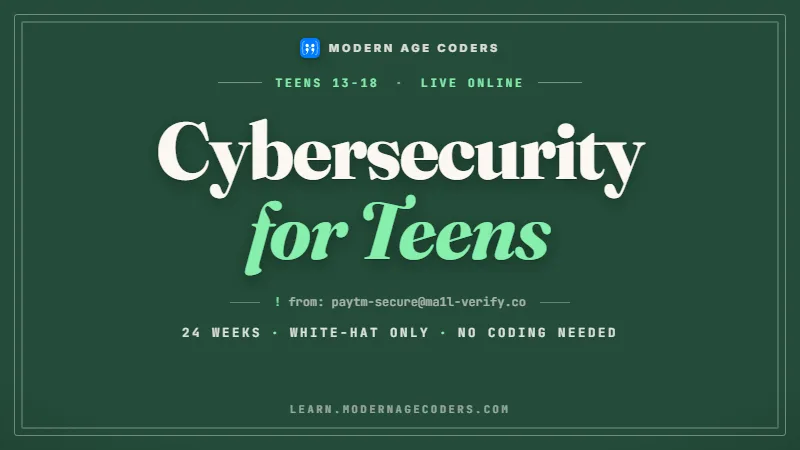
ACDT / 03
Passwords, authentication and threats, the privacy and security side of the curriculum, taught defensively.
Open the syllabus →How the subject is organised
Every content description in Digital Technologies sits in a strand, a sub-strand and a band. Knowing where a task sits tells you what it is really asking for.
| Strand | Sub-strand | What it covers in plain terms |
|---|---|---|
| Knowledge and understanding | Digital systems | Hardware, software and networks: what the parts are and how they move data |
| Knowledge and understanding | Data representation | How text, images, sound and numbers become integers and binary |
| Processes and production skills | Acquiring, managing and analysing data | Collecting data, checking it and finding patterns with spreadsheets and databases |
| Processes and production skills | Investigating and defining | Turning a vague need into a defined problem with design criteria and user stories |
| Processes and production skills | Generating and designing | Designing algorithms and user experiences before building |
| Processes and production skills | Producing and implementing | Writing, editing and debugging programs |
| Processes and production skills | Evaluating | Judging a solution against its criteria, its users and its wider impact |
| Processes and production skills | Collaborating and managing | Planning projects and working with others using digital tools |
| Processes and production skills | Privacy and security | Accounts, passwords, authentication, digital footprints and threats |
The bands are Foundation, then Years 1 to 2, 3 to 4, 5 to 6, 7 to 8 and 9 to 10. Each band has a band level description, an achievement standard and a set of content descriptions with codes such as AC9TDI8P13, where the digits after TDI name the year at the end of the band and the P or K says which strand it belongs to.
The codes are useful in conversations with a teacher. If a report says your child is working towards a standard in data representation, the code points to exactly which skill, and the elaborations under it show the kind of task schools use.
Not every sub-strand appears in every band. In the early years, for example, the Foundation content is short: recognising digital systems, representing data as objects, pictures and symbols, and identifying data that is personal and owned by the child. The data sub-strand under Processes and production skills appears as the bands rise.
Your state or territory decides how the curriculum is taught. Some publish their own syllabuses built from it, and schools choose how much time it gets. What follows is the national content, the shared reference point underneath those choices.
Source: ACARA, Australian Curriculum Version 9.0, Digital Technologies content F to 6 and Digital Technologies content 7 to 10, Word downloads read on 7 October 2026. We have no connection with ACARA.
Band by band
An achievement standard says what a student should be able to do by the end of a band. These lines are taken word for word from the Version 9.0 files.
| By the end of | ACARA's wording (opening sentences) |
|---|---|
| Foundation | "students show familiarity with digital systems and use them for a purpose. They represent data using objects, pictures and symbols and identify examples of data that is owned by them." |
| Year 2 | "students show how simple digital solutions meet a need for known users. Students represent and process data in different ways. They follow and describe basic algorithms involving a sequence of steps and branching." |
| Year 4 | "students create simple digital solutions and use provided design criteria to check if solutions meet user needs. Students process and represent data for different purposes. They follow and describe simple algorithms involving branching and iteration and implement them as visual programs." |
| Year 6 | "students develop and modify digital solutions, and define problems and evaluate solutions using user stories and design criteria. They process data and show how digital systems represent data. Students design algorithms involving complex branching and iteration and implement them as visual programs including variables." |
| Year 8 | "students develop and modify creative digital solutions, decompose real-world problems, and evaluate alternative solutions against user stories and design criteria." |
| Year 10 | "students develop and modify innovative digital solutions, decompose real-world problems, and critically evaluate alternative solutions against stakeholder elicited user stories." |
The first shift happens between Year 6 and Year 8. Up to Year 6 the curriculum asks for visual programs, the block-based coding most primary schools use. The Years 7 to 8 band description says students should implement algorithms "in a general-purpose programming language", and the Year 8 standard repeats it: students "design and trace algorithms and implement them in a general-purpose programming language."
The second shift comes in Years 9 to 10, where the Year 10 standard adds programs "including in an object-oriented programming language" and asks students to "model cyber security threats and explore a vulnerability." That is real software engineering vocabulary, and students who meet it cold often find it the hardest year.
Every band asks students to define problems before solving them and to judge solutions afterwards. Even in Years 1 to 2, the standard begins with showing how a digital solution meets a need for known users.
Privacy and security also run the whole way through, from identifying personal data in Foundation to recorded usernames and passwords in Years 1 to 2, memorised passwords in Years 3 to 4, unique passphrases in Years 5 to 6, and authentication and threat models in secondary school.
A worked example from Years 7 to 8
One Years 7 to 8 content description asks students to "explain how multi-factor authentication protects an account when the password is compromised and identify phishing and other cyber security threats". Here is how we teach it, with arithmetic a Year 8 student can follow.
ACARA's elaboration describes multi-factor authentication as preventing "unauthorised access by prompting the account owner for a token or single-use password", and gives the example of a funds transfer that needs "a one-time password received via SMS" as well as a login.
The point students need to grasp is that the second factor is something the attacker does not have, even after a password leak. We make that concrete by counting. A six-digit one-time password can be any number from 000000 to 999999, so there are 1,000,000 possible codes, and a fresh one is issued each time.
Suppose an attacker has the password and a site allows five guesses at the code before locking the attempt. The chance of guessing right is at most 5 in 1,000,000, or 0.0005 per cent. Without the second factor, the leaked password alone gets them in every time.
Students then test the idea against the phishing half of the description. ACARA's elaboration lists techniques such as "using an email address from an unofficial domain when pretending to be an online retailer". If a fake page asks for the code as well as the password, the maths stops protecting you, which is why the lesson ends with spotting the fake page rather than trusting the numbers.
| Second factor | Possible values | Chance with 5 guesses |
|---|---|---|
| None (password only, already stolen) | Not applicable | Certain |
| 4-digit code | 10,000 | 5 in 10,000 (0.05 per cent) |
| 6-digit code | 1,000,000 | 5 in 1,000,000 (0.0005 per cent) |
| 6-digit code given away on a phishing page | 1,000,000 | Certain: the attacker was handed it |
The last row is the reason the content description pairs authentication with phishing. A good lesson does not stop at "turn on two-factor". It shows why it works, then shows exactly how people defeat it, which is the habit of thinking about an attacker that the Years 9 to 10 band later formalises as a threat model.
Quotations: ACARA, Digital Technologies content 7 to 10, Version 9.0, code AC9TDI8P13 and its elaborations, read on 7 October 2026. The guess limits and percentages are an illustration we wrote; real services set their own rules.
Helping at home
You do not need to code to help. Most of the support a child needs is conversation about problems, steps and checking.
Talk through everyday algorithms: getting dressed, a recipe, the route to school. Ask what happens if a step is missed or swapped. That is the sequencing and branching the early standards describe.
Ask to see the visual program, then ask your child to predict what it will do before pressing run. Predicting first is the habit that later becomes tracing and debugging.
Ask how they tested it. A program that works on one example is not finished. The Years 9 to 10 content asks students to "validate algorithms and programs by comparing their output against a range of test cases".
Security is the area where family habits matter most. Content descriptions from Years 1 to 2 onwards deal with usernames, passwords and personal data. Setting up a passphrase together, or turning on a second factor on a shared account, makes the classroom content real.
The Years 9 to 10 band also asks students to "investigate how hardware and software manage, control and secure access to data in networked digital systems" (AC9TDI10K01) and to apply the Australian Privacy Principles to the data that services collect (AC9TDI10P14). Reading a privacy policy together is a genuine curriculum activity.
When a teenager gets stuck on a project, the most useful question is about the problem, not the code: who is it for, and how will they know it works? The curriculum calls these user stories and design criteria, and most stalled projects are missing one or the other.
If you want structured help, our classes teach the same skills in a steadier sequence than a school timetable allows. We teach technique and thinking; any assessed work a school sets stays the student's own.
Quoted content descriptions: AC9TDI10P06, AC9TDI10K01 and AC9TDI10P14, ACARA Digital Technologies content 7 to 10, Version 9.0, read on 7 October 2026.
From blocks to text
Children reach each rung at different ages. The order is what matters.
| Around | Rung | The sign it is secure |
|---|---|---|
| Years 1 to 2 | 1. Steps and choices | Describes a sequence with a decision in it, out loud |
| Years 3 to 4 | 2. Visual programs | Builds a block program with a loop and a condition |
| Years 5 to 6 | 3. Variables | Uses a variable to keep score or count, and explains why |
| Years 7 to 8 | 4. A text language | Writes and traces a short program with functions |
| Years 9 to 10 | 5. Testing and structure | Tests boundaries and invalid input on purpose |
Most of the difficulty is typing and syntax, not ideas. Students who could build a working block program already understand loops and conditions; they need time with a text editor.
Short daily practice beats occasional long sessions while that adjustment happens.
Students who enjoy the puzzles often try the Bebras Challenge and the Australian Informatics Olympiad, both listed on our Australian competitions calendar.
Senior computing subjects differ by state, and we cover several of them on separate pages.
The catalogue
Grouped by where a student is in the curriculum. Each card opens a full syllabus.
ACDT / P / 01
The visual language many primary classrooms use, taken further.
Open the syllabusACDT / P / 02
Blocks to games, apps and a first look at AI.
Open the syllabusACDT / P / 03
How AI works, explained without hype.
Open the syllabusACDT / S / 01
Variables to files, with tests written as you go.
Open the syllabusACDT / S / 02
Structured data and queries, as the 9 to 10 content describes.
Open the syllabusACDT / S / 03
Content, structure and presentation, built into real pages.
Open the syllabusACDT / X / 01
The step from writing code to designing efficient solutions.
Open the syllabusACDT / X / 02
Threats, defences and ethics, taught from the defender's side.
Open the syllabusACDT / X / 03
An object-oriented language from first class to full programs.
Open the syllabusHow lessons run
Our teachers work from India, behind every Australian state and territory. A 4.30 pm class in Adelaide in October, for example, starts at 11.30 am India time, so after-school slots are easy for us to staff and to keep steady all year.
After school
The usual choice for primary and middle years.
Weekend mornings
Popular with secondary students who have sport after school.
School holidays
A short block on one topic, such as a first text language.
Students say what code will do before running it, every time.
Boundary and invalid inputs are part of every program, not an afterthought.
Placed by what students can already do, not only by year level.
For a gap that needs closing quickly, or a student ready to race ahead.
What was covered and one thing worth asking about at home.
We teach the skill; assessed tasks are completed by the student under the school's rules.
Student work
Built by learners for their own reasons. More are in the student labs.

AI and ML
An AI nutrition coach that reads what you eat and works you toward a target.

AI and ML
A chatbot that answers mathematics and programming questions, built and deployed by a student.

AI and ML
An assistant that helps a young person recognise unsafe situations online.

Web app
A weather forecasting site with live conditions for any location.
Fees
Families in Australia pay monthly in US dollars, the rate we charge in every country outside India, with no deposit and the option to stop at the end of any month.
Free first class
USD 0
no card required
Group batch
USD 100
a month, billed in US dollars
One to one
USD 150
a month, billed in US dollars
What families say
Families describing their experience, quoted as they wrote it on Google.
★★★★★
"The one step solution for my son. Modern Age Coders make learning coding so simple that kids love it. The teachers explain complex concepts clearly with practical exercises and interactive content."
Ria Mukherjee
Parent
★★★★★
"Modern Age Coders has been a game-changer for me. I struggled to grasp IT concepts and coding before joining, but their classes transformed everything. I can now confidently write complex programs with ease."
Samriddha Mondal
Student
★★★★★
"One of the most wonderful education centres out there. Education is not limited to school syllabus but focuses on skill development."
Vansh Agarwal
Student
★★★★★
"My child Dhairya is really enjoying the Modern Age Coders classes. This is his first online class and he eagerly looks forward to it. I can already see his improvement, and the teachers are very cooperative."
Sonam Oswal
Parent of Dhairya
★★★★★
"Modern Age Coders have wonderful teachers who teach in a clear, easy and practical way. The teacher boosts students' confidence and inspires them to learn without hesitation."
Sonu Goyal
Parent
★★★★★
"I highly recommend this computer coding class! The teachers are incredibly knowledgeable and passionate about coding."
Ritu Kedia
Parent
Questions about Digital Technologies
It is the computing subject within the Technologies learning area. It teaches how digital systems work, how data is represented and analysed, and how to design, build and evaluate digital solutions, including programs.
Knowledge and understanding covers digital systems and data representation. Processes and production skills covers what students do: acquiring and analysing data, defining problems, designing, programming, evaluating, collaborating, and privacy and security.
Up to Year 6 the content asks for visual programs. The Years 7 to 8 band asks students to implement algorithms in a general-purpose programming language, and Years 9 to 10 add object-oriented programming.
AC9 marks Australian Curriculum Version 9.0, TDI marks Technologies: Digital Technologies, the number is the year at the end of the band, P means Processes and production skills (K means Knowledge and understanding), and the last digits number the content description.
No. The national curriculum is the shared reference, but each state and territory decides how it is implemented, and some publish their own syllabuses built on it.
A login that asks for more than a password, such as a one-time code. The Years 7 to 8 content asks students to explain how it protects an account when the password is compromised.
We teach the skills a project needs, such as defining the problem, designing the algorithm and testing. The project itself stays the student's own work under the school's rules.
For most students in Years 7 and above we start with Python. Younger students begin with visual programming, as the curriculum does.
No. ACARA writes the curriculum; we are an independent online school whose lessons build the same skills.
We agree a weekly slot after the trial class, usually after school in your state. Every Australian state and territory is ahead of India time, by between two and a half and five and a half hours depending on the state and the season.
Related pages
Curriculum, competitions and coding pathways.
Our main page for Australian families.
The step into a text language, in detail.
Primary-age classes, state by state.
Where Digital Technologies leads in NSW.
Bebras, the AIO and more, month by month.
Why copied code fails, and what to do instead.
Start here
Tell us the year level and what the class is working on. The free lesson starts from there and ends with a straight answer about next steps.
Prefer to look around first? Every course sits on the course atlas, and how we teach walks through a real lesson.
WhatsApp us · +91 91233 66161 · connect@modernagecoders.com
WhatsApp usually gets the fastest reply. Our number begins +91 because the school runs from India; we have no Australian office.
A priority demo is a full class of about 45 to 60 minutes. After the class the mentor sends a written skill report and a personal learning roadmap on WhatsApp. If you enrol, the demo fee is adjusted against your first month's fee. Share your demo Order ID with us on WhatsApp and we take it off.
Book a priority demo