DEPTH / 01
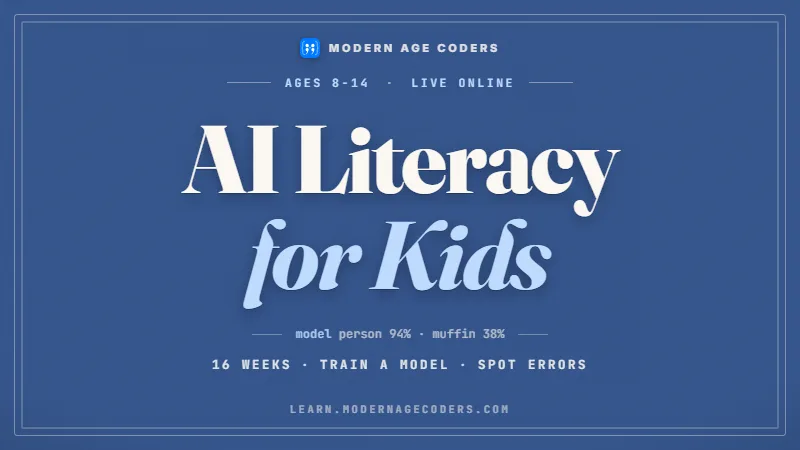
AI Literacy for Kids
The honest simplified version from about eight: a very good guesser at what comes next, which looks nothing up, and can be sure and wrong at once.
Open the syllabusHow LLMs work · Live online · Worldwide · Ages 6 to 67
Almost every misunderstanding about these systems, in both directions, comes from assuming that something which writes well must be doing something like knowing. A language model is trained to produce a probability distribution over what comes next, choose one, append it and repeat. Fluency is what the objective optimises. Truth is correlated with fluency and is not the same thing, and that gap is the entire explanation for a confident, well-formed, completely invented citation. This page shows the loop, shows why letters cannot be counted, and derives six familiar behaviours from the mechanism.
Live online · ages 6 to 67 · taught from India, worldwide · from USD 100 a month · first class free
Start here
At three depths, by age. The honest simplified version for children, the actual mechanism for teenagers with an API project attached, and the full treatment including training dynamics for adults.
DEPTH / 01
The honest simplified version from about eight: a very good guesser at what comes next, which looks nothing up, and can be sure and wrong at once.
Open the syllabus →
DEPTH / 02
The actual loop, tokenisation, training against inference, then something built on an API so the abstraction stops being one.
Open the syllabus →
DEPTH / 03
The full treatment for adults: adaptation, grounding, and agents that are bounded, logged and loud when something goes wrong.
Open the syllabus →The short answer
A large language model is trained to produce a probability distribution over the next token given the text so far, then to sample one, append it and repeat. That loop is the whole of inference: nothing in it consults a database or checks whether a sentence is true. Fluency is therefore what the objective optimises directly and truth is only correlated with it, which is why a confident, well-formed, invented citation is not a malfunction but the system doing exactly what it was built to do. Modern Age Coders teaches this mechanism from about age eight in honest simplified form and in full to teenagers and adults. Group teaching is USD 100 a month, private is USD 150, first class free.
The single idea
Almost every misunderstanding about these systems, in both directions, comes from assuming that something which writes well must be doing something like knowing.
A language model is trained to do one thing: given some text, produce a probability distribution over what comes next. That is not a simplification for children, it is the objective. Everything impressive it does is a consequence of doing that extremely well across an enormous quantity of text.
Which means fluency is the thing being optimised, directly. Truth is not. Truth correlates with fluency, because true sentences are common in the training text and coherent documents tend to be accurate ones, and correlation is why the systems are useful at all. But it is a correlation, and it can break without anything looking different.
That is the entire explanation of the behaviour people find most unnerving: a confident, well-formed, completely invented citation. The model was not lying, because lying requires a belief about truth. It produced what a citation in that position usually looks like, which is exactly what it was built to do.
Understanding this changes how a person uses the tools far more than any list of prompting tips. It tells you where to check, what kinds of question are structurally risky, and why a confident tone carries no information at all about correctness. That is the whole argument for teaching it to a twelve year old.
Two mechanisms, shown
These two blocks explain a large fraction of everything odd you have ever seen one of these systems do.
"The capital of France is" ->

   Paris    0.94
   the      0.02
   located  0.01
   a        0.01
   ...

Pick one. Append it. Do it all again.

# That is the whole loop. There is no
# lookup, no database, no step where it
# checks whether the sentence is true.
Once you have seen the loop, hallucination stops being mysterious. Nothing in it ever consults reality; the model is producing what such a sentence usually looks like.
"strawberry"  ->  ["str", "aw", "berry"]

# The model never sees s-t-r-a-w-b-e-r-r-y.
# It sees three opaque ids: 496, 707, 15717.

Q: how many r in strawberry?
It is being asked to count something
it structurally cannot see.
This is not a gap in knowledge that a bigger model fixes by knowing more. It is a consequence of the representation, which is why the failure looks so strange from outside.
The right-hand block is the more important one and it is genuinely all there is to inference. Take the text so far, produce a distribution over the next token, choose one, append it, and repeat. There is no separate stage where the sentence is checked against anything. The model does not know whether it is answering from something it saw a million times or improvising.
The left-hand block explains a class of failure that makes people think the systems are pretending. Text is split into tokens before the model sees it, so a question about individual letters is a question about something below its resolution. It is not being obtuse; it has been handed three numbers and asked about spelling.
How one gets made
Most public confusion comes from attributing a property to the wrong stage.
Before anything, text is chopped into pieces from a fixed vocabulary and each piece becomes an integer. Common words are one token, unusual ones are several, and individual characters are usually invisible. Every downstream oddity about spelling, arithmetic digits and unusual languages starts here.
The model is shown vast quantities of text and repeatedly asked what comes next, adjusting itself when wrong. This is where essentially all of the capability comes from, and it is also where the knowledge cutoff comes from: it knows the text it saw and nothing after.
Further training on curated examples and human preferences makes it helpful, safer and conversational. This changes behaviour and style substantially and adds relatively little new knowledge, which is why a polite refusal and a confident fabrication can come from the same model.
At use time it does only what the second block above shows. Sampling settings decide how adventurously it picks among likely candidates, which is the entire technical content of temperature and why the same question can produce different answers.
The model has no memory between conversations. Whatever it appears to remember was placed back into the window by the surrounding software. Deciding what goes in there is the real engineering problem, and it is the subject of the context engineering page.
Consequences, derived
| Behaviour you notice | The mechanism it comes from | What actually helps |
|---|---|---|
| Invents a plausible citation | Nothing in the loop checks reality | Verify externally; never trust tone |
| Cannot count letters in a word | It sees tokens, not characters | Give it a tool, or do it in code |
| Forgets what you said earlier | It fell out of the context window | Restate, or retrieve it deliberately |
| Knows nothing about last week | Pretraining has a cutoff date | Supply the document yourself |
| Different answer each time | Sampling, not determinism | Lower the temperature, or fix a seed |
| Changes answer when you push back | Agreement is a likely continuation | Ask for evidence, not for confirmation |
Every row is derivable from the loop rather than memorised as a quirk, which is the difference between understanding these systems and having a list of tips. A student who has the mechanism can predict a failure mode in a tool released next year; a student with the tips cannot.
Using this
Proper nouns, statistics, citations and dates are precisely where fluency and truth part company, because a plausible-looking one is easy to generate and impossible to detect by reading. These are the highest-yield things to verify and almost the only ones worth verifying every time.
The tone is produced by the same process as the content and carries no signal about correctness. A hedged wrong answer and a confident wrong answer are equally wrong, and the confident one is more dangerous only because of how you respond to it.
Handing the model the document and asking about that is a different and far more reliable operation than asking what it remembers. This is the whole idea behind retrieval, and it is the single biggest reliability improvement available to an ordinary user.
Not because the reasoning is a true account of an internal process, but because intermediate steps are individually verifiable. A wrong step is visible in a way a wrong conclusion is not.
Agreement is often the most likely continuation of a sentence in which somebody pushed back. If a challenge flips the answer without new evidence, you have learned about the loop rather than about the question.
Rewriting, summarising supplied text and generating options are low risk because the material is in front of it. Recalling facts, doing exact arithmetic and counting are high risk. Sorting your requests into those two piles is most of using these tools well.
Teaching it
Under twelve: it is a very good guesser about what words come next, it does not look anything up, and it can be completely wrong while sounding completely sure. That is age appropriate and it is also true, which matters more than it sounds.
Teenagers get the actual loop, tokenisation, and training against inference, and then build something with an API so the abstraction becomes concrete. Adults and university students go further, into how the context window is filled, which is context engineering, and how to measure whether any of it works, which is evaluation.
That anybody fully understands why these work as well as they do. The mechanism is clear and the emergent capability is genuinely an open research question. A course claiming otherwise is overselling.
That this page settles whether they understand anything. That is a real philosophical dispute among serious people, and we teach the mechanism and let students argue about the rest, which most of them enjoy considerably.
That knowing this makes you an AI engineer. It is the foundation. Building on it is the Build AI track, and it takes a good deal longer.
The catalogue
At three depths, by age. The honest simplified version for children, the actual mechanism for teenagers with an API project attached, and the full treatment including training dynamics for adults.
DEPTH / 01
The honest simplified version from about eight: a very good guesser at what comes next, which looks nothing up, and can be sure and wrong at once.
Open the syllabusDEPTH / 02
The actual loop, tokenisation, training against inference, then something built on an API so the abstraction stops being one.
Open the syllabusDEPTH / 03
The full treatment for adults: adaptation, grounding, and agents that are bounded, logged and loud when something goes wrong.
Open the syllabusDEPTH / 04
For anyone who wants to train one rather than understand one. Two more years of work, and a different subject from this page.
Open the syllabusStudents who arrive through this page also take Python and AI for Kids · AI Literacy for Kids · Python for Teens · AI and Machine Learning for Teens · Data Science for Teens · Git and GitHub · AI and ML Masterclass · Generative AI: LLMs, RAG and Agents. The full list is on the catalogue.
Fees
The same flat pair of figures everywhere we teach outside India, in US dollars, charged monthly with no minimum term.
Free first class
USD 0
no card required
Group batch
USD 100
a month, billed in US dollars
One to one
USD 150
a month, billed in US dollars
What learners and families say
Real reviews from real families. We neither write nor commission them.
★★★★★
"The one step solution for my son. Modern Age Coders make learning coding so simple that kids love it. The teachers explain complex concepts clearly with practical exercises and interactive content."
Ria Mukherjee
Parent
★★★★★
"Modern Age Coders has been a game-changer for me. I struggled to grasp IT concepts and coding before joining, but their classes transformed everything. I can now confidently write complex programs with ease."
Samriddha Mondal
Student
★★★★★
"One of the most wonderful education centres out there. Education is not limited to school syllabus but focuses on skill development."
Vansh Agarwal
Student
★★★★★
"My child Dhairya is really enjoying the Modern Age Coders classes. This is his first online class and he eagerly looks forward to it. I can already see his improvement, and the teachers are very cooperative."
Sonam Oswal
Parent of Dhairya
★★★★★
"Modern Age Coders have wonderful teachers who teach in a clear, easy and practical way. The teacher boosts students' confidence and inspires them to learn without hesitation."
Sonu Goyal
Parent
★★★★★
"I highly recommend this computer coding class! The teachers are incredibly knowledgeable and passionate about coding."
Ritu Kedia
Parent
The rest of the series
This page is the mechanism. Context engineering, RAG and evaluation are the three things you build on top of it once you accept what the loop does and does not do.
Questions about how LLMs work
That is a genuine dispute among serious people and we do not pretend to settle it in a class. What we teach is the mechanism, which is not in dispute, and then let students argue about the rest, which they enjoy a great deal. What we will say firmly is that the loop contains no step which checks a sentence against reality, and that fact alone explains most of the behaviour people find puzzling.
Because nothing in the process distinguishes recalling from improvising. The model produces what text of that shape usually looks like, and a plausible citation is exactly as easy to generate as a real one. It is not lying, which would require a belief about truth; it is doing the only thing it does, in a case where fluency and accuracy have come apart.
A group batch of five to eight students is USD 100 a month and one to one is USD 150 a month, billed in US dollars, and these are the same figures everywhere we teach outside India. No enrolment fee, no minimum term, and the first class is free without a card.
The honest simplified version works from about eight: it is a very good guesser about what comes next, it does not look anything up, and it can be totally wrong while sounding totally sure. That is age appropriate and true, which is the combination we insist on. The actual loop and tokenisation land well from about thirteen.
Not for the mechanism on this page, which is conceptual and needs no notation at all. You need mathematics to build one, and specifically linear algebra, probability and calculus, which is what the machine learning courses cover. Understanding what these systems do and being able to train one are separated by a couple of years of work.
The specific models are, constantly. The content of this page is not, because it describes the objective and the inference loop, which have been stable throughout every generation so far and are what the architecture is built to serve. That is exactly why we teach mechanism rather than a tour of current products.
There is no memory between conversations. Everything the system appears to remember was put back into the context window by the software wrapped around the model, and anything that falls out of that window is gone completely. What goes into it is a design decision, and a large one, which is the subject of the context engineering page.
Ours do, with the mechanism explained first and with age floors respected, because most of these products set a minimum age and several are eighteen plus. The order matters more than the answer: a child who has been told how it works checks things, and a child who has been handed a magic answer box does not.
This is the foundation those courses assume. The machine learning track goes on to train models, measure error against a baseline and deploy something, which is months of work. This page is the conceptual grounding, and it is worth having even for a learner who never intends to build anything.
A mentor calls to arrange the free class. For this topic the session is usually spent making a model fail live, on purpose, in two or three of the ways this page predicts, because watching the mechanism produce a specific wrong answer teaches more than any explanation of it, including this one.
Start
The most useful ninety minutes we can give a new learner on this topic is not an explanation. It is sitting with a model and making it produce a confident wrong answer on purpose, in two or three of the ways this page predicts, and then explaining why each one happened. It costs nothing, needs no card, and it tends to change how a family uses these tools that same week regardless of whether they ever enrol.
Rather read first? Context engineering, RAG systems, or evaluations.
WhatsApp us · +91 91233 66161 · connect@modernagecoders.com
We hold no premises anywhere. Every session is a live video call taught from India, and the number above rings in India. Sending the form opens a conversation rather than an enrolment, and holds no place in any batch.